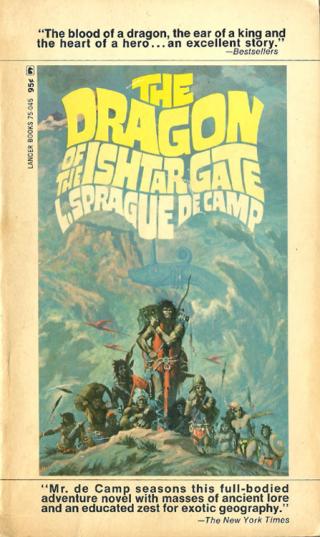
The Dragon of the Ishtar Gate
- Автор: Де Камп Лайон Спрэг
- Год: 1968
- Язык: английский
- Год: Lancer Books
- Жанр: Научная фантастика

Электронная книга - «The Dragon of the Ishtar Gate». Краткое содержание книги:
Dragon is probably closest in mood to de Camp's fantasy novels, while Bronze God and Arrows are closer to his science fiction, with their description of engineering problems, and personality clashes among researchers and engineers. Dragon also reflects de Camp's then-recent acquaintance with the Conan stories and other works of Robert E. Howard. Bessas, the huge Persian nobleman, is not only a close match for Conan in physique, but his mood swings, fixation on his mother, and tendency to toss of verses, seems a reflection of Howard himself. (Fortunately, his poems reflect de Camp's verbal dexterity and wit, not Howard's melancholy.)
"What I do," said Myron, "is quite as important as our wretched little lives."
"Mean you looking at asphalt wells?"
"No; I mean reviving the glory of Miletos."
"With asphalt? Are you mad?"
"You no more understand than your horse understands astronomy. The glory of Miletos was the glory of the mind. We Milesians were the first folk ever seriously to ask how the universe is made and how it works. What shape is the earth? Where does the sun go at night? What is the basic substance of all things: fire, air, or water? Whence came mankind? We may not know the final answers to these questions, but at least we have sought the solutions, instead of swallowing the many and inconsistent myths purveyed by the priests.
"When Darius' generals crushed the first Ionian revolt, some of the Milesians were massacred; some like myself were enslaved; some were deported to Chaldea; some fled to Sicily. The city was utterly depopulated. Other people have moved into Miletos since then, but they lack our tradition of wisdom-seeking. If I can learn enough in my travels, I might yet revive the wisdom-loving tradition, which was the glory of my city."
"It sounds noble but not practical," said Bessas. "Most men, you will find, care not a whit if the earth be shaped like a plate, or a cup, or even round like a ball." He guffawed at the absurdity. "Therefore, instead of honoring you for your deep thinking, they'll scorn you as a bookish fool."
"Dogs also bark at what they do not know," bridled Myron. "Besides, wisdom-lovers can be practical when necessary. Thales, who first laid down the laws of geometry and determined the sun's course from solstice to sol-tice, was once annoyed by people who said: 'If you are so clever, why aren't you rich?' So he rented all the olive mills for one season and, having thus cornered the sources of oil, earned a large fortune. Then he went back to philosophy."
"Mithra prosper your enterprise. When you have made such a fortune yourself, you might ask Bessas of Zariaspa to help you spend it. Meanwhile, if you do not leave" your asphalt well and come along, I will toss you in head foremost, so that you shall learn the properties of mineral pitch at first hand."
Northwest of Id, the landscape became more barren. When Myron and Bessas arrived at Baia Malcha, the desert had almost crept to the river's edge, where poplars and tamarisks grew in clumps along the margins of the flume and on the islands in the river.
Towns were few and small. Most of the people were either nomads or dwellers in huts of reeds and dried mud among the feathery tamarisks. They pastured sheep on the scanty strips of grass, speared fish in the shallows, and beat up the thickets for wild pig.
The next day the travelers toiled through a desolate land of sand and rock, which rolled away gently to the horizon save when broken by outcrop or hill. Short-lived spring grasses, not yet browned by the summer sun, carpeted patches of desert with gray-green films, in which the wild flowers shone like gems. Groups of gazelles and ostriches appeared, to bolt off into the blue when the travelers turned towards them.
A little yellow whirlwind arose in the middle distance, drifting this way and that. When it dissipated, another took its place. After these dust whirls had been in sight for some time, Bessas said:
"By the four teats of Ishtar, I'll wager that is a spirit sent to spy upon us by that Labashi fellow! I'll teach the demon to pester me!"
The Bactrian spurred off into the desert, drawing his bow and an arrow. As he galloped past the dust whirl, he loosed. The arrow went through the column, which faded and died at once. Bessas circled, picked up his arrow, and rode back grinning. "What did I say?"
"I fear you but winged it," said Myron. "There's another—or perhaps the same one farther off."
Another dust whirl danced in the distance.
"I taught it a lesson, anyway," growled Bessas. "I suppose if I slay one, the wizard can always conjure up another, like that Kasmirian sorcerer I told you about, the one who sat on a Himalayan peak and collected human hides for a hobby."
"Personally," said Myron, "I should say that they were a natural phenomenon. Herakleitos insisted that most things have rational explanations, if only men took the trouble to seek them out."
"Where do the gods fit into this rational world of your Herakleitos?"
Myron shrugged. "I have heard tales of the gods of many lands, all of which can hardly be true at once. As Xenophanes said, if the horses had a god, they would visualize him with mane, tail, and hooves. I suspect that whatever gods exist are beyond our comprehension, just as we are beyond the comprehension of that butterfly." He pointed at a black and golden insect, which fluttered across their path. "To him we should no doubt seem almighty, immortal, and incomprehensible, just as the gods seem to us."
"Mean you that the gods are really mortal, though their span be greater than ours?"
"I don't know, Bessas; no god has confided in me. I merely point out a possibility."
"Take heed that, in all your pointing out and surmising, you rouse not the ire of these gods, who all the myths agree are a fractious and touchy lot." Bessas sang in his booming bass:
"Are you not a Mithraist?" asked Myron.
"Aye; but I do not importune the god to the point of boring him. When he receives a prayer from me, he knows it's about a really urgent matter."
"King Xerxes sacrifices horses to Mithra at the New Year. Wherein, then, does your creed differ from his?"
"Oh, Xerxes worships Mithra, just as we Mithraists also believe in Auramazda. The difference lies in this: that we don't think the Lord of Light bothers himself with men's personal problems, any more than King Xerxes can personally comfort every afflicted peasant in his Empire. Auramazda is remote and withdrawn from these material things; Mithra truly governs the world. So our prayers are directed to Mithra. But the Zoroastrians would lower Mithra to the rank of a mere angel. If Xerxes is fain to belittle Mithra and address Auramazda directly, that is his business, but what call does that give him to interfere with us?"
"I suppose he desires to strengthen his Empire by unifying the Aryan religion."
Bessas spat. "If he would please the unseen powers, let him begin by acting justly himself, not by causing my mother and me to suffer for others' misdeeds."
They stopped at Ana with its palm groves and its fort on an island in the river. Bessas gave Myron lessons in archery and, using sticks whittled from tamarisk stems, in sword fighting. On the morrow, Myron awoke with bruised knuckles to hear Bessas say:
"Perhaps no god has confided in you, but one of them visited me in dreams last night."
"Indeed?"
"Aye; 'twas the hero Artagnes. He said—" (Bessas closed his eyes):
"It sounds ominous. Who is Hvareno?" asked Myron. "Our goddess of fortune—our Tychê. What make you of it?"