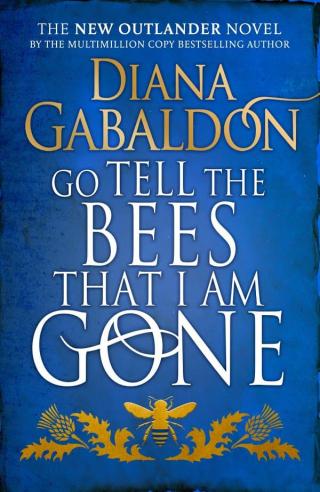
Go Tell the Bees That I Am Gone
- Автор: Гэблдон Диана
- Серия: Outlander #9
- Год: 2021
- Язык: английский
- Год: Delacorte Press
- ISBN: 978-1-473-51900-8
- Жанр: Исторические приключения

Электронная книга - «Go Tell the Bees That I Am Gone». Краткое содержание книги:
The past may seem the safest place to be . . . but it is the most dangerous time to be alive. . . .
Jamie Fraser and Claire Randall were torn apart by the Jacobite Rising in 1746, and it took them twenty years to find each other again. Now the American Revolution threatens to do the same. It is 1779 and Claire and Jamie are at last reunited with their daughter, Brianna, her husband, Roger, and their children on Fraser’s Ridge. Having the family together is a dream the Frasers had thought impossible. Yet even in the North Carolina backcountry, the effects of war are being felt. Tensions in the Colonies are great and local feelings run hot enough to boil Hell’s teakettle. Jamie knows loyalties among his tenants are split and it won’t be long until the war is on his doorstep. Brianna and Roger have their own worry: that the dangers that provoked their escape from the twentieth century might catch up to them. Sometimes they question whether risking the perils of the 1700s—among them disease, starvation, and an impending war—was indeed the safer choice for their family. Not so far away, young William Ransom is still coming to terms with the discovery of his true father’s identity—and thus his own—and Lord John Grey has reconciliations to make, and dangers to meet . . . on his son’s behalf, and his own. Meanwhile, the Revolutionary War creeps ever closer to Fraser’s Ridge. And with the family finally together, Jamie and Claire have more at stake than ever before.
This request resulted in a quarter hour of fussing about the tiny house, picking up sticky jars of preserves and putting them down again, and concluding in Mr. Elmsworth’s belated recollection that he had used the note to light his candle.
“There wasn’t much to it, son,” Mrs. Elmsworth told him sympathetically, seeing his disappointment. “She only thanked us for keeping her, and said as how her brother would take her to her husband.”
IT WAS LATE in the day by now, and his horse was tired and in need of food, so despite his urge to ride off immediately, he reluctantly accepted the hospitality of the Elmsworths’ small barn for the night. They had invited him to share their supper as well, but having seen that their supper was to consist of a dab of cornmeal porridge with a few drops of molasses and a few slices of hard and curling bread, he assured them that he had a little food in his saddlebags and retired to the barn to see to Betsy’s needs before seeking the refuge of his own thoughts.
In fact, he had a bruised apple and a small chunk of hard cheese, this oozing grease and slightly moldy. He paid little attention to his sparse supper, though, his mind being occupied with what the devil to do next.
Adam. It had to be Adam. The problem was that he didn’t know where Adam was supposed to be. He’d not seen his cousin in more than a year, and such conversation as he’d had lately with Papa and Uncle Hal hadn’t touched on Adam at all, everyone being taken up with Benjamin’s death.
The last he had heard of Adam, his cousin was a captain of infantry, but (wisely, he thought) not in his father’s regiment. Hal’s sons had all concluded, early in their military careers, that their chances of remaining on good terms with their father depended on not serving under him, and they purchased their commissions accordingly.
“Well, start from the other end, then, ass,” he said impatiently. “The only way Adam would have found out where Dottie was, is from Denzell. We assume Denzell is with Washington, and Uncle Hal says that Washington is in winter quarters in New Jersey.”
All right, then. He belched slightly, tasting the sweet decay of the apple’s soft spots, and relaxed a little, hunching his greatcoat up round his ears and curling his toes inside his cold, damp boots. He didn’t need to know where Adam was or had been, if this reasoning was sound. But his guess was that Adam was with Clinton’s army in New York—if they still were in New York. If Clinton was intending to go take Charles Town, though, surely he wouldn’t be doing it so late in the year? Still, if the Hunters were not with Washington in New Jersey, Adam was his only source of information as to their whereabouts.
Betsy lifted her tail and deposited a steaming cascade of horse apples, two feet away from where William sat on an upturned pail. William leaned over and rubbed his frozen hands above the warmth, thinking.
He did wonder why Denzell had decided to send for Dottie, having placed her with the Elmsworths for safety, but that wasn’t important. His own choice seemed clear: either ride on to New York and look for Adam, go to New Jersey and look for Denzell, or turn round and ride back to Savannah and tell Uncle Hal what he’d learned.
He dismissed this last option.
It was roughly the same distance from where he was to either New York or New Jersey—about three hundred miles. He glanced out through the open half door at the cloudy sky. Maybe a week, if the roads were decent.
“Which they won’t be,” he said, watching small hard flecks of what wasn’t quite yet snow drift in to land on his hands and face, melting in tiny pinpricks of cold. “Nothing else to do, though, is there?”
THE NEW YEAR had come before William arrived at Morristown. He’d had plenty of time on the road to make his decision. And while he assured himself that Morristown was the logical place to begin his inquiries, since this was where Denzell was and Dottie would likely be with him by now, his conscience observed acidly that this decision was the counsel of cowardice as much as logic. He didn’t want to walk into Sir Henry Clinton’s headquarters as a shabbily dressed civilian and face the stares—if not the blunt questions—of men he knew.
He just didn’t.
Morristown itself boasted two churches and two taverns, with a cluster of maybe fifty houses and a large mansion near the edge of town. From the flags adorning this house, and the sentries before it, it was evidently now Washington’s headquarters. William wouldn’t mind seeing the fellow, but curiosity could wait.
Curiosity, though, caused him to ask someone on the town green why so many folk were waiting outside the churches, lined up and stamping their feet against the cold.
“Smallpox,” he was told. “Inoculations. General Washington’s orders. Troops and townspeople alike—like it or not. They been doin’ it in the churches every Monday and Wednesday.”
William had heard of inoculation for smallpox; Mother Claire had mentioned it once, in Philadelphia. Inoculation meant doctors, and Washington’s name meant army doctors. Thanking his informant, he strode to the head of one line and, tipping his hat to the person at the door, pushed his way inside as though he had a right to be there.
A doctor and his assistant were working near the baptismal font at the front of the church, using the altar for their supplies. The doctor wasn’t Denzell Hunter, but he was a place to start, and William strode purposefully up the aisle, drawing surprised looks from the people waiting.
The doctor, a fat gentleman with an eared cap pulled down over his brow and a bloody apron, was standing by the baptismal font, this structure having been temporarily topped with a wide piece of board on which were the tools of inoculation: two small knives, a pair of forceps, and a bowl full of what looked like very thin, dark-red worms. As William approached, he saw the doctor, his breath wreathing round his face, cut a small slit in the hand of a woman who had turned her face away, grimacing at the cut. The doctor swiftly wiped away the welling blood, picked up one of the worms, which turned out to be threads soaked in something nasty—smallpox? William wondered, with a brief shudder—with his forceps, and tucked it into the wound.
As the woman wrapped her hand in a handkerchief, William deftly inserted himself at the head of the queue.
“I beg your pardon, sir,” William said politely, and bowed. “I am in search of Dr. Hunter. I have an important message for him.”
The doctor blinked, took off his glasses, and squinted at William, then put them back on and took up his knife again.
“He’s at Jockey Hollow today,” he said. “Probably at the Wick House, but might be among the cabins.”
“I thank you, sir,” William said, meaning it. The doctor nodded absently and beckoned to the next in line.
Another inquiry sent him uphill to Jockey Hollow, a rather mountainous area—Washington was damned fond of mountains—where a scene of immense devastation spread before him. It looked as though a meteor had struck a woodland, shattering trees and churning the soil. The Continentals had cut down what had to be at least a thousand acres of trees—the stumps poked ragged fingers out of the mud, and bonfires of discarded branches smoked throughout the camp, each one with a fringe of soldiers holding out frozen hands to the heat.
Logs were piled everywhere, in a rude order, and William saw that in fact, sizable cabins were being built. This was clearly going to be a semi-permanent encampment, and not a small one.
Soldiers, mostly in plain dress or with army greatcoats, swarmed like ants. If Denzell was in there, it would take no little time to winkle him out. He walked up to the nearest bonfire and nudged his way into the circle of men around it. God, the heat was wonderful.