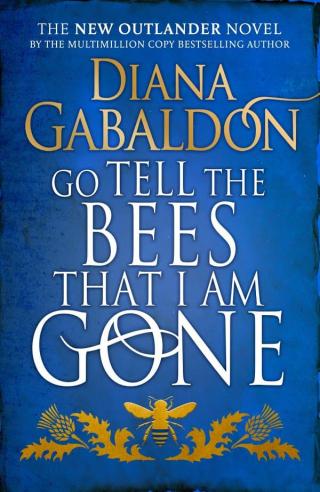
Go Tell the Bees That I Am Gone
- Автор: Гэблдон Диана
- Серия: Outlander #9
- Год: 2021
- Язык: английский
- Год: Delacorte Press
- ISBN: 978-1-473-51900-8
- Жанр: Исторические приключения

Электронная книга - «Go Tell the Bees That I Am Gone». Краткое содержание книги:
The past may seem the safest place to be . . . but it is the most dangerous time to be alive. . . .
Jamie Fraser and Claire Randall were torn apart by the Jacobite Rising in 1746, and it took them twenty years to find each other again. Now the American Revolution threatens to do the same. It is 1779 and Claire and Jamie are at last reunited with their daughter, Brianna, her husband, Roger, and their children on Fraser’s Ridge. Having the family together is a dream the Frasers had thought impossible. Yet even in the North Carolina backcountry, the effects of war are being felt. Tensions in the Colonies are great and local feelings run hot enough to boil Hell’s teakettle. Jamie knows loyalties among his tenants are split and it won’t be long until the war is on his doorstep. Brianna and Roger have their own worry: that the dangers that provoked their escape from the twentieth century might catch up to them. Sometimes they question whether risking the perils of the 1700s—among them disease, starvation, and an impending war—was indeed the safer choice for their family. Not so far away, young William Ransom is still coming to terms with the discovery of his true father’s identity—and thus his own—and Lord John Grey has reconciliations to make, and dangers to meet . . . on his son’s behalf, and his own. Meanwhile, the Revolutionary War creeps ever closer to Fraser’s Ridge. And with the family finally together, Jamie and Claire have more at stake than ever before.
“I don’t hate Ian Murray,” William said, with some coldness. “I owe him my life, after all.”
“Which is why you hate him,” Cinnamon said, matter-of-factly, and handed William his own best knife, with the beaded sheath. “That, and you want his wife. Don’t tell me it will be all right. I’ve seen what kind of trouble you get into when you are with me. I’ll light a candle to the Blessed Virgin every day until you come back with your cousin.”
“Merci beaucoup,” William said, with elaborate sarcasm. “You don’t have that much money.” But he meant it, and Cinnamon grinned at him.
“Have you got a good thick cloak? And woolen drawers to keep your balls warm?”
“You look after your own balls,” William advised him, putting his foot in the stirrup. “Mind yourself, and do what my sister tells you.”
Cinnamon widened his eyes and crossed himself.
“You think I would dare to do otherwise?” he said. “That is a fearsome woman. Beautiful,” he added thoughtfully, “but large and dangerous. And besides, I want my portrait to look like me. If I made her angry …” He crossed his eyes and stuck his tongue out of the corner of his mouth.
William laughed, and tucking the knife into his belt, patted it and took up the reins.
“Serve you right, gonze. Adieu!”
Cinnamon shook his head.
“Au revoir,” he corrected soberly. “Et bon voyage!”
102
The Winds of Winter
BAR A FEW SHOWERS and one day of solid rain, the weather held and the roads were not bad. As for armies, though …
His job was to retrieve Dottie and bring her home. No one had mentioned her husband, who was presumably still an escaped prisoner of war. Granted, Denzell Hunter might be with Dottie in Virginia, but if he weren’t … He knew his cousin well; he knew Denzell Hunter well, too, and thought that once Dottie was safe, Hunter would likely have returned to the Continental army, as a matter of personal belief as well as military duty. Uncle Hal had shown him the official dispatches and told him what General Prévost supposed to be true, regarding both British and American troop dispositions. Winter was coming, and all hostilities had essentially ceased up north. Sir Henry Clinton had been lurking in New York since Monmouth, and George Washington—according to Hal’s dispatches, which his uncle had thought likely accurate—was still keeping the main body of his men in winter quarters in New Jersey.
One of Washington’s generals, though—Lincoln, the man who’d mounted the unsuccessful siege of Savannah—had gone north with his troops and was presently holding the city of Charles Town, and Clinton wanted it.
“So according to the latest, Sir Henry was intending to send some fourteen thousand troops down the coast to take the place, once D’Estaing’s frogs quit New York, but he was delayed by needing to go and protect Newport, which is where the frogs went next.” Uncle Hal had riffled through the small stack of dispatches, peering through his half spectacles. “And then the frogs bloody turn up here! You did say you thought you’d seen D’Estaing himself?”
“With my own eyes,” William assured his uncle, who snorted briefly.
“And we know that Lincoln left here after the siege failed and went up to hold Charles Town, which puts something of a stumbling block in Clinton’s path,” Lord John had put in.
“Being that winter is coming, Sir Henry’s intentions may have been further delayed by the weather—and the minor problem of housing his fourteen thousand troops, in case Benjamin Lincoln doesn’t immediately oblige by surrendering Charles Town. That being so, I’ve no idea what you might find if you go through Charles Town—or anywhere near it—but …”
“But it would be a lot faster to go through Charles Town than round it,” William finished, smiling. “Don’t worry, Uncle Hal. I’ll get to Virginia as quickly as I possibly can.”
Uncle Hal’s face, shadowed with tiredness and worry, relaxed into one of those rare, charming smiles that made you feel as though everything would be fine, because surely the world could not resist him.
“I know you will, Willie,” he said, with affection. “Thank you.”
William had therefore set out on his mission with a warm heart, stout boots, a good horse, and a purse full of gold, Uncle Hal meaning to ensure that he would lack for nothing in transporting Dorothea back to her father’s arms. Uncle Hal hadn’t happened to mention any role for Denzell Hunter in these transactions, but Lord John eventually had.
“He’s a Quaker, of course,” he told William, privately, “but he’s also a surgeon in the Continental army. And an escaped prisoner of war—he broke his parole, he says. He may be with Washington now, which means he’s likely in New Jersey. If he is, bloody leave him there and bring Dottie back with you at once, no matter what she says—or does—to you.”
“She’s a Quaker now, isn’t she?” William asked. “She won’t do anything violent.”
Lord John gave him a look.
“Somehow I doubt that religious conviction will be sufficient to overcome Dorothea’s familial tendencies toward high-handedness. Remember who her bloody father is.”
“Mm,” William said noncommittally. He was in fact recalling that the last time he had told a young Quaker woman—Denzell Hunter’s bloody sister, no less!—that she wouldn’t strike him, she had slapped his face. She’d also called him a rooster, which he rather resented.
William hadn’t given Denzell much thought during the discussion of Dottie’s rescue, but if he had, he would have come to the same conclusion as had Papa and Uncle Hal. He would, he thought, send word to Denzell as to Dottie’s whereabouts and well-being, at least.
William was feeling at once slightly heroic, sentimental, and magnanimous. This was largely due to his current feelings regarding Amaranthus, which were confused but suffusingly pleasant. Half of him urgently wished he had taken advantage of Mrs. Fleury’s summerhouse to accomplish the first step of the plan Amaranthus had suggested to him. The other half was rather glad he hadn’t.
In fact, he hadn’t, largely because of Dottie’s baby, and Amaranthus’s reaction to news of her death, which had abruptly made the child real to him. Before seeing Amaranthus’s sudden tears, he had himself felt the sadness of the situation, but it was an abstract sadness, safely distant from himself. But when Amaranthus wept for the child, he had been struck quite suddenly—and painfully—by the realization that she, little Minerva Joy, had been an actual person, one whose death had grievously wounded those who had loved her, for however short a time.
It was the tenderness engendered by this thought, as much as lust, that had made him touch Amaranthus, enter that kiss.
He touched his own lips with the back of his hand. Such a strange kiss, and somehow wonderful. For those few moments, when their lips had met and their bodies pressed together, kindling each other in the wet, chilly garden, it was as though some connection had been forged between them—as though he knew her now, in some way beyond words.
And he’d bloody wanted to know her a lot further—and she him. At one point, he’d slid his hand up the long bare thigh under her skirts, taken her mound in the palm of his hand, and felt the fullness, the slickness of her, wanting him. The pads of his fingers rubbed half consciously against his palm, tingling.
He swallowed and tried to put the memories of Amaranthus away. For now.
But the tenderness remained—and the thought of the baby. That’s why he’d stopped. Because it had suddenly occurred to him that what he was doing might in fact cause someone real to be born.