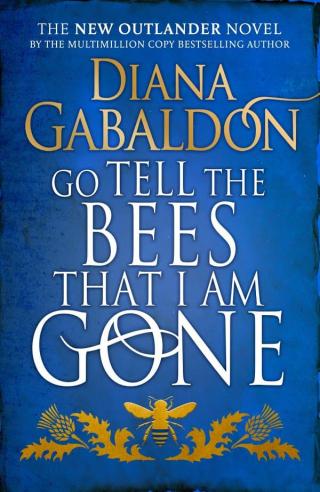
Go Tell the Bees That I Am Gone
- Автор: Гэблдон Диана
- Серия: Outlander #9
- Год: 2021
- Язык: английский
- Год: Delacorte Press
- ISBN: 978-1-473-51900-8
- Жанр: Исторические приключения

Электронная книга - «Go Tell the Bees That I Am Gone». Краткое содержание книги:
The past may seem the safest place to be . . . but it is the most dangerous time to be alive. . . .
Jamie Fraser and Claire Randall were torn apart by the Jacobite Rising in 1746, and it took them twenty years to find each other again. Now the American Revolution threatens to do the same. It is 1779 and Claire and Jamie are at last reunited with their daughter, Brianna, her husband, Roger, and their children on Fraser’s Ridge. Having the family together is a dream the Frasers had thought impossible. Yet even in the North Carolina backcountry, the effects of war are being felt. Tensions in the Colonies are great and local feelings run hot enough to boil Hell’s teakettle. Jamie knows loyalties among his tenants are split and it won’t be long until the war is on his doorstep. Brianna and Roger have their own worry: that the dangers that provoked their escape from the twentieth century might catch up to them. Sometimes they question whether risking the perils of the 1700s—among them disease, starvation, and an impending war—was indeed the safer choice for their family. Not so far away, young William Ransom is still coming to terms with the discovery of his true father’s identity—and thus his own—and Lord John Grey has reconciliations to make, and dangers to meet . . . on his son’s behalf, and his own. Meanwhile, the Revolutionary War creeps ever closer to Fraser’s Ridge. And with the family finally together, Jamie and Claire have more at stake than ever before.
And that it somehow wasn’t right that he should oblige that someone to take on burdens that were—rightfully or not—his own to bear.
But if I married her, and didn’t go away if she fell pregnant … His son—God, what a thought, his son!—would still inherit Ellesmere’s title and Dunsany’s, but not until he was ready for it. He could prepare the boy, show him …
“Jesus.” He shook his head violently, driving out the thoughts, or trying to. The notion was new, frightening—and quite thrilling, in a way. He pushed it aside, his mind sliding back to its memories of Amaranthus and her soft blond brows, trickling water, pungent grass, and the gleaming black eyes of the watchful toad.
He barely noticed the miles pacing away beneath his horse’s hooves, and stopped only when darkness made the road disappear.
103
Virginia Reel
HE STOPPED FOR THE night in a hamlet some thirty miles north of Richmond. William felt the pull of Mount Josiah: He’d passed within a few miles of the road that would take him there, and for a few moments he was there in spirit, sitting on the broken porch with Manoke and John Cinnamon, eating fried catfish and pig meat smoked underground, the faint sweet scent of tobacco riding on the evening breeze.
He wondered briefly whether perhaps he should take Dottie there for a while. The weather was getting colder and rain more frequent; a newly bereaved woman weakened by illness surely oughtn’t to be required to ride through storms and mud for weeks. And if Manoke was still in residence, he and the Indian could easily repair enough of the house to give them shelter …
No. This was a fantasy, born of his own desire to sit still on his shattered stoop and think about things. He needed to get Dottie back to Uncle Hal as soon as possible, where she could be taken care of, heal in the bosom of her family. And, said a small treacherous voice in the back of his mind, you might just want to see Amaranthus again before too long.
“That, too,” he said aloud, and nudged his horse into a faster pace.
He had enough money to bring Dottie back by coach—but that was assuming a coach was to be had. The settlement of Wilkins Corner boasted three oxen, one mule, and a small herd of goats, plus the odd pig or two. There were only four houses, and a brief inquiry of a woman milking a goat sent him directly to the door of Fear God Elmsworth.
This gentleman proved to be in his eighties and quite deaf, but his much younger wife—only sixty or so—was able by shouting into his ear at a distance of two inches to get across to him William’s identity and mission.
“Dorothea, you say?” Mr. Elmsworth cocked a bushy brow at William. “What’s he want with her?”
“I … am … her … cousin,” William said, leaning down to address the old gentleman at the top of his voice.
“Cousin? Cousin?” The old man looked at his wife for confirmation of this unlikely statement, and receiving it, shook his head. “You don’t look nothin’ like her.”
William turned to the wife.
“Will you please tell your husband that Dorothea’s father is my uncle, and his brother is my stepfather?”
The woman heard this but was plainly baffled by the genealogical information, for she opened her mouth for a moment, then shut it, frowning.
“Never mind,” William said, keeping his patience. “Please, just tell Dorothea that I’m here.”
“Dorothea ain’t here,” said Mr. Elmsworth, somehow catching this. He looked puzzled and glanced at his wife. “Is she?”
“No, she isn’t,” said Mrs. Elmsworth, looking puzzled as well.
William took a deep breath and decided that shaking Mrs. Elmsworth until her head rattled wouldn’t be the act of a gentleman.
“Where is she?” he inquired, gently.
Mrs. Elmsworth looked surprised.
“Why, her brother came and fetched her, near on a month ago.”
WILLIAM HAD NODDED in automatic response to Mrs. Elmsworth, but then actually heard what she’d said and jerked as though stung by a bee.
“Her brother,” he repeated carefully, and both the old people nodded. “Her brother. What was his name?”
Mr. Elmsworth, who was now lighting his long-stemmed clay pipe, removed it from his mouth long enough to say, “Eh?”
“He don’t know,” Mrs. Elmsworth said, shaking her capped head in apology. “I was workin’ in the orchard when the man came, and by the time I came back, they’d gone away together. Dorothea left a sweet note, thanking us for looking after her, but she said nothin’ about her brother’s name in it, and my husband was too deaf to understand what they said, beyond them making signs to him.”
“Ah.”
It was possible that Mr. Elmsworth had misunderstood the situation entirely, William reflected, but it was just possible that it had been Henry. When last he’d seen Henry Grey, the man had been living in Philadelphia with a very handsome Negro landlady who might or might not be a widow, recovering slowly from having lost a foot or two of his guts after being shot in the abdomen. William supposed that Denzell might have paused in Philadelphia on his way to New Jersey and given Henry word of Dorothea’s presence, and either had asked Henry to go and fetch her or Henry had determined to do so on his own.
A sudden thought struck him, though, and he inflated his lungs, leaned down close to Mr. Elmsworth’s hairy earhole, and shouted, “Did he wear a uniform?”
Mr. Elmsworth started and dropped his pipe, which his wife fortunately caught before it could shatter on the floor.
“Goodness, young man,” he said reprovingly. “’Tisn’t manners to shout indoors. That’s what I was always taught as a young’un.”
“I beg pardon, sir,” William said, in a slightly lower tone. “Mrs. Hunter has … two brothers, you see; I wondered which it might be.”
Henry had been invalided out of the army, but his elder brother, Adam, the middle one of William’s three cousins, was captain in an infantry battalion.
“Oh, ah,” said Mrs. Elmsworth, and set about questioning her husband in a high-pitched howl, eventually eliciting a dubious opinion that the young fellow might have been in some sort of uniform, though with so many folk going about with guns and colored britches and fancy buttons these days, ’twas hard to say.
“We don’t hold with vanity, see,” he explained to William. “Being Friends, like. Not with armies nor guns, neither, save they’re for hunting. Hunting’s all right. Folk have to eat, you know,” he added, giving William a faintly accusatory look.
William kept his patience, there being no choice, and was rewarded with a more promising thought. He turned to Mrs. Elmsworth.
“Will you ask your husband, please—did the man who came for Dorothea resemble her?” For Henry and Benjamin were slender and dark-haired, like their father, but Adam looked like his mother, as did Dottie, both being fair-haired and pink-cheeked, with rounded chins and large, dreamy blue eyes.
Mr. Elmsworth had grown somewhat tense during the questioning and was puffing on his pipe with an air of agitation, but relaxed when this was put to him. He exhaled a great cloud of blue smoke and nodded, hard.
“He did, then,” he said. “Very like, very like.” Adam. William relaxed, too, and thanked the Elmsworths profusely, though they refused any gift of money.
As he prepared to take his leave, he had another thought.
“Ma’am—do you still have the note my cousin wrote to you?”