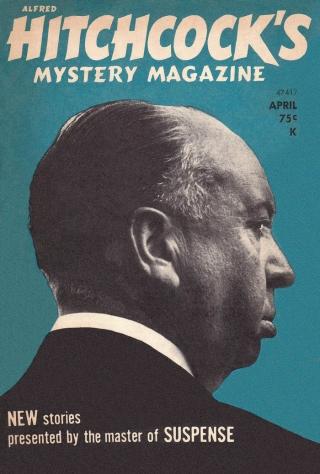
Alfred Hitchcock’s Mystery Magazine. Vol. 17, No. 4, April 1972
- Автор: Breese Edward Y., Бриттен Уильям
- Год: 1972
- Язык: английский
- Год: H.S.D. Publications
- Жанр: Другие детективы

Электронная книга - «Alfred Hitchcock’s Mystery Magazine. Vol. 17, No. 4, April 1972». Краткое содержание книги:
Henry sighed. “So now what, Janet?”
I said, “Now it looks like all we have to do is return that fifteen hundred dollars.”
He made a vague gesture. “How? The books won’t balance, and it’s too late now to say I must have made a mistake in my original count.”
That of course was true, but I still smiled at him. “We’ll think of something,” I said.
Two days later, Mr. Holcomb called us all into his office. The morning mail had just arrived and he had unwrapped a small package. The package contained several banded money packets, along with a brief anonymous note Mr. Holcomb passed around to everyone.
Here’s fifteen hundred dollars back, the hand-printed note read. I held up your place because I needed money for an operation on my kid, plus hospital expenses. Two thousand did it. Call the rest conscience money I can’t keep. Sorry I gave you a bad time.
“Most amazing, I must say,” Mr. Holcomb mused. “I’ll inform the insurance company at once. Now, let’s get back to work, shall we?”
I didn’t concoct that phony note; Henry did, which sort of augurs well for his creative ability and his writing aspirations, don’t you think?
As for that delicate point I touched on, conscience did play some part in my confession to Henry. Mainly, though, it was because he wasn’t getting over his obsession, was driving himself up the wall, making himself ill. I suddenly realized I couldn’t let that continue. I told you in the beginning I just liked Henry, but all at once I sensed it was more than that. Maybe it was... well, a lot more.
Of course, I couldn’t tell Henry that. Even in this age of women’s lib, a girl has to have some pride.
True Friends
by Patrick O’Keeffe
In this particular instance, one might possibly say, with reason, that one good friend deserves another.
One circumstance of my first meeting with Brentford could be viewed as foreshadowing the future: he was reading a mystery novel, the book jacket of which illustrated a voluptuous redhead sitting cross-legged in a witness chair facing a jury. Brentford had booked for London in the old Ambassadress, a medium-size combination passenger and cargo liner then in postwar service between New York and the United Kingdom. After watching the pilot climb down into his launch off Ambrose Lightship, I strolled into the smoking room. Brentford was sitting alone at one of the tables, his long legs stretched out beside it, his free hand curled around a tall glass of black stout. He looked up from the novel as I entered, and his attractive, broad face lighted up with a friendly smile.
“Rather quiet in here,” he remarked, with a glance around the empty tables.
“Things will liven up once the rest of the passengers have finished unpacking and get all straightened away,” I said.
Brentford invited me to have a drink, but I declined, saying I didn’t feel like one just then. However, I pulled out a chair and engaged him in conversation. Nodding at the caduceus under the three gold rings on my sleeve, he remarked that I must be the ship’s doctor. I replied that I was, and I’d probably have said little beyond that, but Brentford had such a pleasing way of listening to you, as if your affairs were of extraordinary interest to him, that I went on to tell him that because of a heart condition I’d abandoned all thoughts of private practice and taken up the less exacting life of a physician afloat.
Brentford told me he was making a hurried business trip to England representing the New York firm of Art Metal Crafts. During the war, he had been attached to a British Government purchasing commission in Washington, and had returned after the war to take a position with Art Metal Crafts. He had also married and settled down.
“Speaking of art metal,” I said, “my daughter and her husband recently bought a home in suburban Connecticut. I visited them recently, and my daughter spoke of coming to New York soon to pick up some decorative metal furnishings for the lawn and the patio.”
“Before I leave the ship,” said Brentford, “I’ll give you a note to Avelardi. He’s in charge of our showrooms. He’ll be happy to take her around and advise her, and extend the courtesies of the firm.”
I thanked him, and he said, “Doctor Jenks, I find it most delightful to talk to you. Nothing would give me greater pleasure than to sit at your table, if I may be so bold as to ask for that privilege.”
I returned his compliment by saying that it would be equally pleasurable to me to have him for a table companion provided, of course, that the seats hadn’t already been assigned. The chief steward told me they had, but he transferred a man who was indifferent about seating, and gave his place to Brentford.
The others at my table were a ship’s chief engineer, a law clerk on a visit to maternal relatives in Cardiff, and a vice-president of an oil company, due in London for a conference with officials of a British subsidiary.
The four of them formed a congenial group — a fivesome, in fact, when I was free to join them — with Brentford the breezy center of cohesion.
Although Brentford spent most of his time with his table group, he held honorary membership in all the other groups and cliques into which even a passenger list as small as the Ambassadress’ seventy or so will inevitably divide. I’d sometimes come upon him chatting merrily with elderly couples, twitting a knot of middle-aged matrons, as often as not teasing younger ones. He could slip into any gathering as smoothly as the chaplain. Even the most standoffish couldn’t have passed his tall, lanky figure without returning his cheerful smile and exchanging pleasantries, and he was a familiar guest at the captain’s private cocktail parties.
It was during the third evening out that he first spoke to me about his wife, though with no hint of his unhappiness. We were sitting alone in the smoking room, the other three being at the horse races in the lounge. He was telling me about the secluded cottage he’d rented upstate as a kind of weekend retreat from the noise and clamor of the city, and he took out his wallet to show me a snapshot of it.
The snapshot showed a shingled house with a run-down appearance and in need of paint, and an open garage attached. “It isn’t much to look at,” said Brentford, “but it’s awfully cozy. It’s a little haven of quiet just off a country road. Margot and I use it to get away from the city during weekends, especially in the hot summers. The old farmer who owns it wants me to buy it. Perhaps I will, but I wanted to try it first. I’d renovate it throughout, pave the garage and put doors on it. That’s Margot.”
Margot was the good-looking but unsmiling woman standing outside the garage. She appeared to be several years younger than Brentford, whom I judged to be about forty, with a small but attractive figure and what he said was reddish hair.
“I became acquainted with her during the war. Her widowed mother was active in Bundles for Britain, and Margot used to help her. Margot still does a little charitable work of that sort.” Brentford shook his head amusedly. “She seems to think the war’s still on and there’s a desperate need of old clothing for bombed-out families. She filled a trunk for me to bring along. I told her it was ridiculous, that there’s absolutely no need for such now. She said I could turn the trunk over to some benevolent organization. I flatly refused to take it. Unknown to me, she had it delivered to the pier, and it was put into my stateroom just as we were about to sail. Heaven only knows what I’m going to do with it.
“I almost didn’t make the sailing myself,” Brentford went on. “It was only by the skin of my teeth I got my passport renewed in time. I reached the consulate almost at closing hour, and the clerk told me I’d have to come back next day. I told him I was booked to sail next day provided my passport was in order, and I wanted it renewed right then and there. I told him I was a friend of the consul-general, and, by George, I’d phone Sir Henry himself, if necessary, to get that renewal.” Brentford chuckled. “I don’t know Sir Henry from Sir Bumbleton, but that clerk really got busy.”