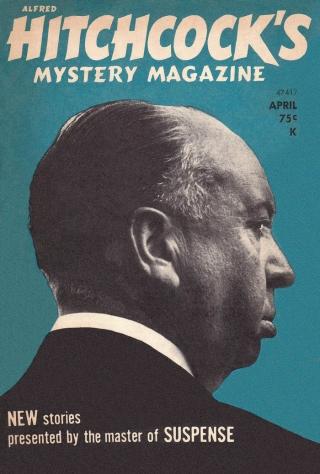
Alfred Hitchcock’s Mystery Magazine. Vol. 17, No. 4, April 1972
- Автор: Breese Edward Y., Бриттен Уильям
- Год: 1972
- Язык: английский
- Год: H.S.D. Publications
- Жанр: Другие детективы

Электронная книга - «Alfred Hitchcock’s Mystery Magazine. Vol. 17, No. 4, April 1972». Краткое содержание книги:
Augustine took a deep breath and let it out with a shudder.
Orin, seeing the old man’s reactions, cocked an eyebrow. “Have you experienced any hallucinations, Augustine?”
“I... I really don’t know.”
“What do you mean, you don’t know? Explain yourself.” Orin’s voice was sharper than he intended it to be.
“It was Saturday evening, Mr. Watkins. I went out for a walk, nowhere in particular. I was having trouble sleeping, what with Marley, and then the files tumbling out of the medicine cabinet. I’d left the house about eleven-thirty, so it must have been after midnight when it happened.”
“When what happened?”
“I had stopped under a street lamp to light my pipe. As I struck the match, I suddenly realized there was a man standing beside me. I hadn’t heard him approach. He must have been wearing rubber-soled shoes.”
“Did the man try to attack you? Did he demand money or anything like that?”
“Oh, no! In fact, he tipped his hat in the most polite manner. It’s just that when he removed the hat, and the light hit his face, I saw that he was wearing a mask.”
“A mask?”
“Yes, sir. It was one of those rubber things that fit over the entire head. Fairly scared the life out of me, it did. You see, the mask was of a... a werewolf. Not only that, but the man suddenly went down on his hands and knees and began howling at the moon. Then, just as quickly, he got to his feet, replaced his hat, shook my hand and vanished into the darkness.”
Orin chuckled. “That one’s easily explained, at least,” he said with a smile. “Either someone coming home from a costume party or a practical joker. Drunk, probably.”
“Perhaps. But after the first two incidents, meeting that man didn’t do my nerves any good, I can tell you that. And I’ve been unable to locate anybody else in the area who either saw the man or even heard of such a thing happening.”
“It is kind of screwy, but not impossible. Is there anything else, Augustine?”
“Yes, Mr. Watkins. One thing more. It happened just last night — or perhaps this morning. It’s hard to say.”
Orin could see that Augustine was visibly shaken by the events that had happened. His thin arms twitched alarmingly, and he seemed on the verge of tears.
“Yesterday evening, I cleaned my room, sir; vacuuming, dusting, the whole thing. At the time I went to bed, everything was in its proper place. You’ve got to believe that, Mr. Watkins. You’ve got to!”
“Okay, Augustine, okay. Nobody’s doubting your word. Go on with your story.”
“Yes, of course. I’m sorry to lose control of myself. At any rate, I locked the door and went to bed. But this morning when I got up, I found... I found...” Augustine suddenly covered his face with the handkerchief and burst into horrible and uncontrolled sobbing.
For several minutes, the silence of Orin’s office was broken only by the pitiful moans of the old man. Finally, with a tremendous effort of will, he became quiet. Bending over, he picked up a roll of paper from the floor beside the chair and tossed it onto Orin’s desk.
“That, Mr. Watkins. I found that on the floor of my room. Held flat with books from my shelves, it was. But I didn’t put it there. I’ve never even seen it before this morning. I swear it, sir! I don’t know where it came from!”
Orin unrolled the stiff paper. It was a poster of some kind. The picture was of a military man in his late fifties or early sixties, wearing the uniform of a World War I soldier. The handsomeness of the rugged face with its neat moustache and coolly competent expression was set off by the brilliant display of campaign ribbons and the general’s four stars on his uniform. Orin read the few words below the picture: GENERAL JOHN J. “BLACK JACK” PERSHING, commander in chief of the American Expeditionary Force in Europe.
“Nothing frightening about the picture, at least,” said Orin finally.
“That’s not the point, Mr. Watkins. I never owned such a picture. How did it get into my room? First, my canary was killed. After that, the files in the medicine cabinet and the man with that hideous mask. And now this. At first, I... I thought about not saying anything to anybody, but—”
“Yeah, that’s what ninety-nine people out of a hundred would do. But you did the right thing, Augustine. Only... Oh, dammit!” Orin balled up a sheet of paper from his desk and hurled it into a corner of the small office.
“Are you all right, Mr. Watkins?”
“Yeah, Augustine. It’s just that you’re too nice a guy for what I’ve got to do to you.”
“What do you mean, sir?”
“Look, you’ve told me some pretty wild things. They just don’t make any sense. For what it’s worth, I don’t think you’re going screwball. On the other hand, I’m not a doctor. I’m a security officer, and regardless of my personal feelings, my first duty’s to the safety and security of The Center. Right?”
“I suppose so, but—”
“Don’t interrupt me while I’m griping. Now, if these things had happened to one of the scientists here, I might think somebody was trying to drive him insane. But frankly, Augustine, your job as a clerk just doesn’t have that high a priority. Let’s face it, if you disappeared tomorrow, you could be replaced without too much trouble. Furthermore, you don’t know enough about the operations here for you to give anybody really vital material. I don’t mean to hurt your feelings, but that’s the way things are.”
“I’m aware of that, Mr. Watkins.”
“All right, then, if we eliminate the idea that some unknown party’s trying to get you out of The Center, what’s left?”
Augustine stared bleakly at the floor. “What you’re trying to say is that I either imagined these things or I did them myself. Isn’t that it?”
“Yeah, but... Oh, hell!” Orin picked up the telephone on his desk and poised an index finger over the dial. “I’m going to have to keep you here at The Center, Augustine,” he said. “You’ll be under guard, and the doctors will be dropping in fairly often. I’ll make you as comfortable as I can, but no word will be allowed out as to your whereabouts. And if you’re thinking about exercising your constitutional rights to habeas corpus, forget it. This is a top-secret government project, not a courtroom.”
“Please don’t worry yourself about my welfare,” said Augustine. “I understood the consequences when I walked in here.”
Orin opened his mouth to speak and then abruptly closed it. What more was there to say? He spun the telephone dial around angrily.
After turning Augustine Lanier over to two guards who were given strict orders not to let the old man out of their sight until he was given clearance, Orin went to the cafeteria and ate a lunch that could have been boiled cardboard for all the enjoyment he got from it. Returning to his office, he flopped into his swivel chair, spun it away from the desk and considered a ground plan of The Center that was mounted on the wall.
There was the sound of drumming feet outside the building, and he turned to watch through the window as the perimeter guards changed. After a formal exchange of salutes, the new men took their places at the small booths by the gates, while those who had been on duty the previous four hours returned to the barracks just below the office. There, the men who lived on the base could read, talk or catch up on their sleep while the noncommissioned officers who had rooms in town dashed out through the gates to catch a bus. Until eight o’clock that evening, their time was their own.
Orin frowned suddenly, glancing from the window back to the floor plan. There was something he hadn’t noticed before. Easy enough to remedy, of course, but a possible breach of security, just the same.
There was a knock on the door. “Come in,” Orin shouted impatiently.