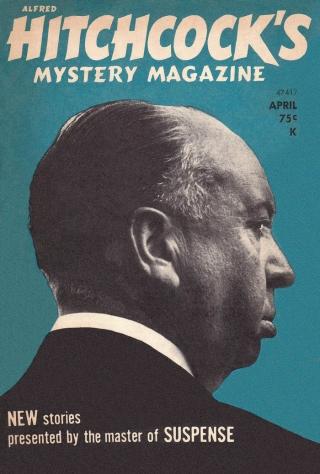
Alfred Hitchcock’s Mystery Magazine. Vol. 17, No. 4, April 1972
- Автор: Breese Edward Y., Бриттен Уильям
- Год: 1972
- Язык: английский
- Год: H.S.D. Publications
- Жанр: Другие детективы

Электронная книга - «Alfred Hitchcock’s Mystery Magazine. Vol. 17, No. 4, April 1972». Краткое содержание книги:
Avelardi paused, as if to allow time for the import of his last remark to sink in. “The detectives told me that both he and his wife had disappeared. They had returned from one of their customary weekends at their country cottage. Next morning, Monday, Brentford got the superintendent to bring up his big trunk from the basement storeroom. Neither Brentford nor his wife has been seen since early that week. The superintendent told the detectives that, so far as he could remember, it was the first time Brentford had used that trunk since moving into the apartment. The detectives asked me if he’d ever used it on business trips. I told them he wouldn’t need to, since all he carried were portfolios and catalogs. They gave me the impression of having dark suspicions about what the trunk might contain.” Avelardi shook his head slowly in disbelief. “I know Brentford wasn’t happy with his wife, but I find it unthinkable he’d — he’d do away with her.”
I’d have been every bit as incredulous if I hadn’t known what happened to that trunk, and if I hadn’t been overwhelmed with sudden recollections that took on new meanings — Brentford saying he’d only just made the sailing, had managed to get his passport renewed in time by the skin of his teeth, would by George, phone Sir Henry himself if he had to; Liebman saying I was an accessory after the fact-true words said in a joke.
Something like shock must have shown in my face, for Avelardi hastened to say, “Of course, I may be seeing it all in the worst light, and Brentford and his wife will turn up safe and well.”
I could have told him that a body inside a trunk at the bottom of the Atlantic wasn’t likely to turn up safe and well anywhere — but I didn’t. An innate sense of loyalty to a friend, even a comparatively new one, froze my tongue. I wanted to be far from Avelardi’s office, to be alone and free to think.
I stood up. “I’m most distressed about Mr. Brentford, and sincerely concerned for him. I’m sorry I must leave so abruptly, but I have another engagement. I dropped in to give you the card. I’ll call again next time I’m in town and hope you’ll have good news of Brentford.”
I hurried back to the ship, my engagement being to examine some new crew members to be signed on that afternoon. I was so agitated with thoughts of Brentford that more than one taxi or truck screeched to a halt, their drivers shouting obscenities at me for crossing against red Don’t Walk signs. By the time I went aboard, miraculously unscathed, I’d come to a decision on Brentford.
As a law-abiding citizen, I should go to the police, but that appeared to me more like betrayal than performing a duty. I shrank from it. A true friend doesn’t rush headlong to inform on another friend; he waits until he knows all the facts. Brentford didn’t seem like a cold-blooded wife murderer. He might have killed in sudden anger or provocation-justifiable homicide. I decided to let the law take its normal course. The police would inquire at shipping offices and learn that Brentford had booked for London in the Ambassadress; they’d learn that the trunk had been delivered to his stateroom; they’d eventually learn that it hadn’t been landed in England. They would then make inquiries aboard the Ambassadress. That would be the time for me to decide whether or not to speak up.
I was puzzled, though, as to why Brentford gave me his card and urged me to call on Avelardi without delay. Surely he must have foreseen I’d hear that his wife was missing and that the police were inquiring for him. Or had he overlooked it, in his eagerness to do me a favor? It occurred to me that he may have intended that I should reveal his whereabouts, even to telling that he could be found in the bar of the London Savoy around opening time any day, but it baffled me to see what he’d gain by it. I felt a little resentful at the notion he was actually using me as a kind of accessory after the fact, but decided not to pass judgment on him until I was sure.
On my next return to New York, I half expected that detectives would board the ship to inquire about Brentford, but it was a trial lawyer who came to my office. He told me he’d been retained to defend Brentford on a murder charge, and would like to talk to me about him.
“So he was brought back from England,” I said.
“Yes. The police learned through Scotland Yard that he was staying with a sister just outside London. He waived extradition proceedings and was brought back by air. He made a full and voluntary confession, but told me privately how he persuaded you to help him with the trunk.” The lawyer shook his head dubiously. He was young, and eager to enhance his reputation. “The best I can hope for is second-degree manslaughter.”
“Then it wasn’t premeditated murder,” I said, with a feeling of relief.
“Not according to his statements, and I’m inclined to believe him, having become impressed by his personality. In the course of his conversations with you, did he ever tell you his wife was an alcoholic?”
I shook my head. “No mention whatever.”
“He had no suspicion of it before he married her a year or so ago. Her mother concealed it from him, anxious to get her married off and herself to a retirement village in California. Brentford was furious when he found out. He tried his damnedest to straighten out his wife, to get her to take a cure, but she was stubborn. In a rage, he once told her mother he wished alcohol were like sleeping pills and an overdose would kill, and he said that went for the mother too. You can imagine the effect of that on the jury when the prosecution puts the mother on the witness stand.”
As the lawyer paused, a quirk of memory brought back to my mind the mystery novel with the voluptuous redhead sitting cross-legged in the witness chair.
“Brentford,” the lawyer resumed, “drove up to their cottage for that last weekend of theirs together. On the Saturday they drove over to the lake and got back late at night. Brentford happened to go into the kitchen as his wife was opening a bottle of whiskey she’d slipped into her weekend bag, intending to start on a binge. He went to take it from her. She tried to crown him with it, but caught him a glancing blow instead. The stinging pain made him lash out at her. She crashed backward over a metal chair and table and ended up on the floor. She didn’t get up. He didn’t know what had happened, but of one thing he was sure — she was dead and he’d killed her.”
“Most likely a broken neck or a cerebral hemorrhage,” I said, venturing a professional opinion.
“As Brentford put it,” the lawyer said, “he was caught with a fait accompli, so to speak. He had to get the body out of sight, and fast. He had, he told me, no intention of paying with life or freedom over a woman’s insatiable craving for alcohol. From crime novels, he’d gained a smattering of criminal law, and he knew that if he could keep the police from finding the corpus delicti, as he called it, guilt would have to be proved on circumstantial evidence alone, the body of the crime, the true corpus delicti. Moreover, he’s a British subject, and if the matter of extradition arose, a British judge might refuse it on the grounds that there was not sufficient evidence to justify a murder charge.”
“Wouldn’t his flight be a strong evidence of guilt?”
“He was prepared to say he’d deserted his wife, because of her alcoholism. Also that she was alive when he fled from the apartment. He’d made it appear she’d returned from the weekend in the country with him. Their apartment was on the ground floor. The elevator operator, who also doubled as doorman, was about to take the elevator up in response to a tenant’s signal when Brentford hurried into the building. He swept past the elevator operator with the two suitcases, saying that his wife was parking the car. He had a moment’s panic when his mother-in-law telephoned from California later in the evening to tell her daughter she was leaving in a day or two for a cruise to Hawaii and back, and would drop her a card or two. Brentford told her that his wife had come back from the cottage with a severe headache, taken a sedative, and gone to bed, but he’d tell her in the morning. Next morning—”