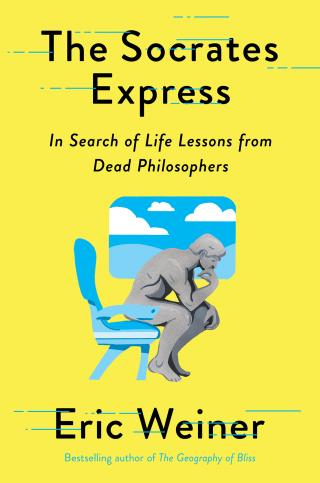
The Socrates Express
- Автор: Вейнер Эрик
- Год: 2020
- Язык: английский
- Год: Avid Reader Press / Simon & Schuster
- Жанр: География, путевые заметки

Электронная книга - «The Socrates Express». Краткое содержание книги:
We contemplate for the same reasons we travel: to see the world from a different perspective, to unearth hidden beauty and find new ways of being. We want to learn how to embrace wonder. Face regrets. Sustain hope.
Eric Weiner, *New York Times* bestselling author of *The Geography of Bliss* , combines his twin passions for philosophy and global travel in a pilgrimage that uncovers surprising life lessons from philosophers around the world, from Marcus Aurelius to Arthur Schopenhauer, Confucius to Montaigne. Traveling by train (the most thoughtful mode of transport) he traversed thousands of miles, making stops in Athens, Delhi,...
The phantom vibrations in my pocket, emanating from where my phone should be, have dissipated. I become aware of a stillness. I experience a moment of what I believe is commonly called “peace.”
Then the mosquitoes strike. Some snipe at me, while others, more aggressive, dive-bomb. They’re annoying. I decamp and continue my amble. I’m contemplating Thoreau’s imperviousness to distraction when I slip on a wooden plank and nearly fall. That was close. I stop and regroup. I make a conscious effort to see, clearly and honestly, what nature proffers. To my surprise, this attempt works. I spot a robin hopping on a telephone wire. At least, I think it’s a robin. It could be an oriole or a towhee or God knows what other species. Does it matter?
Thoreau didn’t necessarily think so, and he knew his birds. Knowledge of the supposed robin can amplify the pleasure of viewing it, but it can also detract. An ornithologist may know the biological rationale for a peacock’s colorful plume but not appreciate its beauty. “I begin to see objects only when I leave off understanding them,” says Thoreau. Jaded eyes see little.
Thoreau cultivated an “innocence of the eye.” He never lost the child’s sense of wonder. He couldn’t pass a berry without picking it. “He is a boy and will be an old boy,” Ralph Waldo Emerson said of his friend. Like Socrates, Thoreau valued a thoroughly conscious ignorance and suggested, only half-joking, that he form a Society for the Diffusion of Useful Ignorance.
Humans have been creating beauty far longer than they’ve been explaining it. Homer knew nothing of literary theory. The unknown artists who adorned the caves of Lascaux some seventeen thousand years ago would flunk an art history class. Better to see beauty than understand it.
The mosquitoes have, thankfully, dispersed, and the ambitious runner is long gone. The bird, though, is still hopping on the wire, and shows no sign of tiring. Good for him, I think, but Walden Pond awaits. I decide to move on.
After a few steps, I stop myself. Why the rush? It’s my visual hypothesis mechanism at work. My brain posits that a creature—quite possibly a robin—is hopping on a telephone wire. In a fraction of a second, my brain accepts this supposition and files a report: Bird, probably a robin, doing something cute and birdlike. Yeah, nature. You’re a regular John Muir. Can we get going now?
I force myself to linger, as Thoreau did. “You must walk sometimes perfectly free—not prying nor inquisitive—not bent upon seeing things.” Thoreau could easily spend an hour watching a painted tortoise lay her eggs in moistened sand or a sail fluttering in the wind. He once spent an entire day watching a mother duck teach her ducklings about the river, later delighting children with his duck tales. But what children find wonderful, adults often find peculiar. A farmer named Murray recalls seeing Thoreau standing motionless, staring into a pond.
I stopped and looked at him and I says, “Da-a-vid Henry, what air you a-doin’?” And he didn’t turn his head and he didn’t look at me. He kept on lookin’ down at that pond, and he said, as if he was thinkin’ about the stars in the heavens, “Mr. Murray, I’m a-studying—the habits—of the bullfrog!” And there that darned fool had been standin’—the livelong day—a-studyin’—the habits—of the bull-frog!
It’s not easy to see slowly like Thoreau. Vision is the speediest sense, far faster than, say, taste. There is no visual equivalent of “savoring.” (We can say our eyes “lingered” on an object, but that lacks the sensuousness of “savor.”)
I am a lazy seer. I expect the subject of my gaze to do all the work. Dazzle me, scenery. Be beautiful, damn it! When the subject—be it the Alps or a Monet—inevitably falls short of my unreasonable expectations, I assign blame to it, not me. Thoreau thought otherwise. The person attuned to beauty will find it in a garbage dump while “the fault-finder will find fault even in paradise.”
I reach a clearing in the woods: the site of Thoreau’s cabin at Walden. A wrought-iron fence encircles the spot, marked by a pile of stones. (The cabin itself is long gone.) An engraving informs me, “Beneath these stones lies the Chimney Foundation of Thoreau’s Cabin: 1845–1847.”
The site of history’s greatest experiment in voluntary solitude is, naturally, crowded: a woman clutching a large Starbucks cup and shouting into her cell phone, a group of Chinese tourists maneuvering their long camera lenses like artillery before snapping photos of the rocks. They’re messing with my solitude, with my Thoreauvian moment. I want them to leave, but they don’t.
That’s unfair, I know. They have as much a right to be here as I do. It’s like traffic. When we’re stuck in it, we gripe about “all this traffic,” ignoring the fact that we’re part of the traffic, part of the problem.
A middle-aged couple is staring at the stone markers. I can tell the man, in particular, is enthralled. He’s muttering something about how much he admires Thoreau.
“What are you going to do,” says his wife, teasing, “go live in the woods?”
The man, chastised, grows silent. No, he’s not going to live in the woods. He is going to steer the minivan home, unload the luggage, and resume his life of quiet desperation.
This is the problem with Thoreau. What he did was impractical. We can’t drop everything and live in the woods, not even with Mom’s home cooking nearby. We have bills to pay and recitals to attend and conference calls to join. Then again, Thoreau never suggested we do as he did. Walden was meant as a wake-up call, not a prescription.
I saunter a bit farther and spot another inscription. These words, from Walden, are perhaps Thoreau’s most famous: “I went to the woods because I wished to live deliberately, to front only the essential facts of life, and see if I could not learn what it had to teach, and not, when I came to die, discover that I had not lived.”
I like it, but would make one small edit. I’d change “live” deliberately to “see” deliberately. I don’t think Thoreau would object. Seeing was the point of his experiment. All the rest—the solitude, the simplicity—were means to this end.
Thoreau saw too much. It exhausted him. “I have the habit of attention to such excess that my senses get no rest, but suffer from a constant strain,” he writes in his journal.
We think of our senses as antennae, scanning the environment and plucking information. They are more like filters, sifting through the jumble of noise for the few relevant signals, lest the flood of sensory data overwhelm us. We are built to, as Thoreau put it, receive “our portion of the infinite,” and not a drop more.
Seeing is deliberate. It’s always a choice, even if we don’t realize it. Proper seeing, says Thoreau, requires “a separate intention of the eye.” It’s all about the angles. No one played them better than Thoreau. Change your perspective and you change not only how you see but what you see. “From the right point of view, every storm and every drop in it is a rainbow.”
Thoreau observes Walden Pond from every conceivable vantage point: from a hilltop, on its shores, a boat on its surface, and underwater. He viewed the same scene by daylight and moonlight, in winter and summer.
Thoreau rarely stared at anything directly. He looked with the side of his eye. There’s a physiological basis for this. In dim light, we can detect objects best by looking at them from the side. Thoreau may or may not have known that. He did know from experience.
Determined not to get stuck in a visual rut, he altered his perspective. Sometimes only the slightest shift, “a hair’s breadth aside from our habitual path or routine,” revealed new worlds. On a cold December day in 1855, Thoreau spotted a pine grosbeak, “unusually far south for the winter,” only because he had chosen a different path.