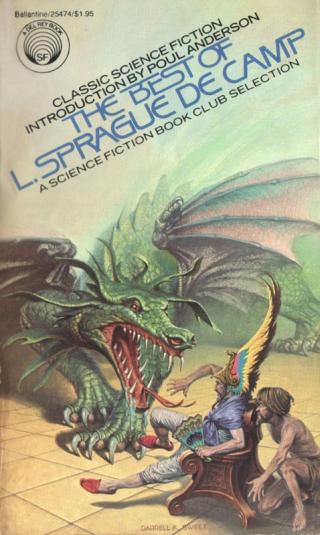
The Best of L. Sprague de Camp
- Автор: Де Камп Лайон Спрэг
- Год: 1978
- Язык: английский
- Год: Del Rey / Ballantine
- ISBN: 0-345-25474-0
- Жанр: Научная фантастика

Электронная книга - «The Best of L. Sprague de Camp». Краткое содержание книги:
"But if I'd done that I'd have smashed the skull, and we mightn't have been able to reify him!"
"You mean ... you're going to—" But Staples didn't finish. He already knew the answer. They gathered up the bear-dog, put him back together more or less the way he had been, and hoisted him into the biggest tank again. Some days later Staples was sorry to observe that the animal was making a record recovery. But Platt had a new cage built that not even this monster could break out of.
But with his size and enormous appetite, Platt decided that he was too expensive and dangerous to keep. He sold him to the Philadelphia Zoo. After the zoo people became acquainted with him they probably regretted their bargain.
The sale attracted some attention, and the Philadelphia Zoo for a while had a capacity audience. Platt inquired about the market for more of his reified animals.
A couple of weeks after the sale, a sunburned man called at Piatt's. He said his name was Nively, and that he represented the Marco Polo Co. This, he explained, included all the wild-animal importers and dealers in the country. It was a membership corporation instead of a stock corporation, to get around the antitrust laws.
Feeling that they could now afford some publicity, Platt and Staples showed him the place. He was duly impressed, especially with their new Dinohyus, a lower Miocene elothere. It was a piglike animal the size of a buffalo, with a mouth full of teeth like those of a bear. It ate practically anything.
Elias was assembling their biggest tank. Platt explained: "That's for Proboscidea. We haven't one big enough for them now. And out in the storehouse I've got a magnificent Parelephas jeffersonii. You know, the Jeffersonian mammoth. That's much bigger than the ordinary or woolly mammoth that the cavemen made such pretty pictures of. The woolly mammoth was a rather small animal, not over nine feet high."
"That so?" said Nively. They were on their way back to the office. "My word! I thought all mammoths were huge things. I say, Dr. Platt, I have a little matter I'd like to discuss in private."
"You can go right ahead, Mr. Nively. I haven't any secrets from Staples."
"Very well. To begin, is this process of yours protected?"
"Sure it is. At least, as far as you can protect any invention by patent applications. What are you getting at, Mr. Nively?"
"I think the Marco Polo might have a proposal that would interest you, Dr. Platt."
"Well?"
"We'd like to buy up your patent applications and all rights pertaining thereto."
"What do you want them for?"
"You see, our business requires considerable capital and involves a lot of risk. You load six giraffes on at Jibouti, and by the time you get to New York one of 'em is alive—if you're lucky. With your process we could put the animals in cold storage at the point of shipment, as it were, and—what's the word you use?—reify them in this country."
"That sounds interesting. Would you be interested in a nonexclusive license?"
"No, we want complete control. To ... ah ... keep up the ethical standards of the business."
"Sorry, but I'm not selling."
"Oh, come now, Dr. Platt—"
They argued some more, but Nively left without getting anywhere. A week later, just after the rock containing the mammoth had been hoisted into its tank, he was back.
"Dr. Platt," he began, "we're businessmen, and we're willing to pay a fair price—" So they went at it again—again without result.
After Nively had gone, Platt said to Staples: "He must think I'm pretty obtuse! The reason they're after my process is that they're afraid it'll break their monopoly. There isn't a circus or zoo in the country that wouldn't like one or two prehistoric animals."
The taciturn Staples opined: "I have an idea they'll get really riled when we get a couple of the same species and breed 'em."
"By Jove, I never thought of that! Nobody buys wild lions nowadays. It's too easy to raise your own. That gives me another idea. Suppose we start a race of, say, elotheres, like our big piggy friend over there. And suppose civilization collapses, so that the record of our work here is lost. Won't the paleontologists of a few thousand years hence have a time figuring how the elotheres disappeared completely in the Miocene, and then reappeared again twenty million years later, warts and all?"
"That's easy," retorted Staples. "They'll invent a sunken continent in the Pacific Ocean, where the Elotheridae hung out during the Pliocene and Pleistocene. And then a land bridge was formed, enabling them to spread over North—Hey, don't throw that! I'll be good!"
Nively's third visit was sometime later, when the mammoth was almost ready to be hoisted out of his tank. The sunburned man came to the point right away.
"Dr. Platt," he said, "we have a big business, built up with a great deal of effort, and we shan't sit around and watch it destroyed just because some scientist gets a bright idea. We'll make you a perfectly fair offer: We buy your patent application, under an agreement whereby you can practice your process, provided you name us exclusive agent for the sale of your animals. In that way you can continue your scientific work; we retain control of the commercial field; everyone's happy. What do you say, old chap?"
"I'm sorry, Mr. Nively, but I'm not in the market for such an arrangement. If you want to talk nonexclusive licenses, I might be willing to listen."
"Now look here, Dr. Platt, you'd better think twice before you turn us down. We're a powerful organization, you know, and we can make things very unpleasant for you."
"I'll take a chance on that."
"A wild-animal collection's a vulnerable piece of property, you know. Accidents—"
"Mr. Nively"—here Platt's color wandered down the spectrum toward the red end—"will you please get to hell out of here?"
Nively got.
Platt, looking after him, mused: "There goes my temper again. Perhaps I should have stalled."
"Maybe," agreed Staples. "He wasn't actually muttering threats when he went out, but he looked as if he were thinking them."
"It's probably bluff," said Platt. "But I think I'll take on another man. We need somebody up and around all the time."
In due season they hoisted the mammoth out of his bath and started his heart. They were nervous, as he was by far the largest animal they had tried the process on. Platt whooped and threw his hat in the air when Parelaphas showed signs of life. Staples whooped, too, but he didn't throw his hat in the air.
They named the mammoth Tecumtha, after the famous Shawnee chief. He stood eleven feet six inches, which is about as big as the biggest modern African elephant. He had helically twisted tusks that almost crossed at the tips. When he became fully conscious he made some rumpus, but after a while calmed down like a modern elephant. During his recovery period he grew a thick coat of short, coarse brown hair.
Platt had, as he had said he would, taken on another man to help Elias. Early one morning Tecumtha had a slight stomach ache. This new man, Jake, went out to see what he was squealing about. Jake dissolved his medicine in an elephant highball—one bucketful, equal parts of gin and ginger extract—and took it in to him. Tecumtha was sucking it up his trunk and gurgling happily, and Jake had stepped out of sight, when Nively materialized. He walked up to the enclosure and shot Tecumtha through the upper part of his head with a Birmingham .303.
That was a mistake. The Birmingham .303 is much too light a rifle for shooting elephants. And the upper part of an elephant's head is merely a cellular bone structure to anchor its huge neck muscles. Its brain is much lower down. Nively had done all his field work in South America and didn't know that about an elephant's construction. The bullet went through Tecumtha's head, but it merely made him very, very angry. He trumpeted. That is a most startling sound the first time you hear it, like twenty men blowing bugles full of spit.