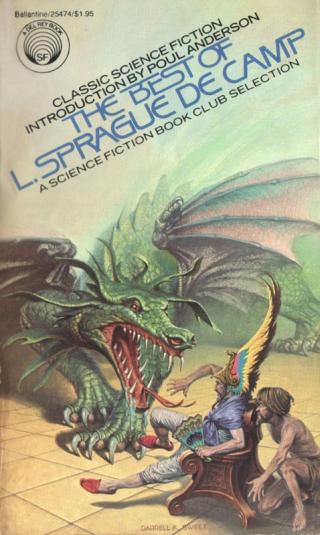
The Best of L. Sprague de Camp
- Автор: Де Камп Лайон Спрэг
- Год: 1978
- Язык: английский
- Год: Del Rey / Ballantine
- ISBN: 0-345-25474-0
- Жанр: Научная фантастика

Электронная книга - «The Best of L. Sprague de Camp». Краткое содержание книги:
The Best of L. Sprague de Camp
L. Sprague de Camp
L. SPRAGUE DE CAMP — ENGINEER AND SORCERER
AS A STUDENT of the myriad ways of man, L. Sprague de Camp has from time to time looked upon his own society with the same objective eye he uses on peoples whom geography or history make strange to most of us. He himself does not seem to find them very alien—and he has encountered many at first hand. Though he knows more about cultural differences than most professional anthropologists, his basic judgment appears to be that human beings everywhere and everywhen are much the same at heart: limited, fallible, tragi-comic, yet endlessly interesting. So in the civilizations of antiquity or among more recent "primitives" he sees engineers and politicians not unlike ours, while among us he discovers taboos and tribal rites not unlike theirs. The insight has directly inspired at least one story and added philosophical depth as well as occasional piquant ironies to most of the others.
Therefore I wonder what he thinks of this curious custom we have of prefacing a collection of one writer's work with the remarks of a colleague. It strikes me as especially odd when the former is senior to the latter, and senior in far more than years. That is, I was a boy when L. Sprague de Camp's first stories were published; I spent a decade being awed by his erudition and captivated by his ability to tell a story, none of which has changed since. When I began to write professionally myself, it became clear, once I was hitting my stride, that there was a considerable de Camp influence on me, though I will never match him in any of those areas he has made uniquely his own. In short, what the deuce am I doing introducing him?
The sole rationale that comes to mind is this. De Camp belongs to that generation of writers whom John Campbell inspired to create the golden age of science fiction and fantasy, beginning about 1937 when he took the helm of what was then called Astounding Stories. Critics be damned, it was the golden age in all truth, when people such as Isaac Asimov, Lester del Rey, Robert A. Heinlein, L. Ron Hubbard, Malcolm Jameson, Henry Kuttner (especially as "Lewis Padgett"), Fritz Leiber, C. L. Moore, Ross Rocklynne, Clifford D. Simak, George O. Smith, Theodore Sturgeon, A. E. van Vogt, Jack Williamson, and more and more either appeared for the first time or, for the first time, really showed what they could do. De Camp stood tall in this race of giants. Gifted new writers have made their considerable marks on the field throughout the years afterward, but the excitement-the sense of utterly green pastures suddenly opened-will never come again. Comparison to the Periclean and Elizabethan periods may strike you as overdrawn, but you might think of jazz in its heyday, or quantum physics in the 1920'S and '30's, or cosmology and molecular biology today.
The era was brief, choked off—though not overnight—by America's entry into World War Two. A number of key creators found that they had more urgent business on hand than writing stories. They included de Camp.
Hostilities having ended for the time being, he returned to his proper business and had much to do with pulling science fiction out of the dismal state into which it had fallen. Besides Astounding as of yore, he was an important contributor to numerous other magazines in the field. The publication of science-fiction books, not as rare oneshots but as a regular thing, was being pioneered then, and his became landmarks. Of all this, more anon.
However, he began increasingly to write other things. These included some grand historical fiction but became primarily nonfiction, with emphasis on science, technology, and the history of these. Factual material, accurately and vividly presented, was not new to him—he had written it from the start of his career—but soon it comprised the overwhelming bulk of his output. I don't know whether to regret this or not. On the one hand, we have doubtless lost a number of marvelous yarns; on the other hand, we do have these perfectly splendid books about elephants and ancient engineers and H. P. Lovecraft and dinosaurs and ...
Luckily for us, of recent years L. Sprague de Camp has from time to time been coming back to storytelling, especially to fantasy. (He is also pleasing aficionados with light verse and familiar essays, but these are of less immediate interest to a reading public starved for honest narratives in which real things happen to persons one can care about.) And thus we arrive at a justification for this foreword: The fact that many younger folk may not be acquainted with his fiction, and in any event will not know what a towering figure he has been—and is—in the field of imaginative literature. The present book, which spans most of his career, ought to remedy that. If you haven't read a de Camp tale before now, you have a treat in store, and I am here to tell you so.
Second, since an anthology can hold but a limited part of an author's work, you might allow me to steer you onto other things, as well. 'What follows will not be a bibliography or a scholarly study, but just a ramble through a few of the good memories, literary and personal, that Sprague has given me. A lot will be omitted; I should not take up space which could be used for an extra story. But perhaps you will get a better idea of his achievement and of what to watch for in bookstores and libraries than you would from something more formal.
As I have remarked, he began writing nonfiction early on. Indeed, his very first published work was an important book, still in print and once cited in a Supreme Court decision, whose self-explanatory title is Inventions, Patents, and Their Management. Not being an inventor of anything except occasional recipes, I must confess to never having read this. However, in my teens I was delighted and enlightened by the articles he wrote for Astounding, pieces like "The LongTailed Huns" (on urban wildlife), "The Sea King's Armored Division" (on Hellenistic science and engineering), and "Get Out and Get Under" (on the history of military vehicles). The subjects demonstrate the range and depth of his interests; the titles indicate the humor with which he made the facts sparkle.
That humor became an emblem of his in science fiction, doubly welcome because it has always been in short supply there, and in fantasy, where it matched the funniest things ever done in a field which has nurtured a lot of sprightliness. His humor was often called "wacky," but I think that's the wrong word. De Camp constructed his stories every bit as carefully, with the same respect for fact and logic, as he did his nonfiction. (He still does, of course.) Much of the laughter came from the meticulously detailed working out of the consequences of a bizarre assumption.
For instance, in the short novel Divide and Rule, extraterrestrial conquerors have imposed a neo-medieval culture on Earth as a way of keeping the human race from uniting to overthrow them. The story opens with Sir Howard van Slyck, second son of the Duke of Poughkeepsie, riding along in chrome-nickel armor, puffing his pipe, near the tracks of the elephant-powered New York Central. Upon his plastron he bears the family arms—which he calls a trademark—-consisting of a red maple leaf in a white circle with the motto "Give 'em the works."
In another short novel, Solomon's Stone, there is a parallel universe in which Earth is inhabited by those people whom we daydream of ourselves as being. The mind of the shy, bookish hero is transferred to the body of the alter ego he had always supposed was purely imaginary, a French cavalier like d'Artagnan. Practically every man is big, muscular, and handsome; every woman ravishingly beautiful. New York is a wild conglomeration of ethnic types, ranging from the Siegfrieds in Yorkville to a Middle Eastern sultan complete with harem (who in our world is really a bachelor clerk at the YMCA). With so many aggressively macho toughs around, society is pretty chaotic, though a government of sorts does exist and even maintains a small army, which consists almost entirely of generals and is commanded by the only private it has.