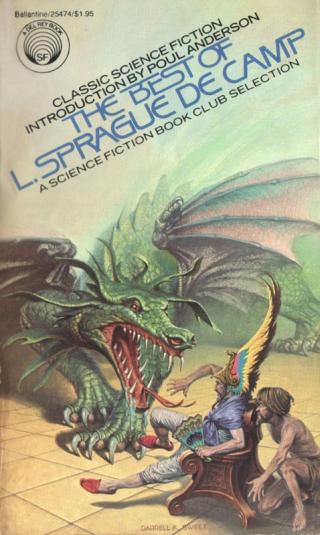
The Best of L. Sprague de Camp
- Автор: Де Камп Лайон Спрэг
- Год: 1978
- Язык: английский
- Год: Del Rey / Ballantine
- ISBN: 0-345-25474-0
- Жанр: Научная фантастика

Электронная книга - «The Best of L. Sprague de Camp». Краткое содержание книги:
"But, Ken, a beautiful thing like that—"
"Take it easy, Gil. This little Pleistocene overlay runs back to your place. If we run the truck around your grounds for a few hours we ought to be able to find some fossils."
"It's a rodent. I thought it was a bear at first from the size of the skull, but now I see those front teeth."
"Right so far. But what rodent?"
Staples frowned at the little heap of bones beside the pit. "Seems to me the only North American rodent that size was the giant beaver, Castoroides."
"Fine! Fine! I'll make a paleontologist out of you yet. What's this bone?"
"Scapula."
"Right. That's easy though. This one?"
"Uh ... humerus."
"No, ulna. But you're doing pretty well. Too bad there isn't more of this one. I think we've about cleaned it out. Do you realize what this means? Hitherto we've been confined to surface indications in barren country. Now we can ignore the surface and locate all the fossils in a given area within fifteen or twenty feet of it! Only that truck won't do. We need something to carry the prospector cross country. An airplane would fly too high and too fast. I have it, a blimp I"
"Yeah?" Staples looked a trifle startled. "Seems to me like a lot to spend on applying a new device. But it's the Fund's money, not mine."
In due course Platt took delivery on the Goodyear Company's good ship Darwin. After we learned how to fly it, we covered most of Indiana in a couple of months, and had located more fossils than we could dig up in fifty years. We made out a checklist of their locations and sent copies to all the museums and universities in the country. For the rest of the summer Indiana was one big bone hunters' convention. If you took a drive into the country, the chances were that you'd pass a field in which a couple of tough-looking parties were arguing with a farmer, and you'd know that they were probably paleontologists from the Field Museum or the University of California dickering with the owner of the field for permission to dig. Though Indiana isn't a very rich state as far as fossil vertebrates go. It's mostly Paleozoic with a little Pleistocene scattered around on top.
A friend of Platt's, a Dr. Wilhelmi of Zurich, arrived for a weekend. He was an archeologist and a dignified man. Staples felt a certain sympathy for him because he had even less hair than the geologist.
This Wilhelmi had been working in Anatolia, where he had found a carload of relics dating back to Tiridates the Great.
"You see, my fwiends," he explained, "they were mostly vessels and such of bwonze. Here is a picture of one as we found it. It is so corroded that it is nothing but a lump of oxide. Now, here is a picture of that one after we westored it by the anode pwocess."
"Say," said Staples, "are you sure that's the same one? The thing in the second picture looks like it was just fresh out of the shop."
"Ha-ha, that is witty. Yes, it is the same. We place it in an electwolytic bath, connected to one of the poles, and wun a current thwough. So all the copper and tin atoms in the oxide cwawl back to their pwoper places. It is quite wonderful to see."
After the Swiss gentleman had left, Platt went to Chicago for a consultation with his patent attorney. He returned looking thoughtful.
"Ken," he said, "let's play hooky for a few days."
Staples looked at him with a wary eye. "I suppose you mean to drop the prospector and work on your fossils for a while?"
"That's it exactly."
Thus it happened that the following day found them in the shop breaking a young Hyracodon—small hornless rhinoceros—out of its matrix. Staples remarked on what a dull piece the work was from a zoological point of view, compared to what it had been in times past.
"To some extent, yes," replied Platt. "Hand me the shellac, please. Though there may be a few whales left that haven't been turned into margarine and gun oil. We're living at the close of one of the many periodic extinctions of the larger forms. The only places you can find a fauna comparable with those of the Pleistocene is on a few preserves in Africa. And with our own bloodthirsty species infesting the earth, it's getting worse all the time. Hm-m-m. The left clavicle and left radius seem to be missing." He carefully chipped slivers of sandstone away with his needle. Being much more of a talker than his assistant, he continued: "I have an idea which, if it works, may do much to relieve the drabness of our present fauna. You heard Wilhelmi tell about restoring oxidized metal by the anode process. Well, why couldn't we work something like that on fossils?"
"You mean to grow a complete animal, hair and all, from a skeleton?"
"Why not? You know what extraordinary things they do in medicine nowadays—growing arms and legs on people who have lost their own."
"With all due respect, my dear employer, I think you're screwbox."
"We'll see about that. I'm going to try some experiments, anyway. We'll keep them to ourselves, of course. If they didn't work, a lot of our colleagues might agree with your opinion."
Platt began his work with rabbits—modern rabbits, that is. He would kill a rabbit, remove various parts, and hook it up in a Ringer's solution bath to a current source. To build up the missing parts he used bio-charged amino acids, which will combine to form proteins and, in the presence of other cells, form whole new cells.
After many failures, he one day observed that the tissues of one of the rabbits were building up. He pointed the phenomenon out to Staples.
The geologist protested: "But it can't be that one. I turned the juice off in that tank."
"Yes?" replied Platt. "Let's see. Ah! You thought you turned it off, but look at this switch!"
Staples saw that he had accidentally struck the open knife switch so that the bars barely touched the contacts.
Platt said: "Now I know; we've been using too much voltage. It wants something like point oh one volts." And the little man was off like a chipmunk with a bunch of nuts, changing the rheostats to one calibrated for higher resistance.
They perfected their methods of reifying recent animals, which later proved of great value in surgery. Their results were not, however, so incredible when you consider that every cell in an animal's body contains a complete set of chromosomes with all the genes that determine the animal's form. It is as if in each cell there was a complete blueprint of the entire animal.
Their first attempt with fossils—the fragmentary remains of the Castoroides—failed. Staples wasn't sorry. He was worrying about the effect of the news of this bizarre experiment on his professional reputation.
Then at dinner one night Platt jumped up and began orating. He waved his knife and fork so that he almost speared his daughter's boy friend, who slid below the edge of the table until the storm had passed. "Ken!" cried the paleontologist. "I know what to do now! You've got to have a lot of the original organic matter of which the organism was composed, in the solution along with the bones. The current makes the original atoms resume their former places, and they serve as a framework for the amino acid molecules in their building-up work. We need a fairly complete skeleton, with considerable organic matter in the surrounding rock—if possible, with impressions of the soft parts. We'll have to analyze the rock, because if the fossil's at all old the original atoms will be scattered through the surrounding rock as to show no visible traces."
The next day they spent in the storehouse, unwrapping the burlap from fossils and testing their matrices for organic material. They picked a specimen of Canis dirus embedded in a big block of sandstone, strung the block up with a chain hoist, and dumped it into one of the tanks.
Nothing happened for a long time. Then the sandstone decomposed into mud, and in its place was a blob of jelly through which they could see the skeleton. The jelly became more and more opaque, and you could see the organs forming as the original atoms took their places, and the others, from the amino acids, polypeptides, and other substances that were introduced into the tank, lined up alongside them. It was uncannily as though the atoms had definite memories of where they belonged in the animal's body back in the Pleistocene.