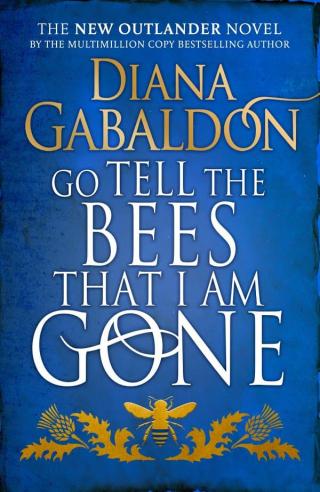
Go Tell the Bees That I Am Gone
- Автор: Гэблдон Диана
- Серия: Outlander #9
- Год: 2021
- Язык: английский
- Год: Delacorte Press
- ISBN: 978-1-473-51900-8
- Жанр: Исторические приключения

Электронная книга - «Go Tell the Bees That I Am Gone». Краткое содержание книги:
The past may seem the safest place to be . . . but it is the most dangerous time to be alive. . . .
Jamie Fraser and Claire Randall were torn apart by the Jacobite Rising in 1746, and it took them twenty years to find each other again. Now the American Revolution threatens to do the same. It is 1779 and Claire and Jamie are at last reunited with their daughter, Brianna, her husband, Roger, and their children on Fraser’s Ridge. Having the family together is a dream the Frasers had thought impossible. Yet even in the North Carolina backcountry, the effects of war are being felt. Tensions in the Colonies are great and local feelings run hot enough to boil Hell’s teakettle. Jamie knows loyalties among his tenants are split and it won’t be long until the war is on his doorstep. Brianna and Roger have their own worry: that the dangers that provoked their escape from the twentieth century might catch up to them. Sometimes they question whether risking the perils of the 1700s—among them disease, starvation, and an impending war—was indeed the safer choice for their family. Not so far away, young William Ransom is still coming to terms with the discovery of his true father’s identity—and thus his own—and Lord John Grey has reconciliations to make, and dangers to meet . . . on his son’s behalf, and his own. Meanwhile, the Revolutionary War creeps ever closer to Fraser’s Ridge. And with the family finally together, Jamie and Claire have more at stake than ever before.
“You’re a Friend?” he said.
“I am,” she replied, and nodding toward Silvia, “as is my friend, Silvia Hardman.”
“Be welcome,” he replied, bowing low to each lady in turn, and lower still to Jenny. “Madam, I am honored.”
“Well, I’m no a Friend myself, sir,” she said. She eyed his feathers and jewelry. “But I’m friendly.” For the moment, her face said plainly.
Brant smiled at that—a genuine smile that reached his eyes.
“I am relieved to hear that, madam. I think I shouldn’t care to have you for an enemy.”
“No, you wouldna,” Ian assured him, straight-faced. “But by good fortune, we all come in peace. My uncle sends ye a token of his friendship.”
Jamie and Ian between them had decided on the gift for Brant, and Ian had had it made in Philadelphia: a handsome inkwell whose heavy crystal was banded with silver, this stamped with the four triangles that symbolized air, earth, fire, and water, and had upon the cap the two triangles lying atop each other, pointing in different directions, that stood for “all that is.” With it was a quill, also banded with silver, made from the forefeather of a great horned owl, supplied by Jamie.
Brant looked at the feather with interest, then at Ian. It was the first feather of the wing, the barbs shorter at one side, so that the feather had a long indented curve at the leading edge, while the barbs on the trailing edge were serrated, like a comb. It was this that let an owl fly silently, with no hint of its presence until it dropped suddenly out of the night to seize its prey. As a present, such a feather might be taken as compliment—or warning. Owls were a symbol of wisdom—but also might be harbingers of something dire or dangerous.
A woman had appeared in the wide doorway behind Brant, smiling. She was dark-haired and pretty, wearing a European dress in sprigged red calico, with a white fichu secured with a gold brooch in the shape of a butterfly.
“My dear,” Brant said, bowing to her with an elegant assumption of London manners, “may I present Okwaho, iahtahtehkonah, and his wife and mother? And their companion,” he added, with another bow toward Silvia. “My wife, Catherine,” he ended, with what seemed a rather casual flourish toward the woman in red, who gave him a sharp look but resumed her smile as she curtsied to the travelers.
She looked astonished when none of the women returned her salute, and she glanced at her husband, as if to ask whether he took note of this rudeness.
“They’re Quakers,” he said, with a small shrug, and her shoulders relaxed.
And Jenny Murray wouldn’t curtsy to the King of England, let alone a man she thinks is a Royalist assassin, Rachel thought, but kept her face pleasantly blank.
Catherine looked dubiously at Jenny, who could look inscrutable when she cared to, but wasn’t doing it at the moment. Mrs. Brant decided the younger women might be more approachable and turned to them, beckoning them to the table where tea was laid and bidding them to sit down.
“Are either of you by chance a peace-talker?” she asked, smiling as she took her own seat.
“I doubt it,” Rachel said cautiously, and looked at Silvia, who shook her head.
“I’m not,” she said, “but I have heard of them.” She turned to Rachel in explanation. “Since Friends are known to be impartial and dedicated to peace, some have been invited to conduct negotiations between … people in conflict?” she ended, with a dubious look at Catherine Brant.
“Yes, that’s right.” Mrs. Brant poured the tea through a silver strainer with flower-work around its rim, and a fragrant, half-familiar steam rose like a ghost.
“Tea!” Rachel said, involuntarily, then blushed. Thayendanegea grinned at her through the steam.
“It is,” he said, and raised one eyebrow. “Do I take it that you have not encountered tea in some time?”
That was a delicately pointed question. Ian was ready for it, though; he’d told Rachel that he meant to make no bones regarding politics, as there was no knowing how much Thayendanegea knew about them already.
“We have not,” Ian said easily, taking a bun from the flowered china plate offered him by a servant. “It makes my uncle sneeze.”
Brant’s eyes creased with humor.
“I have heard of your uncle,” he said. “‘Nine-Fingers,’ he’s called among some of the Iroquois?”
Rachel hadn’t heard that one, but either Ian had or he hid his surprise.
“Aye. The Tsalagi call him ‘Bear-Killer.’”
“A man of many names,” Brant said, amused. “And General Washington calls him friend, I believe.”
“He is a friend to liberty,” Ian said, with a shrug.
“It’s fine tea, to be sure,” Jenny said to Mrs. Brant, though she set her cup down undrunk. “And a handsome house. Have ye lived here for some time?”
Rachel didn’t know whether the word “liberty” was a signal agreed upon between mother and son, or merely the natural rhythm of a conversation that must necessarily hover between politics and politesse, but Catherine Brant answered Jenny’s question, and the women passed easily into talk about the house, the furnishings, and then—by way of the china patterns—food, at which point the conversation became truly cordial.
Despite a genuine interest in corn soup and frybread, Rachel kept an ear on the men’s conversation, which ranged easily between English and Mohawk. She caught a name now and then—she recognized Looks at the Moon’s Mohawk name, and “Ounewaterika,” the name the Indians gave General Lee. And then her ear caught the name she had been waiting for. Wakyo’teyehsnonhsa.
She tried not to listen and forced herself not to look at Ian. She felt, rather than saw, Jenny’s sharp glance at him.
It didn’t last long, whatever was being said about the woman, for after a little, Brant turned to her to ask after her brother, Denzell, whom he had met briefly in Albany, and the eddies of the table’s conversation converged into a smooth current.
Smooth enough, now that Works With Her Hands had been momentarily dealt with, that Rachel could draw breath and consider the peculiarities of this table and the man who owned it, who was chatting in the most amiable fashion now with Silvia Hardman, about turkeys.
How could they be sitting here, engaged in the most ordinary sorts of conversation, opposite a man of whom it was said that he had killed, and ordered to be killed, numbers of people?
You not only sit down to dinner with Jamie Fraser, you love and respect him, her inner light pointed out. Has he not done the same things?
Not to innocent people, she thought stubbornly. Though in fairness, she knew well enough that anything might be said of a man, without its necessarily being true.
And both of them have done what they’ve done because it’s war, I suppose … Her inner light was skeptical, but retreated at a sudden shift in the talk.
Brant had said something to Ian in Mohawk, in a casual tone, but with a sidelong glance at Rachel that made the hairs of her scalp prickle. Ian deliberately turned to one side, so she couldn’t see his face, and said something in the same language that made Brant laugh.
She became aware that Jenny, beside her, was giving Brant a very narrow look. And that Catherine Brant was watching them over the rim of her teacup, one brow raised. Seeing that Rachel had noticed, she set down the cup and leaned forward a little.
“He said that if Wolf’s Brother should find that he couldn’t keep two wives, he should know that Works With Her Hands has eighty-five acres of good bottomland in her own name—she is very good at farming. But Wolf’s Brother should not fear for your future”—she smiled at Rachel—“because a good peace-talker would be welcome at any hearth and Thayendanegea would himself offer to keep you.”