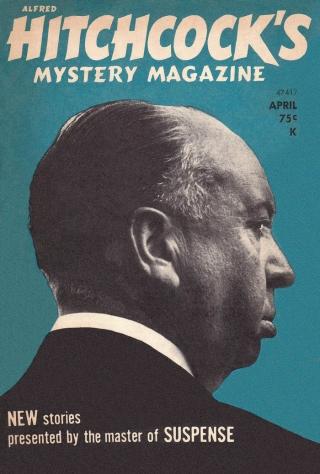
Alfred Hitchcock’s Mystery Magazine. Vol. 17, No. 4, April 1972
- Автор: Breese Edward Y., Бриттен Уильям
- Год: 1972
- Язык: английский
- Год: H.S.D. Publications
- Жанр: Другие детективы

Электронная книга - «Alfred Hitchcock’s Mystery Magazine. Vol. 17, No. 4, April 1972». Краткое содержание книги:
Phil didn’t know it, but Sam put all job applicants who answered his Help Wanted ads to work. He told them all that they looked like salesmen. What he meant was, they looked like pigeons ready for the plucking. The word Sam used was “mooches.” A real salesman wouldn’t have been caught dead working for Sam — but then real salesmen knew better than to answer his ads.
Phil was green. He was respectful and eager and painfully anxious for a job — any job. Since his old firm was sold he’d found out life wasn’t easy for a forty-eight-year-old unemployed general office worker. Phil and Janey were very cheerful with each other these days. Still, they were both beginning to panic a little as the savings account continued to melt away. Phil really was a prime pigeon for Sam’s style of plucking.
“We’ve got the best product package in town for selling door-to-door,” Sam said. “Look at them: as pretty a little combination TV and radio as you ever saw, and a portable sewing machine. Look at the labels: U.S. made, they say; one year guarantee. Nobody else in this city can offer a deal like our magic combo.”
Sam was right. Nobody could — and neither could he. The machines he sold had American brand names but they were made behind the Bamboo Curtain where any label can be used. They cost him $37.95 each at the dock. By the time they fell apart or blew up, Sam would be long gone. Phil would still be around.
“Yes, sir, Phil,” Sam said. “With these twins the world is your oyster. You sell two for the price of one. Why, some of my best men knock off an easy five hundred dollars every week in commissions. The buyers will snatch ’em out of your hands.
“These cost me $50 each. I got a friend who gets them for me. You sell the pair for $299.95, and everything over $200 is your commission. You collect that for down payment and put it right in your pocket every day. No waiting and no expense. We drop-ship, supply your sales literature, cards and printed guarantees. All you do is get out and sell. Nobody can beat that deal. Of course if you cut price to make a deal, that’s strictly your business. The cut comes out of your end.”
“It sounds all right,” Phil said.
“All right? It’s the chance of your life, Phil boy. It’s old Opportunity knocking with a satchel full of C-notes. The best ever.
“Just one more thing,” Sam continued. “Your demonstrator kit. These are special, high-grade machines I sell you at my cost of $175 for the whole kit, including supplies. That’s my cost and I let you have it for that because I’m sure you’re gonna be a star salesman.”
The demonstrators actually were specially made and of good quality. He wouldn’t have dared trust his real product to a salesman. In untrained hands they’d have gone bad the first day.
“I don’t know about $175 all at once,” Phil had to say.
Sam noted the threadbare suit. “Okay, then, just gimme fifty bucks now and pay the rest outta your commissions.”
“I’m too softhearted for my own good,” Sam told his current heart-throb, Daisy, that night in a bar. “Besides, some of them mooches really don’t have the whole ante in one bite. They’re honest, though. I can trust ’em to get it up later.”
“What good will a little creep like that do you anyway?” the practical-minded Daisy asked.
“On the average they’re good for about six deals apiece with friends and neighbors,” Sam said. “Also the profit on the demonstrators. I got twenty on the streets now. In two months they give up and I hire twenty more.”
For Sam the whole thing was strictly routine. He had no illusions about Phil having real sales ability. He had no illusions about anything at all. The people he preyed upon kept him in smooth silk suits and smoother women. The only problem was, the tic under his eye kept getting worse. It was the closest thing he’d ever have to a conscience.
Phil took things more seriously than most of those Sam hired. Sam should have foreseen that sooner or later somebody would, but he hadn’t. The bourbon and the women took up too much of his attention.
Phil had read somewhere that real salesmen “thought big,” and that’s what he started to do — which is why Sam tried to kill him.
What Phil did was forget his relatives and go look for a volume buyer. After all, he had a whale of a price for a radio-TV-sewing machine combo.
He went on thinking big while he took his briefcase, demonstrators and sincerity to see the purchasing agent at Leopold’s Department Store. The demonstrators sold themselves. Phil came out with an order for five hundred “guaranteed, American name-brand combos” at $225 each.
In the morning Phil was first in line at the bank to deposit the down payment before he went to tell Sam the good news.
Sam would rather have been handed a live grenade with the pin out than that contract. As soon as he read it he knew he had to deliver 500 sets of good machines or go to jail. He couldn’t palm off his junk on Leopold’s. They’d put him behind bars if he tried to back out — or Phil would. If he tried to run, there’d be warrants out.
He didn’t even have the money to buy good machines and fill the order at a loss. His credit wasn’t good anywhere at all. He’d have taken the loss to stay out of jail if he could.
No matter which way he looked Sam was face-to-face and eyeball-to-eyeball with disaster. He was so stunned he even let Phil get away without throwing him out the window of the eleventh floor office.
Eight hours and seventeen sour-mash bourbons later, Sam bought a gun — which he forgot to load — and went looking for Phil. When he tried to kick the door down he broke two of the bones in his right foot.
“I can’t understand it,” Phil told Janey and the cops.
It was all right, though. Inside of a week Leopold’s hired him, and he went right on thinking big till they made him a department head.
The Artificial Liar
by William Brittain
Many a case has hinged upon a “singing canary” but rarely upon one deceased.
Marley was dead, to begin with.
Major Orin Watkins, chief of security for the government’s Biological Research Center No. 27, was familiar with most of Charles Dickens’ works; however, he never expected to have Marley’s demise reported to him in his official capacity. Dickens’ A Christmas Carol, he believed, should be left to 19th Century London. There was no place for the defunct partner of old Scrooge in The Center, a thoroughly modern complex of buildings occupying almost a hundred acres, where chemists and biologists with astronomical IQ’s spent their working hours developing vaccines and antitoxins against diseases that in some cases hadn’t been developed yet.
Life had been simpler for Scrooge; he had never heard of germ warfare, but it’s unlikely that the old miser, had he put in an appearance, could have come within fifty feet of the gates. It would have been the job of Orin Watkins’ men to keep him away from The Center. Those who did enter were constantly screened to within an inch of their lives. Orin himself was required to present the proper passes to the guard at the gate each day. No, Scrooge, Bob Cratchet, et al. were far better off nestled between the covers of a book.
Still, old Marley was as dead as a doornail.
Orin looked across the desk at the small man seated opposite. Augustine Lanier, his wrinkled old face reflecting anxiety and puzzlement, might have been himself a Dickens character. Not Scrooge, of course, not even Micawber. Augustine was too kindly for the one and too slender for the other. Barkis, that was it. Augustine was the very image of Barkis as Orin pictured the old wagoner after reading David Copperfield. Even though he was little more than a file clerk at The Center, Augustine was the most conscientious of workers. Like Barkis, Augustine, too, was willin’.