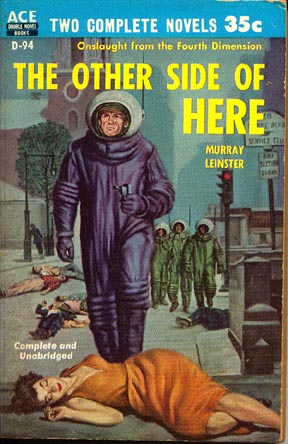
The Other Side of Here
- Автор: Лейнстер Мюррей
- Язык: английский
- Жанр: Научная фантастика

Электронная книга - «The Other Side of Here». Краткое содержание книги:
Newark ... Manhattan ... Baltimore—one by one they went out. A succession of thriving communities suddenly put out like a guttered flame—men, women, children sprawled like grotesque mannikins.
Steve Waldron knew it couldn't be plague. There had to be some connection with the disappearance of the nation's top scientists. And then he plunged to the very center of a dead city and gaped at a truth he could not believe. What could he do against so fearsome a force that threatened to engulf the whole nation?
Here's a spine-tingling science-fiction novel by an old master. It will open up a new dimension of suspense and excitement.
The decorative floor was fouled with mud and clay and discolored bits of glass. The sound of motors was a subdued thunder within the enclosure. The trucks kept coming in, moving past men who barked at the drivers in some strange language. The soda fountain had been torn out and hauled away. Ends of the piping still flowed streams of water, to which nobody paid any attention whatever. The newsstand, of course, was destroyed.
But in the room thus enlarged, a platform of rough wooden planks had been built up, perhaps a foot and a half from the floor, with a ramp leading to it. The platform was itself the floor of an open-ended cage. The Sides of the cage were bars of polished metal all of an inch thick, which wound round and round and under the platform to form a hollow spiral—not unlike a gigantic spring—into whose open, farther end the trucks rolled as they mounted the platform.
And in that spiral, they vanished, like the blown-out flames of candles.
They came growling into the huge room. They rolled across the untidy mess their predecessors bad tracked into the building. Then they shifted gears and went ponderously up upon the platform, inside the wide-spaced coil of metal bars. And then they flickered and were not. Truck after truck, loaded with all manner of loot, they filed into this building and into the colossal, cryptic device. And in it they seemed to fade into thin air and were gone....
Heavy copper cables led to the helical cage. A queer, unearthly, bluish wild fire seemed to play all about the platform. A heavy-duty long-haul truck, packed with machinery, rolled up on the platform. It was followed by a smart, light delivery truck from an expensive grocery. The one behind that was worn and dilapidated, with streaks of fabric showing where the tread of the tires should have been.
But each truck was as heavily burdered as its body would hold, and each one was driven by a man who wore curious, scaly armor. And each vehicle rolled upon the clumsy platform inside the coil-like bars, and when it got there it flickered and was not—and then there was room for another.
The flickering fire seemed half solid—no, not half solid but half phantomlike. It shimmered in an uncanny fashion, in an incalculable combination of many rhythms. At times Waldron had the feeling that it was not merely flame or luminosity. It was something else.
He watched one certain spot. The blue glow came and went. But when it was present and when it was strongest, it had a definite pattern impressed upon it. That pattern moved. Presently Waldron saw a man's face in it. It came back and the man had shifted his position. It looked almost as if colored motion pictures were being thrown upon a screen of smoke which wavered and vanished and appeared again irregularly. It was as if something impressed a deep-blue tint upon all the projected image, and the smoke which served as screen appeared only in patches and flecks, and nowhere showed a complete picture.
Lucy drew back to look bewilderedly at him. The light that came out of their peephole showed his face clearly enough. His eyes were glowing in deep satisfaction.
"Steve!" she whispered. "I don't understand!"
"Those pictures you see," he whispered in reply, "they're actually views of Fran Dutt's world—of the other side of here. The trucks go through and small bits of light come back. We're seeing where Fran came from. In case of need, now, we might even invade that world to get back the people and things that have been carried there."
He watched an instant longer. Knowing or guessing at the full meaning Waldron meant to convey, Lucy gazed again at the fragmentary scenes. Her father, Waldron said, was most likely in that world she now saw in fragments of bluish-tinted scene. She looked upon an enigmatic planet which was not Earth and yet was Earth, which was in what might be called a fourth dimension and yet was bounded absolutely by the common three. She gazed with totally illogical intensity as if hoping for a sight of her father.
But the shimmering, flickering vision, such as might come from a television set with something not working quite right in its innards, showed only scraps of what was to be seen. She saw torches flaring—but only intermittently. Once she saw a truck which was of Earth. She even remembered its huge and sleekly shining shape. It had rolled up on the platform and vanished a bare two minutes since. Now she saw its image in those phantom bluish flames, with men swarming about it. It had vanished and yet it existed. It did not exist on this earth, but it did exist on another earth which was in the same space as this earth.
In a low voice, Waldron said: "We'll go."
Again he led the way. But now it was Lucy who kept a wary watch. Waldron seemed so engrossed in the meaning of what he had seen that he would have walked straight toward the line of trucks if she had not stopped him. That, of course, was after they had moved through blackness well away from the building of the helix and the platform.
But at her whispered word he came back to himself. Then he was all awareness of the crime and the silence which spread in every direction save where the truckloads of loot moved toward envanishment.
They've got a line of trucks coming down from Belleville and another one out yonder." He waved his arm in the blackness. They can loot only so far, or the military cordon around the town will hear. What I've got to do is—" Then he said half aloud to himself: "Professor Hamlin will do! Lucy, I know where he lives. He's a big enough name to make anybody listen, and he'll have to accept what I can tell him. I can prove it. We find him and I explain—"
"Steve! He's—he's like everybody else—"
"Naturally! But if I can't revive him I'm in a bad fix, and if I can it's conclusive. The first thing is to get to him. We have to edge around..."
He chose a new course. But he was no less absorbed in the meaning of the thing he had seen. Up to this moment, all the events dating from the first phone call from Fran Dutt had seemed ominous. Bit by bit they did fit into a sort of hypothesis he had built up. But now he had seen something which made that hypothesis quite different from a guess. Now he knew it was an explanation—the explanation of all that had happened.
He talked under his breath as he and Lucy fumbled then-way through the blackness of the immobilized city. The tumbled figures they stumbled upon and the disasters they skirted were not gruesome, now. They were inspiring of horror and of a monstrous fury. Waldron filled in what he knew with what he had guessed before. From there he went on to what could not be proved by evidence but which by the nature of things had to be accepted as true.
There was another planet occupying the same space as Earth. Straussman's Theory was correct. This other planet must be very nearly the same size, and it must contain the same elements in the same proportions. Undoubtedly, its atmosphere and oceans and clouds resembled those of Earth. And Waldron, stumbling as silently as he could through the stillness of death, grew utterly absorbed in speculations in his own specialty of biology.
If there were occasional interchanges of biological specimens, the existence of animal and plant species on Earth without any clear line of ancestry could be understood. It was certainly conceivable that such exchanges had taken place in cataclysms of one sort or another. In such a case, the peopling of one world from the other could be accounted for, and the fact that Fran Dutt and his compatriots were human would be accounted for. As a matter of scientific theorizing, Straussman's Theory could even be right in more than merely claiming that there could be two worlds existing in the same place at the same time. There should be three, at least. There might be six or eighteen or fifty-four....
While Waldron talked, he made a huge circling movement around the part of the city receiving the immediate attention of the men in scale armor. However, the prospects he envisioned went beyond the mere reversal of the monstrous crime which surrounded him.