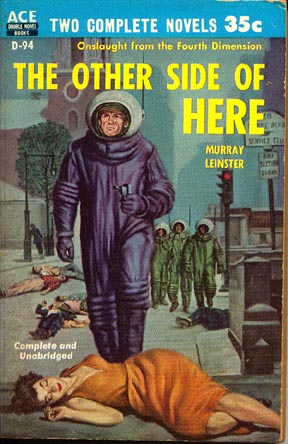
The Other Side of Here
- Автор: Лейнстер Мюррей
- Язык: английский
- Жанр: Научная фантастика

Электронная книга - «The Other Side of Here». Краткое содержание книги:
Newark ... Manhattan ... Baltimore—one by one they went out. A succession of thriving communities suddenly put out like a guttered flame—men, women, children sprawled like grotesque mannikins.
Steve Waldron knew it couldn't be plague. There had to be some connection with the disappearance of the nation's top scientists. And then he plunged to the very center of a dead city and gaped at a truth he could not believe. What could he do against so fearsome a force that threatened to engulf the whole nation?
Here's a spine-tingling science-fiction novel by an old master. It will open up a new dimension of suspense and excitement.
Waldron turned on the truck's headlights to their brightest, and he and Lucy fled. But he risked a few brief seconds to flash the light on and off again, three short flashes of light, and three long ones, and three short ones again. Presently men would become aware that there was life in the dead, still city of Newark.
During the racketing flight from downtown, Waldron had kept his original purpose in mind. The placing of the truck had its purpose. Its lights would not be visible from where the looting was busiest. But now or soon there would be a deadly hunt for whoever had killed the two officer-leaders. If it was true that all of them carried metal-tipped whips and used them so arrogantly and mercilessly as Waldron had seen, then it was apparent that a hideous division of castes existed among the invaders. Unbearable brutality was probably practiced upon the lower castes by the higher. Therefore, there was a good chance that the killings would seem more nearly mutiny than the result of an outsider's action. Time might be lost in the attempt to find out who was in revolt. There might be harsh punishments to prevent the idea of mutiny from spreading. The consequence would be to create a greater tendency to mutiny. In short, Waldron might have performed a successful guerilla operation against Fran Dutt's compatriot army.
But his purpose was something more and better than that. He knew his way about the city. Within half an hour after leaving the truck—and actually before it was found and its lights turned off—Waldron had opened an unlocked back door of the residence of Professor Hamlin.
He and Lucy went inside. They had a peculiar, insistent discomfort that they were acting like burglars. This was a private home, and they did not feel they had a right to be in it. Moreover, it was even blacker inside the house than outside. The sensation of intrusion and furtiveness in the dark was almost intolerable. It was not until Lucy, remembering the hour at which the "plague" had struck, suggested the dining room that they were able to find the professor.
Waldron struck a match, while Lucy drew the heavy curtains which the elderly scientist's wife had put up a good ten years before her death. There was a candelabra stick on a mantel and Waldron lighted a candle.
Professor Hamlin, portly, white-haired and austere, was pompous even in his own home. He had been seated at table, in the act of raising a spoonful of soup to his lips, at the moment he was stricken lifeless. His arm had frozen halfway. His lips were pursed to open. He looked grotesque. He looked ridiculous. The soup had dried in the spoon. The plate before him contained only a gummy mess.
Waldron unslung his own high-frequency pack, depending only on the scaly armor for his own continued life. He fitted the pack to the body of the portly scientist whose assistant he had been. He turned it on.
The scientist moved in the candlelight. He continued the gesture he had begun forty-eight hours before. His spoon was empty. Then his eyes widened in stark, blank incomprehension. The lights were out. He became aware of the single flickering candle in the room. And there was a strange figure in improbable armor, and a girl with dusty clothing....
It was minutes before he could recognize Waldron clothed in the eccentric garb. It was a long time before he could believe Waldron's story. He had no sense whatever of any time-lapse. It was necessary for him to peer out of his house at unlighted streets and dark houses, listen to the horrifying silence of Newark, before he could begin to believe. Then he found a flashlight and discovered his servants' stone-hard bodies, and he was sure they were dead....
Lucy convinced him, finally, by indicating the motionless tropical fish in the professor's aquarium. She lifted one out and held it in her hand. Suddenly revived by the high-frequency current, it flapped wildly. She dropped the fish back into the tank and it was still and frozen again.
Then the scientist really listened, while brushing clouds of dust from his sleeve.
"I see," he said profoundly, at last. "What you tell me is impossible according to all preconceived notions, but it is apparently true. Straussman seems to have been right. I know that Professor Blair was inclined to accept his theories. My dear, have you heard anything of your father?"
Lucy said bitterly: "He's in that other world we saw—the one the trucks all go to."
"I shall go," said Professor Hamlin soberly, "to this military cordon you have told me about. I shall identify myself. And I will be proof that some hundreds of thousands of people are not dead. In this contrivance you have put on me, Steven, I shall have evidence that others can be revived. I should think that a regiment or two of soldiers, equipped as I am, would handle things nicely, eh?"
"They should," said Waldron dourly. "But you'll have to be extremely careful, Professor! Everybody's trigger-happy!"
Professor Hamlin rose with dignity. With even greater dignity he put on his hat and a light topcoat. Lucy blew out the candle and with Waldron followed him out of the house.
The utter darkness of Newark and the fainter glare in the sky which was New York and Jersey City were further proofs of the incredible. Almost beyond the professor's front door they came upon a pathetic bundle on the ground. A boy and girl—high-school children—had been talking together. They had fallen side by side. Professor Hamlin recklessly struck a match. He saw their faces.
"Girls," said Waldron grimly, "are being loaded on trucks and carried to that other world. This girl is pretty enough—"
Professor Hamlin said with dignity: "It shall be stopped!"
And Waldron and Lucy walked with him downhill and toward the place where there would have to be soldiers, watching lest anyone go into or try to come out of a city that seemed both dead and deadly.
It was a long walk, and Professor Hamlin grandly took the initiative. He made Waldron feel that he was merely a subordinate, again. But he did ask questions, and he did agree that for them to move on foot was preferable to taking any of the available cars. A car could be heard in motion, especially when starting. But toward the end of the hike his feet were beginning to hurt. But then, a little later, they saw a bonfire burning in the middle of a street. All the houses, all along the way, had been dark and still.
"Ha!" said Professor Hamlin profoundly. "There is the cordon—and about time! I shall approach it alone, Steven. And I think I can promise you that within twelve hours there will be adequate action taken to end this terrible catastrophe."
"Better not mention my name," said Waldron cynically. "At least not until you have to. I'm guilty by association with what's happened here."
Professor Hamlin shook hands, impressively.
"And be sure to call ahead when you go up to the cordon," Waldron added. "They've orders to shoot anybody who tries to come out. You'll have to argue with them."
"They will not shoot me," said Professor Hamlin, confidently.
But they did.
Waldron saw it happen. The portly figure of the scientist moved away from him through the darkness. A long time later, they heard him speak. It sounded peculiar, as if he were raising his voice in the manner of a lecturer filling a large hall.
There was a sudden flare of light. A spotlight on a car flicked on. A thin lance of light shot out and outlined the impressive, dignified figure. The professor waved his hands and walked forward. Somebody shouted back to him. The tone was commanding. Professor Hamlin halted. The other voice rasped commands, obviously commands that the man retrace his steps. Professor Hamlin replied indignantly. He moved deliberately, impressively forward.
There was an outburst of tiny sparks: the tearing rat-tat-tat of small-arm fire. Outlined in the spotlight beam, Professor Hamlin fell and lay still.
The two far back in the darkness were stunned. The spotlight flickered about, searching. It stopped at one spot where something could be mistaken for a human figure. The guns rasped again. The object was a tree trunk. The spotlight continued to search.