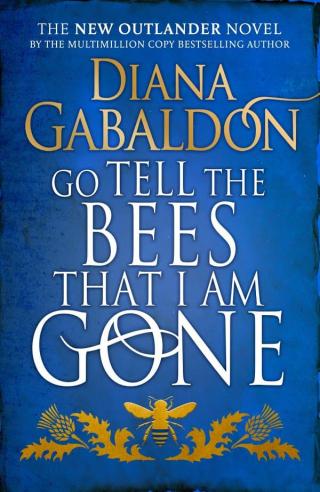
Go Tell the Bees That I Am Gone
- Автор: Гэблдон Диана
- Серия: Outlander #9
- Год: 2021
- Язык: английский
- Год: Delacorte Press
- ISBN: 978-1-473-51900-8
- Жанр: Исторические приключения

Электронная книга - «Go Tell the Bees That I Am Gone». Краткое содержание книги:
The past may seem the safest place to be . . . but it is the most dangerous time to be alive. . . .
Jamie Fraser and Claire Randall were torn apart by the Jacobite Rising in 1746, and it took them twenty years to find each other again. Now the American Revolution threatens to do the same. It is 1779 and Claire and Jamie are at last reunited with their daughter, Brianna, her husband, Roger, and their children on Fraser’s Ridge. Having the family together is a dream the Frasers had thought impossible. Yet even in the North Carolina backcountry, the effects of war are being felt. Tensions in the Colonies are great and local feelings run hot enough to boil Hell’s teakettle. Jamie knows loyalties among his tenants are split and it won’t be long until the war is on his doorstep. Brianna and Roger have their own worry: that the dangers that provoked their escape from the twentieth century might catch up to them. Sometimes they question whether risking the perils of the 1700s—among them disease, starvation, and an impending war—was indeed the safer choice for their family. Not so far away, young William Ransom is still coming to terms with the discovery of his true father’s identity—and thus his own—and Lord John Grey has reconciliations to make, and dangers to meet . . . on his son’s behalf, and his own. Meanwhile, the Revolutionary War creeps ever closer to Fraser’s Ridge. And with the family finally together, Jamie and Claire have more at stake than ever before.
“How … cozy. Have you had any breakfast?” William asked, raising one brow.
“No, it isn’t ready yet.”
“Neither have I,” he said, getting to his feet. “Though I’m not quite as hungry as I was before you told me that.” He glanced down at his waistcoat. “Have I any dung beetles in this noble assemblage?”
That made her laugh.
“No, you haven’t,” she said. “Not nearly colorful enough.”
Amaranthus was suddenly standing quite close to him, though he was sure he hadn’t seen her move. She had the odd trick of seeming to appear suddenly out of thin air; it was disconcerting, but rather intriguing.
“That bright-green one,” she said, pointing a long, delicate finger at his middle, “is a Dogbane Leaf Beetle, Chrysosuchus auratus.”
“Is it, really?”
“Yes, and this lovely creature with the long nose is a billbug.”
“A pillbug?” William squinted down his chest.
“No, a billbug,” she said, tapping the bug in question. “It’s a sort of weevil, but it eats cattails. And young corn.”
“Rather a varied diet.”
“Well, unless you’re a dung beetle, you do have some choice in what you eat,” she said, smiling. She touched another of the beetles, and William felt a faint but noticeable jolt at the base of his spine. “Now here,” she said, with small, distinct taps of her finger, “we have Ash Borer, a Festive Tiger Beetle, and the False Potato Beetle.”
“What does a true potato beetle look like?”
“Very much the same. This one’s called a False Potato Beetle because while it will eat potatoes in a pinch, it really prefers horse nettles.”
“Ah.” He thought he should express interest in the rest of the little red-eyed things ornamenting his waistcoat, partially to repay her kindness in embroidering them but more in hopes that she’d go on tapping them. He was opening his mouth to inquire about a large cream-colored thing with horns when she stepped back in order to look up into his face.
“I heard my father-in-law talking to Lord John about you,” she said.
“Oh? Good. I hope they’d a fine day for it,” he said, not really caring.
“Speaking of False Potato Beetles, I mean,” she said. He closed his eyes briefly, then opened one and looked at her. She was perfectly solid, not wavering in the slightest.
“I know I’m a trifle the worse for drink,” he said politely. “But I don’t think I resemble any sort of potato beetle, regardless of my uncle’s opinion.”
She laughed, showing very white teeth. Maybe she didn’t drink coffee …
“No, you don’t,” she assured him. “The dichotomy just reminded me of what Father Pardloe was saying—that you wanted to renounce your title, but couldn’t.”
He felt suddenly almost sober.
“Really. Did you happen to overhear the reason?”
“No,” she said. “And it’s not my business, is it?”
“Evidently you think it is,” he said. “Or why are you mentioning it?”
She bent and plucked a small bunch of grapes out of the trug, offering it to him. Moira, he noticed, had gone about her business.
“Well, I thought that if that’s truly the case … I might be able to suggest something.”
With an odd sense of exhilaration, he took the grapes and asked, “Such as?”
“Well,” she said, as reasonably as though she were describing the eating habits of a firefly, “it’s quite simple. You can’t renounce your title, but you could hand it on. Abdicate in favor of your heir, I mean.”
“I haven’t an heir. Are you suggesting—”
“Yes, exactly.” She nodded approvingly at him. “You marry me and as soon as I have a son, you can give him your title, and either retire into private life and breed dachshunds or perhaps pretend to commit suicide and go off to become anyone you like.”
“Leaving you—”
“Leaving me as the dowager countess of whatever your estate is called, I forget. That might be slightly better than being the Duke of Pardloe’s penurious daughter-in-law, mightn’t it?”
He took a deep breath. Coffee was indeed on the wind, and so was bacon, but he’d suddenly lost interest in food. He stared at her. She cocked one smooth blond eyebrow.
“And what if your next child is a daughter?” he said, to his own surprise. “And the one after that? It seems to me that I should be in substantial danger of ending with a—a—hareem of girls, all in need of dowries and marriages, and myself still a bloody earl.”
Her brow wrinkled slightly.
“What’s a hareem?”
“It’s what Arab sheiks do to leaven the monotony of marriage, or so I’m told. Polygamy, I mean.”
“Surely you don’t mean to imply that you think being married to me would be boring, William.” The shadow of a dimple flickered in her cheek. “But as for hareems, nonsense. You needn’t marry me straight off, you know. We’d give it a go, and if the result is male, then you marry me, acknowledge the child, and—” She gave a flick of her hand in a silent “voilà.”
“I don’t believe I am having this conversation,” he said, shaking his head violently. “I really don’t. But for the sake of argument, just what the devil do you propose doing if the result, as you so casually put it, is female?”
She pursed her lips and turned her head to one side, considering.
“Oh, I can think of a dozen things at least. The simplest would be for me to go abroad at the first suggestion of pregnancy—I should do that in any case, as we wouldn’t be married yet—and pretend to be a wealthy widow. Then—”
William uttered a noise that he’d meant to be a laugh, and she raised a palm to suppress him, continuing serenely, “And then, if the child were to be a girl, I should simply come back with the little darling (for I’m sure any child of yours would be adorable, William) and announce that a good friend of mine had died in childbed and that I had adopted her daughter, out of charity, of course, but also to give my darling Trevor a sister.”
She lowered the palm and widened her eyes at him.
“That’s one way. I can think of others, if you—”
“Please don’t.” He didn’t know whether to laugh, shout at her, eat a grape, or just leave. Before he could decide, she’d done her illusion again and was pressed lightly against him, her hands on his shoulders, face beguilingly turned up.
“But you see,” she said reasonably, “there isn’t really any risk. To you, I mean. And you might”—her hand cupped his cheek, brief and cool as rain, and her forefinger traced his lips—“just possibly enjoy it.”
47
Tace Is the Latin for a Candle
JOHN HAD KNOWN THEY’D have to talk about Percy, but he’d succeeded in avoiding Hal until the next day, by the simple expedient of leaving his coat and gorget with Prévost’s cook and going down to the harbor while Hal was still talking to Old Bullet Head. There he hired a boat to take him fishing in the marshes. His guide, a local by the name of Lapolla, was very knowledgable, and John came in after dark, smelling of mud and marsh grass, with a sack full of redfish and a large, horrible thing called a horseshoe crab, which they had discovered—fortunately dead—on a tiny islet composed entirely of oyster shells.
He had eaten some of his fish, broiled over a fire on the beach and utterly delicious. Then, slightly drunk, he had stolen into Hal’s room around midnight and left the dead crab on the bedside table beside his sleeping brother, as a symbolic comment on the situation.
What with one thing and another, though, he didn’t encounter a conscious Hal until late the next afternoon, following a harrowing tea party at the home of a Mrs. Tina Anderson, who, while herself a tall, statuesque blond beauty possessed of great charm, was also possessed of a horde of chattering friends who had descended on him en masse, affectionately clinging to his sleeve or fingering his gold braid while expressing their gratitude for the army’s presence and their admiration of the courageous soldiers who were saving them—apparently—from mass rapine.