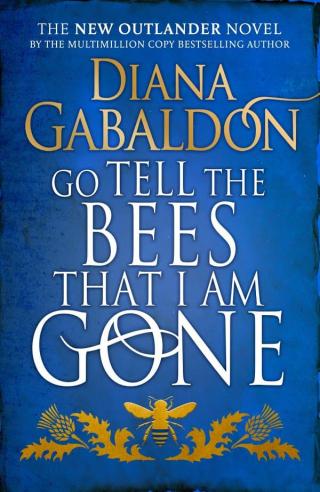
Go Tell the Bees That I Am Gone
- Автор: Гэблдон Диана
- Серия: Outlander #9
- Год: 2021
- Язык: английский
- Год: Delacorte Press
- ISBN: 978-1-473-51900-8
- Жанр: Исторические приключения

Электронная книга - «Go Tell the Bees That I Am Gone». Краткое содержание книги:
The past may seem the safest place to be . . . but it is the most dangerous time to be alive. . . .
Jamie Fraser and Claire Randall were torn apart by the Jacobite Rising in 1746, and it took them twenty years to find each other again. Now the American Revolution threatens to do the same. It is 1779 and Claire and Jamie are at last reunited with their daughter, Brianna, her husband, Roger, and their children on Fraser’s Ridge. Having the family together is a dream the Frasers had thought impossible. Yet even in the North Carolina backcountry, the effects of war are being felt. Tensions in the Colonies are great and local feelings run hot enough to boil Hell’s teakettle. Jamie knows loyalties among his tenants are split and it won’t be long until the war is on his doorstep. Brianna and Roger have their own worry: that the dangers that provoked their escape from the twentieth century might catch up to them. Sometimes they question whether risking the perils of the 1700s—among them disease, starvation, and an impending war—was indeed the safer choice for their family. Not so far away, young William Ransom is still coming to terms with the discovery of his true father’s identity—and thus his own—and Lord John Grey has reconciliations to make, and dangers to meet . . . on his son’s behalf, and his own. Meanwhile, the Revolutionary War creeps ever closer to Fraser’s Ridge. And with the family finally together, Jamie and Claire have more at stake than ever before.
“Mr. Ransom,” William said firmly, turning to see Denys Randall, uniformed and looking much more soigné in his toilet than on previous meeting. “Your servant, sir.”
He looked back and saw that Campbell’s party had come in but that Uncle Hal and his father had in the meantime somehow contrived to flank Prévost, behaving as though they were part of the official receiving line, greeting each of the London politicals—several of whom Uncle Hal appeared to know—with effusive welcome before Campbell could introduce them.
Smiling, he turned back to Denys.
“Any word of my cousin?”
“Not directly.” Randall snagged two glasses of sherry from a passing tray and handed one to William. “But I do know the name of the British officer who received the original letter with the news of your cousin’s death.”
“Colonel Richardson?” William asked, disappointed. “Yes, I know that.” But Denys was shaking his head.
“No. The letter was sent to Richardson by Colonel Banastre Tarleton.”
William’s sherry went down sideways and he choked slightly.
“What? Tarleton received the letter from the Americans? How? Why?” William’s last meeting with Ban Tarleton had ended with a pitched fight—on the battleground at Monmouth—over Jane. William was reasonably sure he’d won.
“I would really like to know that,” Denys replied, bowing to a gentleman in blue velvet across the room. “And I sincerely hope you’ll find out and tell me. Meanwhile, have you heard anything of our friend Ezekiel Richardson?”
“Yes, but probably nothing very helpful. My—father received a letter from a sailing captain of his acquaintance, who mentioned casually that he’d seen Richardson on the docks in Charles Town.”
“When?” Denys betrayed no open excitement at the news, but cocked his head like a terrier wondering whether he had just heard the scrabbling of a gopher underground.
“The letter was dated a month ago. No telling whether the captain saw the fellow then or sometime before. No hint that Schermerhorn—that’s the captain—knows that Ezekiel Richardson is a turncoat, by the way, so I suppose he wasn’t in uniform. Not an American uniform, I mean.”
“Nothing else?” The terrier was disappointed, but perked up again at William’s next bit of information.
“Apparently Richardson was with a gentleman named Haym. But he didn’t say anything about what they were doing, or who Haym might be.”
“I know who he is.” Denys kept control of his expression, but his interest was plain.
The conversation was interrupted at this point by the banging of a small gong and the butler’s announcement that luncheon was served, and he found himself separated as another acquaintance hailed Denys.
“All right, Willie?” His father popped up beside him as he made his way through the double doors of the reception room into a generous hall with a fantastic floorcloth of painted canvas, done in simulation of the mosaic of a Roman villa. “Has he found out anything about Ben?”
“Not much, but there may be something.” He hastily conveyed the gist of his conversation with Randall.
“He says he knows the man Richardson was seen with in Charles Town. Haym.”
“Haym?” Uncle Hal had caught up with them in time to hear this, and lifted an eyebrow at the name.
“Possibly,” said William. “You know him?”
“Not to say ‘know,’” his uncle said with a shrug. “But I have heard of a rich Polish Jew named Haym Salomon. I can’t think what the devil he’d be doing in Charles Town, though—the last I heard of him, he’d been sentenced to death as a spy, in New York.”
LUNCHEON WAS TEDIOUS, with small patches of aggravation. William found himself seated between a Mr. Sykes-Hallett, who seemed to be a Member of Parliament from someplace in Yorkshire, judging from his incomprehensible accent, and a slender, stylish gentleman in a bottle-green coat called Fungo (or possibly Fungus), who burbled about the brilliance of the Southern Campaign (about which he plainly knew nothing, nor did he notice the stony looks of the soldiers seated near him) and kept addressing William as “Lord Ellesmere,” though he’d been tersely invited to stop.
William thought he caught a sympathetic look from Uncle Hal at the adjoining table, but wasn’t sure.
“Do I understand correctly that you have resigned your commission, Lord Ellesmere?” the green fungus asked, between nibbles of poached salmon. “Colonel Campbell said that you had—some trouble about a girl? Mind, I don’t blame you a bit.” He raised a hair-thin eyebrow in a knowing fashion. “A military career is well enough for men who have capacity but no means—but I understand that you fortunately do not require to make your way in life at the cost—at least the potential cost—of your blood?”
William had been raised to exercise courtesy even in adverse circumstances, and thus merely took a forkful of the rabbit terrine and put it into his mouth instead of stabbing Fungo in the throat with it.
Now, had it been Campbell … but it wasn’t really Campbell’s malice that troubled him. He hadn’t realized how much it would bother him, not being a soldier anymore. He felt like an imposter, an interloper, a useless and despised lump, sitting here among soldiers in a waistcoat covered with fucking beetles, for God’s sake!
It was a large gathering, some thirty men, two-thirds of them in uniform, and he could feel the lines drawn between the civilians and the soldiers, clearly. Respect, certainly—but respect with an underlying scorn—on both sides.
“What a charming waistcoat, sir,” said the man across the table, smiling. “I admit to a great partiality for beetles. I had an uncle who collected them—he left his collection to the British Museum when he died.”
The man’s name was Preston, William thought—second secretary to the undersecretary of war, or something. Still, he wasn’t either sneering or leering; he had a strong though rather homely face, with a large, crooked nose that bore a pair of pince-nez, and obviously intended nothing more than friendly conversation.
“My cousin embroidered them for me, sir,” William said, with a slight bow. “Her father is a naturalist, and she assures me that they’re completely correct—save for the eyes, which were her particular fancy.”
“Your cousin?” Preston glanced at the next table, where Papa and Uncle Hal were engaged in conversation with Prévost and his two principal guests, a minor nobleman sent as a representative of Lord George Germain, the secretary of state for the colonies, and a dressy Frenchman of some sort. “Surely it is not the duke who is a naturalist. Oh—but of course, the uncle must be on your mother’s side?”
“Ah. No, sir, I have misled you. She is my cousin’s widow, my uncle’s daughter-in-law.” He tilted his head in the direction of Uncle Hal. “Her husband died as a prisoner of war in New Jersey, and she and her young son have taken refuge with … us.”
“My profound sympathies to the young woman, my lord,” Preston said, looking genuinely concerned. “I suppose her husband was an officer—do you know his regiment?”
“Yes,” William said, letting the “my lord” pass. “The Thirty-fourth. Why?”
“I am a very junior under-undersecretary of the War Office, my lord, charged with overseeing the support of our prisoners of war. Pitifully meager support, I am afraid,” he added, with a tightening of the mouth.
“In most cases, all I can do is to solicit and organize help from churches and compassionate Loyalists in the vicinity of the prisons. The Americans are so straitened in their means that they can scarce afford to feed their own troops, let alone their prisoners, and I blush to say that the same is often very nearly true of the British army as well.”