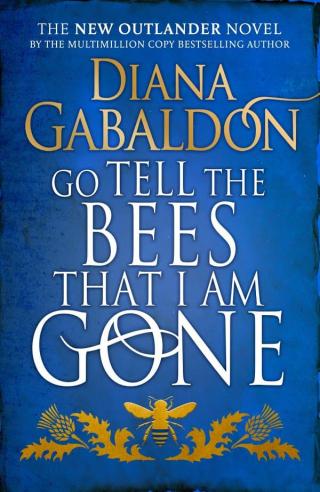
Go Tell the Bees That I Am Gone
- Автор: Гэблдон Диана
- Серия: Outlander #9
- Год: 2021
- Язык: английский
- Год: Delacorte Press
- ISBN: 978-1-473-51900-8
- Жанр: Исторические приключения

Электронная книга - «Go Tell the Bees That I Am Gone». Краткое содержание книги:
The past may seem the safest place to be . . . but it is the most dangerous time to be alive. . . .
Jamie Fraser and Claire Randall were torn apart by the Jacobite Rising in 1746, and it took them twenty years to find each other again. Now the American Revolution threatens to do the same. It is 1779 and Claire and Jamie are at last reunited with their daughter, Brianna, her husband, Roger, and their children on Fraser’s Ridge. Having the family together is a dream the Frasers had thought impossible. Yet even in the North Carolina backcountry, the effects of war are being felt. Tensions in the Colonies are great and local feelings run hot enough to boil Hell’s teakettle. Jamie knows loyalties among his tenants are split and it won’t be long until the war is on his doorstep. Brianna and Roger have their own worry: that the dangers that provoked their escape from the twentieth century might catch up to them. Sometimes they question whether risking the perils of the 1700s—among them disease, starvation, and an impending war—was indeed the safer choice for their family. Not so far away, young William Ransom is still coming to terms with the discovery of his true father’s identity—and thus his own—and Lord John Grey has reconciliations to make, and dangers to meet . . . on his son’s behalf, and his own. Meanwhile, the Revolutionary War creeps ever closer to Fraser’s Ridge. And with the family finally together, Jamie and Claire have more at stake than ever before.
“I, um, saw the garments you kindly had prepared for me,” William said, tactfully diverting the conversation. “I’m most appreciative, of course—though I don’t think I shall have occasion to wear them at present. Perhaps—”
“Gray will suit you very well,” Lord John said, looking happier when Moira came in and set down a glass of what smelled like coffee with whisky in it next to him. He nodded toward Amaranthus, seated across from William. “Your cousin embroidered the beetles on the waistcoat herself.”
“Oh. Thank you, cousin.” He bowed to her, smiling. “By far the most fanciful waistcoat I’ve ever owned.”
She straightened up, looking indignant, and pulled her wrapper tight across her bosom.
“They aren’t fanciful at all! Every single one of those beetles is to be found in this colony, and all of them are the right colors and shapes! Well,” she added, her indignation subsiding, “I’ll admit that the red eyes really were a touch of fancy on my part. I just thought the pattern required more red than a single ladybird beetle would provide.”
“Entirely appropriate,” Lord John assured her. “Haven’t you ever heard of licencia poetica, Willie?”
“William,” William said coolly, “and yes, I have. Thank you, coz, for my charmingly poetical beetles—have they names?”
“Certainly,” Amaranthus said. She was perking up, under the influence of tea and sausages; there was a tinge of pink in her cheeks. “I’ll tell you them later, when you’re wearing it.”
A slight but unmistakable frisson went through William at that “when you’re wearing it,” together with an instantaneous vision of her slender finger slowly moving from beetle to beetle, over his chest. He wasn’t imagining it; Papa had glanced sharply at Amaranthus when she said it. There was no sign of intentional flirtation on her face, though; her eyes were fixed on the steaming dish of kippers as it was set down before her.
William took a dollop of mustard and pushed the pot over to her.
“Beetles and finery notwithstanding,” he said, “I can’t be wearing gray velvet breeches to clear out a shed with Cinnamon, which is my chief errand today.”
“Actually not, William,” said Lord John, lending his name the lightest touch of irony. “Your presence is required at luncheon with General Prévost.”
William’s kipper-loaded fork stopped halfway to his mouth.
“Why?” he asked warily. “What the devil has General Prévost got to do with me?”
“Nothing, I hope,” his father said, reaching for the mustard. “He’s a decent soldier, but what with a heavy Swiss accent and no sense of humor, having a conversation with him is like pushing a hogshead of tobacco uphill. However …” Lord John added, peering over the table. “Do you see the pepper pot anywhere? … However, he’s entertaining a party of politicals from London at present, and a couple of Cornwallis’s senior officers have come down from South Carolina to meet them.”
“And …?”
“Aha—got you!” Lord John said, lifting a napkin and discovering the pepper pot under it. “And I hear that one Denys Randall—alias Denys Randall-Isaacs—is to be one of the party. He sent me a note this morning, saying that he understood you were staying with me, and would I be so kind as to bring you with me and Hal to lunch, he having procured an invitation for you.”
IT WAS HOT and muggy, but clouds were gathering overhead, casting a welcome shade.
“I doubt it will rain before teatime,” Lord John said, glancing up as they left the house. “Do you want a cloak for the sake of your new waistcoat, though?”
“No.” William’s mind was not on his clothes, fine as they were. Nor was it really on Denys Randall; whatever Randall had to say, he’d hear it soon enough. His mind was on Jane.
He’d avoided walking down Barnard Street since he and Cinnamon had reached Savannah. The garrison headquarters was in a house on Barnard, no more than half a mile from Number 12 Oglethorpe Street. Across the square from headquarters was the commander’s house, a large, fine house with an oval pane of glass set in the front door. And growing in the center of the square was a huge live oak, bearded with moss. The gallows tree.
His father was saying something, but William wasn’t attending; he dimly felt Lord John notice and stop talking. They walked in silence to Uncle Hal’s house, where they found him waiting, in full dress uniform. He eyed William’s suit and nodded in approval, but didn’t say anything beyond, “If Prévost offers you a commission, don’t take it.”
“Why would I?” William replied shortly, to which his uncle grunted in a way that probably indicated agreement. His father and uncle walked together behind him, giving his longer stride room.
They hadn’t managed to hang Jane. But they’d locked her in a room in the house with the oval window, overlooking the tree. And left her alone, to wait out her last night on earth. She’d died by candlelight, cutting her wrists with a broken bottle. Choosing her own fate. He could smell the beer and the blood; saw her face in the guttering light of that candle, calm, remote—showing no fear. She’d have been pleased to know that; she hated people to know she was afraid.
Why couldn’t I have saved you? Didn’t you know I’d come for you?
They passed under the branches of the tree, boots shuffling through the layers of damp leaves knocked down by the rain.
“Stercus,” Uncle Hal said behind him, and he turned, startled.
“What?”
“What, indeed.” Uncle Hal nodded at a small group of men coming from the other side of the square. Some of them were dressed as gentlemen—perhaps the London politicals—but with them were several officers. Including Colonel Archibald Campbell.
For an instant, William wished John Cinnamon was at his back, rather than his father and uncle. On the other hand …
He heard his father snort and Uncle Hal make a grim sort of humming noise in his throat. Smiling a little, William strode purposefully up to Campbell, who had paused to say something to one of the gentlemen.
“Good day to you, sir,” he said to Campbell, and moved purposefully toward the door, just close enough to Campbell to make him step back automatically. Behind him, he heard Uncle Hal say—with exquisite politeness—“Your servant, sir,” followed by his father’s cordial, “Such a pleasure to see you again, Colonel. I hope we find you well?”
If there was a reply to this pleasantry, William didn’t hear it, but given the expression on Campbell’s face—crimson-cheeked and small blueberry eyes shooting daggers at the Grey party—he gathered there had been one.
Feeling much better, William waited for Uncle Hal to come up and manage the introductions to General Prévost and his staff, which he did with a curt but adequate courtesy. He gathered that there was no love lost between Prévost and his uncle but that they acknowledged each other as professional soldiers and would do whatever was necessary to address a military situation, without regard to personalities.
He shook hands with Prévost, looking covertly to see if the scar was visible. Papa had said Prévost was called “Old Bullet Head” as the result of having his skull fractured by a bullet that struck him in the head at the Battle of Quebec. To his gratification, he could see it: a noticeable depression of the bone just above the temple, showing as a hollow shadow under the edge of Prévost’s wig.
“My lord?” said a voice at his elbow as he went in to the reception room, where the guests were assembling to be given sherry and savory biscuits to prevent starvation before the luncheon should be served.