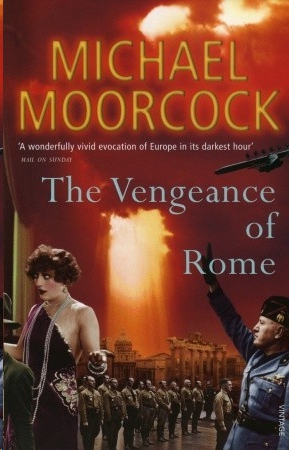
The Vengeance of Rome
- Автор: Муркок Майкл
- Серия: Between The Wars #4
- Язык: английский
- Жанр: Научная фантастика

Электронная книга - «The Vengeance of Rome». Краткое содержание книги:
In some ways the holiday in Nuremberg was my last ordinary innocent pleasure. When it was over, my descent into several kinds of hell began. I had no intimation of it, of course. After the break, as soon as we were back in Munich, Kitty arranged for us to visit Prince Freddy’s extraordinary flat where, she assured me, ‘snow’ was always in plentiful supply. He could not seduce me, of course. I knew how to control my appetites.
In a note Prince Freddy told Kitty he would be delighted to see her guest. He already knew that the famous American film star, Max Peters, was in town, and he longed to meet me. He had seen many of my films and was immensely flattered that I should want to visit him.
His huge apartment was in a very well-to-do-suburb of the city, not far from where I had met Frau and Fräulein Röhm. The house itself was a rather fanciful one, owing a little to the extravagance of the Wittelbachs, so I was not surprised it had been built by one of that family. It was now owned by a Ruhr industrialist who used it occasionally as a holiday place but rented the upper part to Badehoff-Krasnya. The suburb’s broad tree-lined roads were largely unmade at that time and carried little motor traffic but were well kept with sweepers and porters, even through the depths of the Depression.
Only the very wealthy weathered the crisis leading to the establishment of the new gold mark. Few feared a continuation of the poverty experienced in the early 1920s. Germany was a naturally prosperous country, growing more so every day. People feared civil war and were prepared to do almost anything to avoid it. The idea of Nationalist Bavaria marching against Socialist Prussia was anathema to modern Germans. That was why a party whose name included a compromise, which resolved the differences and united the people, was attractive to so many who knew little of the real Nazi policies and therefore did not properly support them when the time came. The fatal flaw was there from the beginning.
We were admitted into the Prince Badehoff-Krasnya’s building by a uniformed porter who directed us to an electric lift which took us up a couple of floors. Here on the landing Prince Freddy awaited us. Slender, short and very dark, he reminded me of a Borgia dagger, but he was charming. One could easily see how he had ruined countless lives. His oiled hair was brushed straight back on his head, he had a pencil-thin moustache and rimless pince-nez through which his silver-blue eyes gazed mildly and wonderingly. His lips were thin, tight against his teeth. His hands and feet were tiny but perfectly formed, while his bearing was that of an infinitely cultured, highly bred man of the world, chivalrous, gentle and courteous to a degree. He apologised for his inconvenient living quarters. This floor and the turret were completely cut off from the rest of the house so that privacy was assured.
He escorted us through the conventional apartment then pulled back a curtain disguising a door into a small lobby. From this a staircase rose. He led us up to the top. Soundproofed double doors shut the staircase off from the landing and led into an entrance hall hung with astonishingly vivid futurist tapestries, more extreme than anything of Fiorello’s! From the ceiling hung octagonal glass spikes of irregular length, stained dazzling red, green, blue, orange, rose du Barry. Inside the glass glowed electric light bulbs. Beneath them in clashing contrast sat a life-sized bronze of the Naples Hercules, pensive, solid in its colossal power.
As the doors closed behind us dead silence fell. Every door and shutter in that strange flat must have been equally soundproofed. Heavy curtains divided the apartment, hiding doors, windows and walls. The rooms and alcoves were dimly lit with more coloured lamps. It was unsettling to find something so exotic in the middle of Bavaria! Even in Berlin this would have seemed more like a film set than an individual’s flat. I could hardly believe these were temporary quarters. The Prince’s house in Berlin, said Kitty, was similarly decorated but was much larger and with special rooms.
The apartment’s interior gave the appearance of tremendous space and loftiness. Each wall was panelled with floor-to-ceiling mirrors. Between them, a foot in breadth, were wooden columns on which vaguely obscene mural frescos were painted in vibrant reds and yellows and blues. The ceiling was mirror glass; mirrors lined the shutters; the glare was toned down by pastel-coloured curtains, divans, cushions and silk hangings. A great, wide, canopied divan occupied half one wall; a cabinet gramophone, with piles of records, stood beside it. In a corner, inexplicably tangled up with electric wires, cables and green baize shades, was an enormous arc light. The floor was thickly carpeted so our feet were also soundless.
Prince Freddy was self-deprecating. ‘I have a taste for the exotic and the modern,’ he admitted. ‘There is a little Eastern vulgarity in me, I fear. But without the vulgar, we die of good taste, do we not?’
Meanwhile, he made us welcome. He had a Japanese servant he called ‘Monsieur Frank’. If we required anything, Monsieur Frank was at our service. Kitty explained how she ‘owed’ me some coca from Nuremberg. ‘You must tell me all about Nuremberg.’ He crossed to a lacquered cabinet from which he produced a long yellow Venetian glass bottle. From the bottle he poured into a phial at least an ounce of the life-giving powder. ‘I hear it is a children’s paradise.’
Refusing money, he assured me that my films had already entertained him so thoroughly he owed me at least that. ‘Take it,’ he said. ‘There is more. There is always more.’
As Kitty and I were leaving, Prince Freddy recommended that we visit the Flashlite Klub, which had opened a few days earlier across the river near Zeppelinstrasse. He had a small investment in the place and could recommend the English girl there. She was unusually talented. He smiled and rested his hand on my arm. I was bound to know her.
For a terrible moment I thought he referred to Esmé, who had so badly let me down in Egypt. Then the Prince produced a handbill to show me who he meant. I was astonished. The star chanteuse at the Flashlite Klub was Gloria Cornish! My old friend Mrs Cornelius! I was amused and delighted by the irony. A few days earlier I had yearned for feminine company and worried where I would find my next supply of ‘snow’. Now, it seemed, I had an excess of both!
THIRTY-SEVEN
Gloria Cornish was never more glamorous. With the customers’ intimate torch-beams playing over her sensuously dressed figure, she stormed on to the little stage of the Flashlite Klub. Radiating joie de vivre, energy personified, she blew a kiss to the band, a kiss to the audience. The cellar was thick with cigar smoke and California poppy. It barely disguised the heavy smell of mould. Yet all was transformed, all shabbiness forgotten, when she emerged from behind the velvet curtain. She was sex. She was joy. A golden promise. The nightclub rented out electric torches and encouraged customers to direct the light wherever they pleased. White beams played on the artistes and on other customers who attracted them. Being mostly Bavarian burghers, they were frequently unsubtle in their play with the beams. Yet nothing could cheapen my goddess! Even Kitty, the eternal cynic, was entranced, though she pretended not to be.
These were the days before every chanteuse was expected to look like Lola-Lola in Der blaue Engel, a costume which became as formal as an Auguste’s face. The real cabaret singers wore stylish gowns, like my Mrs Cornelius.