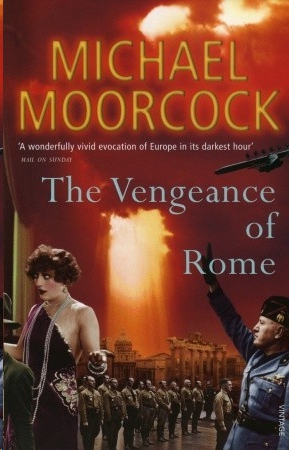
The Vengeance of Rome
- Автор: Муркок Майкл
- Серия: Between The Wars #4
- Язык: английский
- Жанр: Научная фантастика

Электронная книга - «The Vengeance of Rome». Краткое содержание книги:
Forced to avoid all public places, I longed for music as much as I longed for conversation and eventually found an old radio down in the offices, which I requisitioned. But the set only received a local station, which was provincial and dull and rather too full of Hitler and Co. It would sometimes broadcast operettas. Jazz was forbidden. The music I heard coming from Munich’s few basement cabarets was largely made by accordions and can be imagined. I complained to Röhm, but he was too busy to listen with any great attention. Or so I thought.
One morning I was woken up by a loud banging on the door. Alarmed, I dragged on a dressing gown and, keeping my door on its chain, looked to see who it was. A hard-faced brown-uniformed monster wearing a swastika armband stood there. It was Karl Weber, one of Hitler’s ‘old fighters’, an SA lieutenant who sometimes called at Corneliusstrasse on party business, and who had been friendly enough in the past. He stooped, picking up in both hands a large wooden cabinet on top of which was a cardboard box. ‘The Stabschef told me to bring this round to you, Prof. Where do you want it?’ He put it on my table, an expensive portable phonograph with a box full of black, brittle discs. I had music!
‘That’s so kind! Where on earth did you find it?’
Weber laughed. ‘Not that far from here. One of our lads liberated it from some Bolshy Jewboy they were evicting on behalf of his landlord. They’d been told to keep a lookout for something like this. So here you are. Everyone benefits!’ He raised his arm in the familiar Ben-Hur salute and was on his way.
As my coffee was brewing I greedily inspected the records, which were mostly familiar German labels like Parlophon, Ultraphon and Homocord. Some were American, Electrola and Victrola. A few of the records had familiar songs and performers. Most seemed to be songs from current Berlin shows. I wound up the machine, took an Al Jolson record from its cardboard sleeve, placed it on the turntable, started the phonograph and carefully lowered the amplifier arm on to the spinning disc.
Not only was the machine excellent, the records had been well kept. Soon my mornings were spent to the tune of ’Sonny Boy’ and ‘Mammy’ or the harsh, catchy cabaret songs of Berlin. ‘Die Muschel von Margate’ was a biting attack on the oil business. I also enjoyed the haunting ‘Surabaya Johnny’ or the catchy ‘Tango Angele’. Germany was full of such clever, sardonic music in those Weimar years. Most of it disappeared, of course, under the floods of jazz, which Hitler and his Nazis did their absolute best to curb. Not for nothing were the worst juvenile delinquents of the Nazi period called ‘jazz-kiddies’.
So powerful an influence was this Negro music that juvenile delinquency actually rose to near epidemic proportions under the Third Reich. No matter how much authority was exerted, the music continued to be played. Eventually, the Nazis gave up and allowed their own jazz bands to broadcast. These wartime songs could often be picked up in England and were often witty, such as Onward Conscript Army / Marching off to war / To fight for Jewish bosses / And die for Jewish whores / Dressed by Monty Burton / Fed on Lyons’ Pies / Fight for Marks and Spencer’s / Die for Jewish lies! All sung to the tune of Sir Arthur Sullivan’s rousing ‘Onward, Christian Soldiers’! and done as an upbeat jazz number.
Signor Frau’s barrel organ, meanwhile, was not as healthy as my new phonograph. While it had earlier shown signs of problems, playing wrong notes, dropping others, wheezing somewhat in certain chords, the machine was what Signor Frau called ‘missing’. He would turn the handle but the machinery would not do what it was supposed to do. The notes the organ did play were often wrong, and it was developing a positively ugly sound, as likely to drive away customers as attract them. Some regular passers-by were beginning to laugh or even jeer.
There was nothing that a little intelligence and mechanical skill could not fix. Surely the instrument would not be expensive to repair? I had myself tinkered with a couple of mechanical fairground organs when I worked for the Armenian in Kiev. I mentioned this to Signor Frau. He said any repairs would absorb most of his profit, but with Christmas coming up, he would have to get a specialist to restore it. He was depressed. The thing had already been overhauled once at the beginning of the year.
Familiar with the Strassenorgel’s mechanics, I asked if I might have a look. He let down the back on hinges and showed me the interior. The straightforward device consisted of a large bellows, a number of pipes of various gauges, a spiked cylinder rather like a player-piano’s, over which passed a series of punched cards, triggering or stopping the appropriate pipes. A bellows supplied the air for the simple system. A borrowed screwdriver, a bicycle repair kit, a can of fine oil, a pair of jeweller’s pliers and some wire, and I soon had the Leierkasten working at full capacity, its voice issuing strong and melodic from the diaphragm at the front. Signor Frau could not thank me enough. He was genuinely delighted. I had made the difference between good times and bad for his little family.
Sitting on a wooden stool one of the traders had lent us, I replaced the casing of the barrel organ feeling that for the first time in months I had done something useful with myself. As I turned to speak to the boy, who had held the tools for me, I saw Zoyea come up to me like a vision. A peck on the cheek, a curtsy and she said very earnestly: ‘You are a friend of our family, Herr Peters, and we thank you for your kindness.’
Thereafter, not only did I have a friend, I had employment. My engineering genius, applied to the primitive mechanism of the barrel organ, was in great demand. Those Italians thought me a wonder! And so I began to earn a few marks from other Italians in the same fraternity. Some still spoke habitually in Italian and were delighted that I could converse with them. I was Il Professore again, and my meals were also assured. Every evening I was welcome in the homes of families, most of whom were also admirers of Mussolini. I found myself in warm and sympathetic company.
They all lived on the other side of the River Isar in the area of old run-down wooden houses known as Glockenbach-Viertel, built on both sides of a muddy stream running into Munich’s chief river. I had grown up in just such a neighbourhood. The buildings had had floors added at random over the past hundred years or so. They had no common design and little sense of order. The houses leaned one against another, forming a kind of organic whole. If one key beam or wall were removed, all the others, so densely packed together and full of humanity, might collapse like cards. Damp rotted much of the woodwork and added to the prevailing smell. Some buildings had been repaired so often with such poor materials they resembled wrecked ships or ramshackle piles of timber. The unmade streets were twisting alleys beneath overhanging balconies and galleries, with blind oiled paper windows and dark, irregular openings running at all angles, and reminded me of the nightmare that was Doctor Caligari. Only slowly did it become clear that there were people living within.
I spent happy hours in the district they called the Stables, an old brick mews belonging to a carriage business in the previous century, now housing machinery as well as animals. Here, many of the street sellers stored their stalls, street organs and so on. There was an entire gypsy-style wagon and others in differing stages of repair. There was a show wagon which broke down into a shooting gallery. The game’s parts, the rifles and targets, had long since disappeared, but it was still a handsome vehicle. It belonged to the Frau family. He had had some idea about putting it all back together and taking it around the county, but the Reds, of course, had brought in all kinds of petty gambling laws, and he had neither time nor money to obtain the appropriate permits.