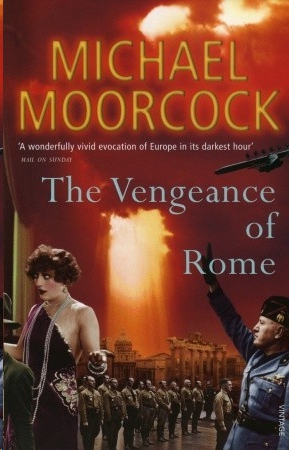
The Vengeance of Rome
- Автор: Муркок Майкл
- Серия: Between The Wars #4
- Язык: английский
- Жанр: Научная фантастика

Электронная книга - «The Vengeance of Rome». Краткое содержание книги:
I have noticed how the Germans and the Americans get a satisfaction from making laws against human nature. No wonder their prisons are full to bursting. Such laws make you an outlaw simply by being a person.
The Fraus did not use the van because of the cost of re-equipping it. The other vans were more easily adapted for living but were less sturdy. In the crooked building which ran along the whole back wall of the mews was a busy aviary, which I understood to be a secret. Judging by the quality of the ornamental ironwork, the whole thing had been stolen from some Wittelbachian fantasy. Birds from macaws to finches were kept here, and a boy was employed to play a big barrel organ when their screeches became too obvious.
I was never sure if the ranks and ranks of caged birds were for sale, to eat or for company. Neither did I know for certain if it was illegal to keep them. Such age-old practices are usually the first things the Reds outlaw! For instance, in the courtyard one afternoon I witnessed a cockfight. I was privileged to attend as a friend of Heinrich Frau. They were proud of their birds. English fighting cocks, they said, with all the aggression of that tiny island nation. The best blood on earth. Smuggled in from Ireland. The spurs were not elaborate, simply little pieces of leather tied on to the bird’s leg through which had been poked a finely sharpened nail, the fighting spur. The sport was a bloody business. Once a bit of glinting feathered flesh struck me in the mouth, but in my excitement, I hardly noticed.
Every night you had to be in the mews by a certain time. A great grille was drawn across the entrance and was not opened again until morning. All was overseen by a horrible old Turkish woman they called the Gatekeeper, which in their argot was also a term for the anal sphincter. She ruled the place while working for an absent owner, Klosterheim, who never appeared and was known only as the Major. Everyone paid their rent to the Gatekeeper, and it was to her they complained. They were convinced she never passed anything but their money on to the Major, rumoured to be a member of the Wittelbach family which had only recently ceased to rule Bavaria.
Sometimes when I worked in the mews repairing the barrel organs and other engines the Italian community used, old Father Bernhardt would pay us a visit. He spoke good Italian and made it his mission to serve the local community, all devout Catholics who worshipped at his church. I took great pleasure in my meetings with a man of refined intellect in that place, and we had some good talks, especially about the Pope and Il Duce. He was a monkey in a cassock, all mouth and no chin, flamboyant gesticulation and brilliant moving eyes, with crimson lips, which in Kiev would have made us call him a ‘borscht-fiend’ in fun. I think he drank. He certainly gambled, because I saw him slipping his bet to one of the boys who acted as a courier for a famous local gang. ‘I long only for the cross and crown,’ he used to say, usually after a bad day’s gambling. The rumour was he sold church artefacts to pay for his habit, but nobody judged him. He was well liked in the Stables.
Despite its poverty the Glockenbach-Viertel area felt very much like home. What streets were paved at all were cobbled, but some were still nothing but packed earth. Here and there could be seen patches of tarred road, like the hardening scabs of some disease. The gutters were filthy. Some of the houses reeked of sewage. Thin dogs ran everywhere. Ragged, often dirty, children played among the piles of garbage. The river, though useful, was not always pleasant to smell. Yet the people living there were hospitable and generous with what little they had. I found it a considerable relief to join a circle of acquaintances who had nothing to do with the NSDAP or, indeed, the Fascist Party. Politics was meaningless to most of them. They thought in terms of patrons, if they thought of such things at all. They paid a couple of grubby German lawyers when they got into trouble, but mostly they kept their noses out of things. They saw little difference between the Sozis and the Nazis still viciously fighting in nearby streets and wanted none of it. Who could blame them?
While I was nominally a member of both groups, I had never felt at all comfortable in uniform. Now I knew it was not always possible to trust one’s party comrades, whereas here, among the Leierkasten, the other Strassenhändler, their friends and relatives, I enjoyed the easygoing acceptance I had experienced earlier in Odessa, where to be part of one family was to be part of many.
These Italians were, of course, not all street organists! Some sold religious plaster figurines from barrows; others sold ice cream in the summer and hot chestnuts in the winter. Some played the accordion or mandolin and sang. Some even worked at steady jobs in Munich. As in Moldavanka, their lives were neither easy nor lavish, yet they knew the security of their extended family, the knowledge that no one would ever starve. The food was not entirely familiar to me but had much of the quality I knew in Odessa. On those clear autumn evenings, we sat on the banks of the Glockenbach watching distant boats and listening to the sound of a band drifting from the faraway English gardens.
Now to Heckie, my Zoyea, I was no longer Herr Peters, but ‘Uncle Mac’, and our mutual enthusiasm was for the Kino. Only too delighted to discover a young lady with the same relish as myself, I proposed to her father very properly that I take Heckie with me on my next cinema visit. We could go after she had completed her performances in the market. Old Frau was delighted. I was now a brother, he declared, part of the family. His little princess deserved a break. He and the boy could cope. She could go with me at least once a week. When I consulted her, Heckie declared joyfully that she was glad to see whatever films I chose, but her personal taste was for historical epics and adventure films, preferably with cowboys. She shared every German child’s fascination for the ‘Wild West’. These films were generally cheaper and more plentiful than the serious films and musical comedies I personally favoured.
I had not until then realised how the Masked Buckaroo was still a familiar favourite with the movie-starved Munichers. With considerable surprise and some trepidation I found myself and Heckie watching, at a cinema which had not yet gone over to sound, an episode of Buckaroo’s Bride, with its outstanding train sequences. By chance the film was one of the few where my face was unmasked in most scenes, largely because of the romance between myself and ‘Gloria Cornish’ as Mrs Cornelius was known professionally. It was based on the original Warwick Colvin Jr novel, A Buckaroo’s Courtship.
Thereafter, I became my little Zoyea’s absolute hero. Her reserve vanished completely. She became warm, vibrant, full of innocent affection. Who would not have fallen in love with the child! She insisted on our going several times to the same programme until it changed. We had to be sure, she said, to see the remaining two episodes. She spent any spare time looking through old film magazines for pictures of Max Peters, the Masked Buckaroo. Someone gave her a couple of German translations of the Colvin novels, which she read quickly, but said she found disappointing. Zoyea was also a keen fan of Tom Mix and Hoot Gibson, though she assured me kindly that her favourite remained the Masked Buckaroo.
Half an Italian in the house is worse than none, as the Germans say, but those Italians provided my lifeline back to some kind of normality. Much of the time I could forget that terrible night with Hitler, I could forget Brodmann’s relentless pursuit of me, I could even forget my relationship with Röhm, as it became increasingly tense.
That Christmas, however, thanks to a chance meeting with Baldur’s gracious sister, Rosalind von Schirach, who heard that I had no plans for the holidays, I spent with the Hanfstaengl family. They were determined to forget the cares of Berlin and enjoy the season no matter what. Putzi and his wife had a strong sense of family and valued their private life above politics, a preference which would get them in trouble later when Hitler had absolute power. They took over a hotel in Nuremberg so we could all visit ‘the Capital of Christmas’ and experience the wonder of the Christkindlmarkt, its lights glistening in the falling snow, as the bells of the city declared Peace on Earth to All and Good Will to the World, while happy citizens carried their cakes and geese and trees and candles home to their firesides where they prayed that tranquillity would come again to Germany and the blight of war would be banished for ever.