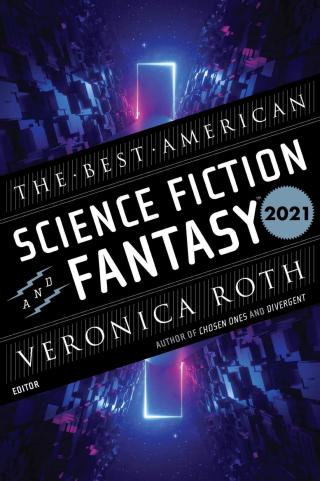
The Best American Science Fiction and Fantasy 2021
- Автор: Рот Вероника, Адамс Джон Джозеф
- Год: 2021
- Язык: английский
- Год: HMH Books : Mariner
- ISBN: 9780358470076
- Жанр: Малые литературные формы прозы

Электронная книга - «The Best American Science Fiction and Fantasy 2021». Краткое содержание книги:
This year’s selection of science fiction and fantasy stories, chosen by series editor John Joseph Adams and bestselling author of the Divergent series Veronica Roth, showcases a crop of authors that are willing to experiment and tantalize readers with new takes on classic themes and by exchanging the ordinary for the avant-garde. Folktales and lore come alive, the dead rise, the depths of space are traversed, and magic threads itself through singular moments of love and loss, illuminating the circulatory nature of life, death, the in-between, and the hereafter.
The Best American Science Fiction and Fantasy 2021 captures the all-too-real cataclysm of human nature, claiming its place in the series with compelling prose, lyrical composition, and curiosity’s never-ending pursuit of discovering the unknown.
■ “Crawfather” was the third story I wrote at Clarion in 2018. I had spent the previous weeks rigorously attempting to impress my peers, and I was feeling burned out. I decided that my next piece would be a “fun” story that didn’t feel weighty or draining to create.
“Crawfather” was indeed the story I had the most fun writing that summer, though it didn’t end up being an entirely silly piece. Remembering so many awkward family gatherings in Minnesota gave me the POV—I think there’s something innately funny about the self-importance of a conservative family narrating in first-person plural. I wanted to convey how family traditions can become nonsensical and harmful over time, and how they tend to encourage a cultish insularity. So, this family organizes its traditions around the myth that they’re being persecuted by a giant crawfish (never mind that it’s no smarter than a regular-sized one).
I’m very fond of this story for how it combines some of my favorite elements: a cool creature, the dangers of ritual, and absurdity with a hint of horror. Also, it continues to have the best title of anything I’ve ever written.
Ted Kosmatka is the author of three novels and numerous short stories. Over the years he’s worked as everything from a corn detasseler to a lab tech to a game writer. His short fiction can be found reprinted in more than a dozen year’s-best anthologies.
■ Working on this story was a bit like painting a garage floor. First you have your paint and then your epoxy activator, in its clear little packet, and you stare at them separately for a bit, trying to work out what’s what before adding part A to part B, mixing them together, and hoping it’ll stick. (And that your dog won’t walk across the floor while it’s wet.) The part A for this story was an idea about artificial intelligence and consciousness that I’d been kicking around for a while. The part B came months later, and that was the story part, a chase into the darkness; and as I was laying it down, I just hoped I’d gotten the mixture right.
Yoon Ha Lee’s debut novel, Ninefox Gambit, won the Locus Award for best first novel, and was a finalist for the Hugo, Nebula, and Clarke Awards; its sequels, Raven Stratagem and Revenant Gun, were also Hugo finalists. His middle grade novel Dragon Pearl won the Locus Award for best YA novel and the Mythopoeic Award, and was a New York Times best seller. His most recent work, the modern fairy-tale collection The Fox’s Tower and Other Stories, came out in October 2021. Lee’s short fiction has appeared in venues such as Tor.com, Lightspeed, The Magazine of Fantasy & Science Fiction, Clarkesworld, Beneath Ceaseless Skies, and Audubon magazine. He lives in Louisiana with his family and an extremely lazy cat, and has not yet been eaten by gators.
■ “Beyond the Dragon’s Gate” came to me because I’m trans. I knew how dysphoria worked in my life, but I wondered how it would affect an AI. I hadn’t seen a lot of discussion as to how changing an AI’s physical shell would affect it, whether that shell was an android or a starship or anything in between. Surely if an AI was advanced enough to feel emotional attachments and use the capabilities of its current physical body, it might then also have very personal feelings about whether or not that body felt right to it.
At the same time, I wanted to contrast this idea of an AI’s dysphoria with the viewpoint of a human character who was fascinated by fluidity of form—who would actively have sought it out, given the opportunity. Even in the space of a short story, I wanted to show that sentient beings could have different visceral reactions to this sort of fluidity of perceived form.
Ken Liu (http://kenliu.name) is an American author of speculative fiction. A winner of the Nebula, Hugo, and World Fantasy Awards, he wrote the Dandelion Dynasty , a silkpunk epic fantasy series in which engineers hold the place of honor reserved for magicians, as well as short story collections The Paper Menagerie and Other Stories and The Hidden Girl and Other Stories. Prior to becoming a full-time writer, Liu worked as a software engineer, corporate lawyer, and litigation consultant. Liu frequently speaks at conferences and universities on a variety of topics, including futurism, cryptocurrency, history of technology, bookmaking, and the mathematics of origami.
■ I wrote “The Cleaners” as part of Faraway, an Amazon Original Stories collection of modern retellings of classic fairy tales. But a strict “retelling” didn’t appeal to me, so I decided to craft a new fable only loosely inspired by an idea from a classic story—the notion of “extraordinary sensitivity” from Hans Christian Andersen’s “The Princess and the Pea.” My tale takes a few metaphors that we’re all familiar with—our emotions color our memories, our memories are attached to our possessions, psychic pollution and emotional labor—and makes them all literally true in this alternate reality, since the literalization of the metaphorical is our oldest mode of storytelling and my favorite way to approach speculative fiction.
As with everything else written in 2020, the global pandemic hovers over each word in this story like an image filter, leaving a distinctive shift in highlights and hues. I still cannot read it without feeling the isolation, the loneliness, the despair that we all endure, not because we live in a particular time or place or are part of some event, but because we’re human.
Barbadian novelist and research consultant Dr. Karen Lord is the author of Redemption in Indigo, winner of the 2008 Frank Collymore Literary Award, the 2011 William L. Crawford Award, and the 2011 Mythopoeic Fantasy Award for Adult Literature. Her other works include the science fiction duology The Best of All Possible Worlds and The Galaxy Game, and the crime-fantasy novel Unraveling. She edited the anthology New Worlds, Old Ways: Speculative Tales from the Caribbean, and has coauthored research on development and on youth employment with the University of the West Indies for the UNDP and the Caribbean Development Bank.
■ I’m tempted to think that “The Plague Doctors” has had greater impact precisely because less than six months after I handed in the final draft, the world saw the beginnings of COVID-19. But this story is more than accidental zeitgeist. It’s the end product of an idea I laid out to my medical adviser for the story, Dr. Adrian Charles: “This is our chance to depict a version of the revolutionary, decentralized approach to health care that we’ve been discussing for ages.”
Dr. Charles knows his sci-fi and did not flinch when I asked him to design a disease that would undermine the global health system by revealing the hubris of the so-called developed world—a disease that looked easy to control until it suddenly (and horribly) was not. The invented pathogen was deadlier and more contagious than the coronavirus, but the resulting massive systemic disruptions were similar. I believe the solutions are also similar: a greater focus on the baseline health of vulnerable communities; decentralized, community-based delivery of free health and well-being services (e.g., clinics and home care) operating in parallel with centralized, specialized medical services (hospitals and specialist centers); and more global interconnectedness, openness, and cooperation, especially among nonstate actors.