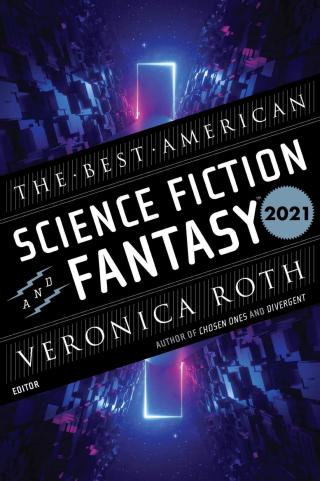
The Best American Science Fiction and Fantasy 2021
- Автор: Рот Вероника, Адамс Джон Джозеф
- Год: 2021
- Язык: английский
- Год: HMH Books : Mariner
- ISBN: 9780358470076
- Жанр: Малые литературные формы прозы

Электронная книга - «The Best American Science Fiction and Fantasy 2021». Краткое содержание книги:
This year’s selection of science fiction and fantasy stories, chosen by series editor John Joseph Adams and bestselling author of the Divergent series Veronica Roth, showcases a crop of authors that are willing to experiment and tantalize readers with new takes on classic themes and by exchanging the ordinary for the avant-garde. Folktales and lore come alive, the dead rise, the depths of space are traversed, and magic threads itself through singular moments of love and loss, illuminating the circulatory nature of life, death, the in-between, and the hereafter.
The Best American Science Fiction and Fantasy 2021 captures the all-too-real cataclysm of human nature, claiming its place in the series with compelling prose, lyrical composition, and curiosity’s never-ending pursuit of discovering the unknown.
It is all I can do to throw the knife into the sink, double-lock the doors, and cower in the bathtub for the rest of the night.
The next morning, I don’t see the rat outside my apartment door and I don’t see it outside my window. I’m too hungover to be elated. Instead, I pull on a pair of jeans and my yellow blazer. I trudge from apartment to apartment, extolling the wonders of the new Kutco steak knives and showcasing the scissors, which can cut straight through a penny.
On the commutes, I google “new york rat life span” (one year). I google “diseases new york rats carry” (all of them). I google “will cutting off a piece of a rat’s tail kill it” (no). I blanch at the thought of the knife that’s still sitting in the sink, inked in the rat’s blood. I google “disinfectant.” I google “sterilizing cleaners.”
I get home and the rat is waiting inside my house, in the kitchen.
My rat and I look at each other. She is wary and still, as if she is afraid of startling me.
How old is she? She is either an old rat or an extraordinarily war-battered one, with three blooms of mottled skin where her fur no longer grows. The length of my forearm, she must weigh a pound, at least. Her four-fingered paws remind me of human hands. Her front left one is mangled, probably injured in a trap—how she must have fought to free herself. The missing chunk of an ear. The tail, its tip scab-dark, dry, and already healing. She looks up at me, her dark eyes and quivering pink nose track my every breath. I imagine her teeth, sharp and vicious, though I don’t see them.
I walk with halting steps toward the kitchen sink. With a shaking hand, I take hold of the knife. I raise it, knowing somehow that this time she will let me bring it down on her body, she will not run or bite me with those jagged teeth. This time, I won’t close my eyes as I scythe through her.
The rat watches me.
I take a deep breath. I will kill this rat and put her in the garbage, where she belongs. I will piece my life back together. I will move on. I will move on. I will move on.
Instead, I lay the knife down on the table.
I lean against the wall and let myself slide down to the floor. I trace a finger over the scar on my wrist, a thin, two-inch line, ruler straight. I hug my knees to my chest.
In my memory, my mother picks me up by the underarms and stands me on her dresser. “My big girl,” she says. She helps me turn toward the mirror and then holds me against her torso until I am stable on my own two feet, which are clad in black patent leather Mary Janes. Her makeup is littered across the dresser around my feet, her jewelry spread across small, shallow glass saucers. I hold still, proud that she’s trusting me not to stumble and kick all these beautiful breakable things.
I look up at us in the mirror. We wear matching dresses: hers a white and red floral sundress with thin straps, mine a cotton shift in the same pattern. It’s summer and both our noses are a little red from the sun. She has brushed my damp hair into a neat braid. My lips are the same color as hers, Cherries in the Snow. She has dusted my cheeks with a hint of blush.
“There,” she says in Spanish. She hugs me from behind, and her hair curtains over my shoulder in blow-dried auburn waves. Her smell wraps around me, that mix of rose, honey, and tobacco. She taps my chin with a warm hand and the gold bracelets on her wrist tinkle. “I’ve done it. I’ve left you my face to remember me by.”
On the floor of the kitchen, I let my grief draw closer, let its sour, rotten odor fill my nostrils. I sink my head into my knees and a searing white pain tightens my rib cage: unbearable, necessary, familiar.
As she nears, the rat’s body radiates a strange heat. She presses her full weight against my leg and I straighten it out. Cautiously, she climbs onto my shin, and I feel her claws through the thick denim of my jeans. I let her perch herself on my knee.
I let her stay.
Contributors’ Notes
Senaa Ahmad’s short fiction has appeared in The Paris Review, Lightspeed, Uncanny Magazine, Strange Horizons, and elsewhere. A Clarion 2018 alum, she’s received the generous support of the Octavia Butler Scholarship, the Speculative Literature Foundation, the Canada Council for the Arts, the Ontario Arts Council, and the Toronto Arts Council. She’s the recipient of the 2019 Sunburst Award for Short Fiction.
■ Many years ago, I had this idea for a metafictional, kind of experimental short story collection. I finally wrote the first few stories at the 2018 Clarion Writers’ Workshop, mostly in a sweaty, unair-conditioned dorm, mostly in a panicked run against time, still trying to figure out how the collection would feel and work.
“Let’s Play Dead” was the first of these stories. I’d been thinking about the ways stories create distance from their readers, ejecting them from the immediacy or emotion of a moment, and where that distance can be useful. For example, how it can dilute or even undercut incidents of violence, so these moments don’t become grueling to read. Sometimes, this “useful” distance can come from humor, or surrealism, or breaking the fourth wall, or a particularly slippery narrator.
Other things that fed this story (a very incomplete list): Italo Calvino’s mind-bending use of anachronism in “The Dinosaurs,” Kate Bernheimer’s essay “Fairy Tale Is Form, Form Is Fairy Tale,” that Millais painting of Ophelia, how cockroaches can survive decapitation but will die eventually of thirst, all the dazzling stories from my fellow writers at the workshop (a couple weeks after this, Mel Kassel would write the perfect, delightful “Crawfather”). I’m wildly grateful to Hasan Altaf at The Paris Review for pulling this story from the slush and for lasering in on things I wanted to improve but didn’t know how.
I wrote this story for many of the obvious reasons. I also wrote it as a sort of one-way correspondence to people I have known, mostly women in my life. A profound pleasure of publishing the story was to have some of them read it.
Celeste Rita Baker is a Virgin Islander currently flitting between the beach and the grocery store as she tries to be one of the survivors of de ’rona pandemic. She chronicled COVID-19 in a rudely opinionated timeline from October 2019 through March 2020, after which she just could not “go another further.” It’s on Amazon as “De Rona Reach.” She is also the author of Back, Belly, and Side, a short story collection, a mix-up of magical realism, fantasy, and mimetic fiction, some in Caribbean dialect and some in Standard English. Her stories have been included in The Caribbean Writer, Moko, Strange Horizons, Lightspeed, and other publications. She used to love doing live performance readings, often in costumes she’d made herself, and hopes to again one day when we can safely gather. A proud 2019 graduate of Clarion West Writers Workshop, she is noticing that her stories are getting more and more silly and absurd and is loving it. Her website is celesteritabaker.com and she is occasionally on Twitter as @tenwest522.
■ I jumped back and almost fell off the chair several times while doing the research for “Glass Bottle Dancer.” Eventually I learned to stand up and reach the keyboard with my arms fully extended. I screamed and cackled and laughed at myself, but I just could not change the roaches to a more socially acceptable creature, like butterflies or grasshoppers. Much as they do in our own homes, they insinuated themselves into the story, which is about a human woman, Mable, and her determination to learn something frivolous just for fun.
I looked at photos of roaches until I learned to appreciate their beauty. I read about roaches until I understood how they contribute to the health of the planet. I knew if I had any hope of readers liking Oswald, Treevia, and their swarm, I had to like them first.