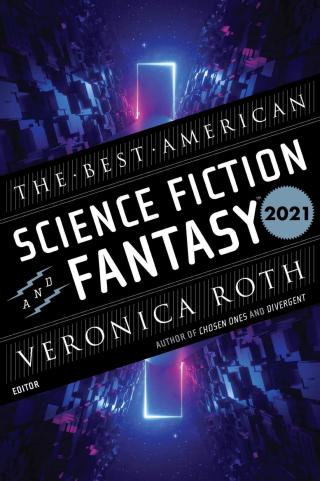
The Best American Science Fiction and Fantasy 2021
- Автор: Рот Вероника, Адамс Джон Джозеф
- Год: 2021
- Язык: английский
- Год: HMH Books : Mariner
- ISBN: 9780358470076
- Жанр: Малые литературные формы прозы

Электронная книга - «The Best American Science Fiction and Fantasy 2021». Краткое содержание книги:
This year’s selection of science fiction and fantasy stories, chosen by series editor John Joseph Adams and bestselling author of the Divergent series Veronica Roth, showcases a crop of authors that are willing to experiment and tantalize readers with new takes on classic themes and by exchanging the ordinary for the avant-garde. Folktales and lore come alive, the dead rise, the depths of space are traversed, and magic threads itself through singular moments of love and loss, illuminating the circulatory nature of life, death, the in-between, and the hereafter.
The Best American Science Fiction and Fantasy 2021 captures the all-too-real cataclysm of human nature, claiming its place in the series with compelling prose, lyrical composition, and curiosity’s never-ending pursuit of discovering the unknown.
When Mable’s ability to dance roaches out of the homes of people and back to their intended environment eliminated the use of pesticides, both of which contribute to asthma and other respiratory conditions, I was delighted with the convergence. I enjoyed being Mable’s friend and companion as she stayed dedicated, despite her responsibilities and the opinions of others, to putting time and energy into adding a purely personal joy into her life. It is something I am continually learning to do. I had a great time writing this story and I hope you enjoyed it.
KT Bryski is a Canadian author, playwright, and podcaster. Her short fiction has appeared in Nightmare, Lightspeed, Apex, Strange Horizons, Augur, and PodCastle, among others, and her audio dramas are available wherever fine podcasts are found. She’s won the Parsec and the Toronto Star Short Story Contest, and she has been a finalist for the Aurora and the Sunburst. KT also cochairs ephemera, a monthly speculative fiction reading series. When she’s not writing, KT frolics through Toronto, enjoying choral music and craft beer. Find her on Twitter @ktbryski.
■ I suspect that in years to come, saying, “I wrote this story in 2020” will solicit an understanding nod. It was an exceptionally difficult year for most people: global pandemic, long-overdue societal reckoning, trauma, and heartbreak.
For me, there was a lot of anger. As usual, I wrestled it fairly philosophically—and partly through the lens of my own Anglicanism. “What does it mean, to forgive? What if the other party doesn’t feel remorse? Wait, isn’t the point of grace that it’s undeserved? Well, maybe for God, but I’m only human . . .”
And so it went. Eventually, I thought, “This is interesting. I’ve never had rage as my baseline emotion.” But almost immediately, I realized that wasn’t true. The last time I’d been so consistently angry, I was in elementary school, getting bullied. (Ironically, I was bullied for liking girls and writing stories. I must admit to a certain amount of satisfaction in growing up to become a queer fantasy author.)
So I took that context, those feelings, and I gave them to Emmy. Maybe I was feeding a tiger of my own. Or maybe I was working through the notion—as Emmy does—that anger isn’t inherently bad, a thing to be fought and exorcised. Harnessed correctly, anger is rocket fuel.
Born and raised in New York City, Yohanca Delgado is a writer of Cuban and Dominican descent. She is a graduate of American University’s MFA program, the Clarion Science Fiction and Fantasy Writers’ Workshop, and the Voices of Our Nations workshops. Her fiction appears in Nightmare, One Story, A Public Space, The Paris Review, and elsewhere. She is a 2021–2023 Wallace Stegner Fellow at Stanford University.
■ “The Rat” was written at the 2019 Clarion Workshop, where the good-but-intense creative pressure helped me bring some seemingly disparate elements together in a single story. I sold Cutco knives for a summer in high school and was atrocious at it, but it was fun to draw on that experience for this story, and to write a character that reminded me so much of myself. As I revised, I found my way to the central question of this story: What if you could bear to look at the full depth of your own grief—and recognize it for what it is, a record of all you have loved and survived in your life?
“Our Language” is tremendously important to me because it allowed me to directly explore my own Dominican lineage. It also taught me a lot about the importance of trust and patience in writing. I let myself write through the wilds of this tale, determined to let it be as strange as it wanted to be, but also knowing, deep down, that I needed the story to resolve in a way that resonated emotionally for me. I didn’t know how to balance those two impulses, and so I didn’t. Instead, I trusted the story and returned to it, over and over, for three years, until my subconscious told me where to go.
Gene Doucette (genedoucette.me) is a novelist, with over twenty science fiction and fantasy titles to his name, including The Spaceship Next Door, The Frequency of Aliens, the Immortal series, and the Tandemstar books. His latest novel is The Apocalypse Seven. This story is his first attempt at short-form science fiction. He lives in Cambridge, Massachusetts.
■ The title came first.
I was brainstorming possible alternative titles for The Apocalypse Seven because at the time—a year after I’d written it—I’d become bored with the working title. (This happens a lot.) I pitched Schrödinger’s Catastrophe to my editor, only half-seriously, as I thought it was both too clever/obscure and too whimsical. Said editor, who did not share my exhaustion with The Apocalypse Seven as a title, suggested that while Schrödinger’s Catastrophe was indeed not a good fit for my apocalypse story, it would make for an excellent short story title.
So I wrote a story to go with the title.
I could say that “Schrödinger’s Catastrophe” came to me quickly and I wrote it all at once in about ten days, but while this is true, it’s also incomplete. The more complete version is that a lot of it had taken up permanent residence in my head long before I started writing; I’d explored quantum theory as a story premise before in a stage play I wrote in the early nineties, called Deus ex Quanta. (It was a locked-room mystery with two detectives attempting to solve the murder of a professor who was simultaneously alive.) “Schrödinger’s Catastrophe,” while featuring a very different plot, goes down the same path, but with the added advantage that I don’t have to think about how one might stage it before a live audience.
I also apparently had a powerful need to write something a little absurd. That kind of opportunity doesn’t come along very often.
Meg Elison is a science fiction author and feminist essayist. Her book series the Road to Nowhere won the 2014 Philip K. Dick award. She was an Otherwise Award Honoree in 2018. In 2020, she published her first short story collection, called Big Girl, containing the Hugo- and Nebula-nominated novelette “The Pill.” Elison’s first young adult novel, Find Layla, was published in 2020. Meg has been published in McSweeney’s, Fantasy & Science Fiction, Fangoria, Uncanny, Lightspeed, Nightmare, and many other places. Elison is a high school dropout and a graduate of UC Berkeley. Learn more at megelison.com and @megelison.
■ “The Pill” is a science fiction story that people tell me all the time is not really fiction. It is written from a fat life, about a fat life in a world that would rather we were almost anything than fat. I was inspired to write it by the death of a close friend’s mother from complications arising from weight-loss surgery, and by the things people say at a fat person’s funeral. I was affirmed in my convictions when the UK government started taking fat children away from their parents as a form of punishment. I wrote it in a white-hot rage after a doctor told me to lose weight to solve an eye infection. It is not really fiction.
Kate Elliott has been publishing for over thirty years with a particular focus in immersive world building and centering women in epic stories of adventure and transformative cultural change. Her most recent novel is Unconquerable Sun, gender-spun Alexander the Great in space. She is best known for her Crown of Stars epic fantasy series, the Afro-Celtic post-Roman alt-history fantasy with lawyer dinosaurs Cold Magic, and YA fantasy Court of Fives. Her work has been nominated for the Nebula, World Fantasy, Norton, and Locus Awards. Her novel Black Wolves won the RT Reviewers’ Choice Award for Best Epic Fantasy 2015. She lives in Hawaii.