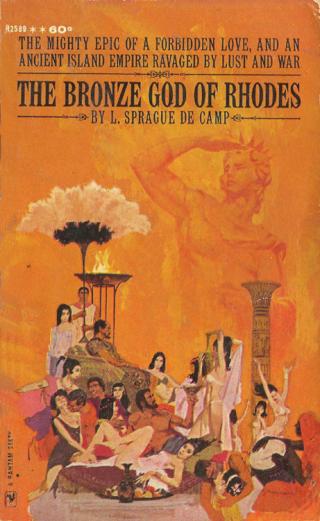
The Bronze God of Rhodes
- Автор: Де Камп Лайон Спрэг
- Год: 1963
- Язык: английский
- Год: Bantam Books
- Жанр: Научная фантастика

Электронная книга - «The Bronze God of Rhodes». Краткое содержание книги:
From the sea in thousands of ships they came, the brutal legions of Antigonos, a giant lusting for the power of Alexander the Great. For endless weeks and months they battered at the tiny island city, smashing it with monstrous weapons, crushing it with the terrible weight of their numbers.
Among the handful of grim defenders was one man who fought for a dream, a vision of a great statue that would stand above the highest towers as a monument to his city's grandeur.
He was Chares, soldier, adventurer, a man tormented by passion, a wanderer in strange, deadly lands—an artist who lived to see his incredible dream become one of the seven wonders of the world.
Kallias picked up a roll of large sheets of papyrus and began unrolling them one by one and holding them up to our view.
"Here," he said, "is my sluing crane. Can you all see the drawing? When a hostile siege engine nears the wall, the crane swings on its pivot until its end is over the machine. Then it seizes the engine by means of these tongs. When the crew pulls on the ropes, the hostile machine is raised into the air, thus. Naturally, the enemies in the engine are shaken out, and most are slain by the fall. Then the crane rotates on its base, carrying the captured engine over the wall, and lowers it to the ground inside the city."
"Euge! Euge!" cried several of the Strangers.
"Thank you, sirs," said Kallias. He went on to explain the mechanical features of his turning crane. Knowing something of architectural engineering, I found his ideas most ingenious.
Other sheets illustrated other devices. There was an enormous hammer, mechanically operated so as to smash siege machines near the walls. There were catapults that worked on new principles, such as falling weights or the compression of air by a piston in a bronze cylinder. The turning crane, however, elicited the most admiration.
Nikolaos: "Your voice has the sound of Dodonian bronze, O Kallias. Could you repeat that lecture before the Council?"
"Oh, sir, you are much too kind! Of course I can, if you think my poor ideas worthy of their notice."
"I think we ought to go into this further. Diognetos' contract runs out soon, and there is a question of whether we ought to renew it. Tell me where I can reach you, and we shall see."
The party soon broke up. The last I saw of Berosos, he stood at a street corner, pointing up to the stars, which spangled the sky like daisies on a black meadow, and expounded his theories of astrology to Zenon of Kition.
The day after my dinner with the Seven Strangers, my father said:
"Genetor was here last night, Chares. He's pleased with you, despite your radicalism, and wants to know when the betrothal will be made formal."
"Oh, divinity! I haven't even seen the girl."
"That can be arranged."
I beat my head with my fists. "For Hera's sake, Father, put him off! I'm too confused to think clearly about such things. At the moment I don't even have a future in my chosen profession to offer."
My father sighed. "I'll try, but henceforth you must think up your own excuses."
Two days later, with Kavaros' help, I loaded fifty bronzen mirrors on an ass and took them across the town to the house of Glôs the engraver for finishing. Glôs said:
"Have you heard the news?"
"What news?"
"About Diognetos and the Council."
"No, what is it?"
"The Council has refused to renew his contract. Nay more, they'll recommend to the Assembly a new contract with this Phoenician wanderer, this Kallias of Arados. Do you know him?"
"I've met him."
"What is he like?"
"I was much impressed. He combined great charm with brilliant ideas."
Glôs: "Well, then, perhaps it won't be a disaster for our beautiful city after all. Of course the Council has long been at loggerheads with Diognetos because of his conservatism. Still, he is deemed one of the world's ablest municipal architects. And he can't be bribed."
"Diognetos did not impress me," I said. "At least, with Kallias I might have a chance to get some commissions."
When work slackened at the foundry, I amused myself by modeling a clay head of Kavaros in a corner. The Kelt said:
"To be sure, young master, if I did not know that this was me here and that was the statue there, I would be expecting to hear that thing talking with my own voice. If I ever need a spare head, I will know where to get one, like those three champions I fought in the battle with the Trokmoi."
"What's that?" I asked.
"Did I not tell you? We put our bravest fighters in the front rank; so, being the most valiant of my clan, I was foremost—"
"Except at climbing masts," I put in. On the Galatea we had amused and warmed ourselves by playing tag, until I found that I could always escape the Kelt by swarming up the rope ladder to the masthead, for he had a deathly fear of heights. Mere height has never bothered me, and I could have made a living as a sailor. Kavaros rejoined:
"I was trained as a warrior, sir, not a—what do you call these beasties the young gentlemen keep for pets, that look like ugly little men?"
"A monkey?"
"A monkey, that is it. Anyway, the Trokmoi had three champions, who fought side by side in their front rank, so I found myself fighting all three of them at once. It was real warm work for a while, until I struck a blow the like of which has never been seen, nor ever will be seen. Would you believe it, sir, it took off the heads of all three of those omadhauns at the same time? If you will come to the land of the Tektosages, I will show you the heads to prove it."
"Kavaros," I said, "why are slaves such liars?"
"Why, Master Chares! Everything I tell you is the perfect truth, and I can prove it."
"I didn't say you; I said slaves in general."
"Oh, well, now, that is different. If I may ask you one in return, sir, what other defense does a poor slave have? As we say, who has no shield must use his cloak; who has no sword must use his stick, only it sounds prettier in the Keltic.
"Now, as I was saying, one of these fellows I hit was Genthios, a famous fighter of the Trokmoi. And would you believe it? Such a fierce man was he that he fought on for hours before he discovered that the head of him was off. It was only when he put up his hand to wipe the sweat off his face that he found it out and fell down dead."
A few days after my talk with Glôs, the Assembly met. As a mere tribesman, I could not attend. In Rhodes we have about six thousand adult men classed as citizens in the broad sense of the word. However, the property qualification for full or voting citizenship is so high that less than a third of these can take part in the government. The rest are second-class or non-voting citizens, or, as I have called them here, tribesmen.
I was working on my father's contract when there came a noise from the street. From the door of the foundry I saw a crowd approaching. At the head was Kallias, flushed with triumph. Others crowded after him, showering him with praise and congratulations. He stopped at our door, grasped my hand, and pulled me into the street.
"Behold!" he said. "Here is the first of past injustices that I, as your new architect, shall right. This is the most brilliant of our young artists, just returned from study on the mainland and denied a chance to exercise his genius by the hidebound stupidity and malignant jealousy of his elders. O Chares, I, Kallias, say that you shall have a commission from the city ere the year be out."
The admirers cheered. I was delighted, if embarrassed at being hauled without warning into public view. Kallias continued:
"Can you show me an example of your work?"
I said: "If you will step in, I'll show you a piece I've been working on."
Kallias entered the foundry, hitching his cloak up daintily to avoid soiling it. I showed him the clay head of Kavaros.
"This is only a rough sketch, a mere bagatelle," I said. "You can see that I lack the space for serious work."
"It shows real talent, Chares," he said. "You will be a great sculptor if you persist. I shall certainly arrange for you to receive an opportunity to match your promise with performance. Rejoice!"
When several days passed without my hearing from Kallias, I went to his temporary office, which Giskon had allowed him to set up in one of the rooms of his house. Kallias was cordial but vague about the reason for my coming until I reminded him of his promise of a commission.