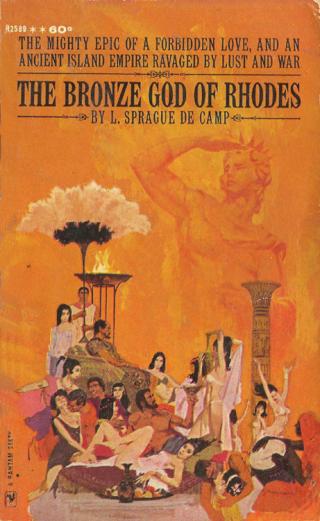
The Bronze God of Rhodes
- Автор: Де Камп Лайон Спрэг
- Год: 1963
- Язык: английский
- Год: Bantam Books
- Жанр: Научная фантастика

Электронная книга - «The Bronze God of Rhodes». Краткое содержание книги:
From the sea in thousands of ships they came, the brutal legions of Antigonos, a giant lusting for the power of Alexander the Great. For endless weeks and months they battered at the tiny island city, smashing it with monstrous weapons, crushing it with the terrible weight of their numbers.
Among the handful of grim defenders was one man who fought for a dream, a vision of a great statue that would stand above the highest towers as a monument to his city's grandeur.
He was Chares, soldier, adventurer, a man tormented by passion, a wanderer in strange, deadly lands—an artist who lived to see his incredible dream become one of the seven wonders of the world.
"So for three days and three nights they wrestled. Such was the force with which they threw each other around that rocks as big as houses were shaken loose from the ceiling of the cave and fell down upon them, but so busy with their wrestle were they that they never noticed.
"Then Agnoman said: 'Wrestling is getting us nowhere either. But I will propose another contest. Do ye see my bathtub, there? Well, I will fill it, and we will put our heads under water, and the one who takes his head out first is the loser.'
"And so they did. My ancestor took a deep breath and plunged his head into the bathtub, which was big enough to sail a ship in. When he had held his head under water for three days and three nights, he found he was getting short of breath. Thinking he might as well be eaten as drowned, he took his head out. Then he nudged Agnoman, saying: 'Come on up, ogre darling; you win.' But never a bit did Agnoman move, having drowned himself dead rather than lose the contest. And the moral is, games are fine, but do not confuse them with serious business."
"What happened then?" I asked.
"Nothing much. Nessia insisted on loading the car with gold and jewels from the ogre's hoard. My ancestor objected that the eagles could not carry the weight, but the lady was determined, and as she was a king's daughter, he did not take so strong a line with her as he might have.
"Sure enough, when the four-and-twenty eagles took flight, they quickly lost height because of the extra weight. When they were over a lake in the Atmonian country, and losing height with every flap of their wings, a flock of ducks flew up from the lake. The four-and-twenty eagles, thinking that what they most needed was a duck dinner, twisted about and upset the chariot. The next thing my ancestor knew, he and the lady and the ogre's hoard were all dumped in a patch of soft black mud in a marsh in the middle of the lake.
"When my ancestor had dug the mud off the face of him, he saw it was a good ten or twelve furlongs' swim to the nearest land.-So he said to the girclass="underline" 'Nessia, my dear, off with the clothes and into the water, for it is no warmer nor less hungry we will be, waiting around here until nightfall.'
"But the king's daughter cried and carried on because she would not give up the Persian queen's gown she was wearing, or the thirty pounds of gold and jewels she had on besides, which is unsuitable for to swim with. So my greatgrandfather hit her a bit of a clip on the jaw and took the things off her himself. He swam to the mainland, holding her face above water with one arm; and there he stole clothes and food and horses from the Atmonians, and so they got home.
"But when the king wanted to give his daughter to my ancestor, he said: 'Thank you, sir, and I will be having the half of the kingdom, if you do not mind. But as for the wench, keep her. Honor is worth more nor life, but gold and jewels are not, and a woman who proves three times running that she values them so is too big a fool for me to wish to be related to her by marriage.'
"Becoming angry, the king would not give the half of the kingdom without the maid. So my ancestor went off by himself and met the Elf-king's daughter, but that is another story."
When the sun went down behind the akropolis, we lit the furnace and set our crucibles to heating. We withdrew our molds from the oven, wherein they had baked all day. The red beeswax in mine had melted and run down into the bowl we had set on the floor of the oven. Lykon assembled his core and mold, and we both placed our molds in the sand pit and packed them against upset.
Then, when our bronze had melted, we poured. I left the hoisting and tipping of my crucible to Kavaros; not that I was not strong enough, but that forty pounds of crucible and molten metal on the end of a long-handled tongs are more safely manipulated by a large man than by a small one.
Next morning we chiseled off our molds and dug out our cores. Anybody could see that the surface of my casting presented a far better texture than Lykon's. However, I still had the task of cutting off my sprues, rods, and nail ends. While Lykon ground and filed at the surface flaws in his bust, I filed down the stumps of the rods. At last I stopped work and said:
"There you are, gentlemen."
Lykon stopped, too, for his bust had so many surface flaws that he could have worked on them for days. After the judges had conferred in whispers, Protogenes said:
"The two busts were finished at about the same time. The two are of about equally good—or bad—workmanship. To tell the truth, neither looks much like the original; but that, I suppose, is the inevitable result of haste. Anyway, since nobody knows what Homer really looked like, one bust may be as much like him as the other.
"However, Chares' method allows a better control of surface texture, especially in giving smoothness where smoothness is desired. It also saves bronze, as his core follows the surface of the mold more closely. Hence his bust weighs less than half as much as Lykon's. Chares wins."
"Euge!" cried my friends among the audience.
Lykon glared at me and stalked out without another word. Feeling magnanimous, I should have been glad to be friends with him, but he had evidently made up his mind that I was the leading fly in his ointment. Now that I look back, I can see that Lykon was in many ways not a bad sort, with the usual assortment of human virtues and faults. Unfortunately his virtues did not include a liking for Chares the Lindian.
I sat in Kallias' office in Giskon's house while the architect talked of his plans for the new theater. Most of the stonework was already in place, but not the colonnades, the stage, and the ornamental statuary.
"One must think on a large scale," said Kallias. "Poor old Diognetos could think of no more than two statues to flank the seats. I shall have four: of Aischylos, Sophokles, Euripides, and Aristophanes."
I said: "When I was in Athens, a fellow named Menandros was making quite a reputation as a writer of comedies. Ought we to consider him?"
"No, it were safer to stick to those who are safely dead. Now, it should be possible to give you a contract for two of these and Lykon that for the other two. Would that suit you?"
Considering that I was still young and unknown, the offer was very flattering. "It pleases me greatly," I said.
Then we argued prices, with the usual hours of haggling. Kallias cited my youth and inexperience, while I brought forward the never-ending rise in the costs of materials, which could throw all one's calculations awry.
At length we agreed on a price of five hundred drachmai for each statue. This was more than I expected.
"Now," said Kallias, "there is the matter of the models to be used. By good luck, Protogenes made a set of sketches, years ago in Athens, of an authentic bust of Sophokles, said to have been made from life. These will, I think, enable us to make an adequate statue without going outside Rhodes.
"For the other three, however, we have nothing on Rhodes as to how they looked. I may be able to write to Athens, to have some sketches sent. But if you will get to work on the Sophokles, I will take care of the rest."
"I understand."
"Good. Now, there is one other matter, which I hope you will also understand." Kallias glanced towards the door. "You will admit, young man, that I have gone to a lot of trouble on your account. A ten-day ago you faced a life of bronze founding and the thwarting of all your high artistic hopes. Now you are a member of the Guild and have been offered a contract that would make many experienced sculptors envious. Think not that I am unaware that the terms are generous."
"True," I said.
"Furthermore, I have staked my own reputation on your turning out statues that shall do the city credit. Now, perhaps you think I have done all these things solely for admiration of your blazing young genius."
So self-conceited was I that I had thought that Kallias had favored me for just that reason. My guardian spirit, however, warned me not to say so.