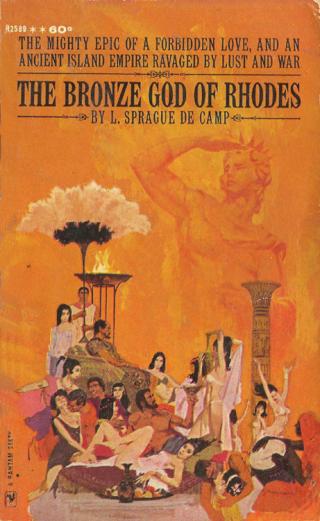
The Bronze God of Rhodes
- Автор: Де Камп Лайон Спрэг
- Год: 1963
- Язык: английский
- Год: Bantam Books
- Жанр: Научная фантастика

Электронная книга - «The Bronze God of Rhodes». Краткое содержание книги:
From the sea in thousands of ships they came, the brutal legions of Antigonos, a giant lusting for the power of Alexander the Great. For endless weeks and months they battered at the tiny island city, smashing it with monstrous weapons, crushing it with the terrible weight of their numbers.
Among the handful of grim defenders was one man who fought for a dream, a vision of a great statue that would stand above the highest towers as a monument to his city's grandeur.
He was Chares, soldier, adventurer, a man tormented by passion, a wanderer in strange, deadly lands—an artist who lived to see his incredible dream become one of the seven wonders of the world.
"There is—let's see—making a small model before beginning a full-sized statue; there is the life mask; there is the lost-wax method of casting. At least, these are the main ones."
"Explain them."
"Do you really wish to hear all about them?" I said, for I feared another disaster.
"Go ahead!" they cried. "We'll stop you when we become bored, fear not!"
So I plunged again into an account of the new techniques I had learnt. When my speech flagged, they shot searching questions at me. Lucky it was that I knew my subject; a poseur would soon have been stripped of his pretensions.
I also defended the modern realistic school of sculpture against the outmoded idealistic school of Pheidias and Polykleitos. "My master always said: 'If you want models, look about you! Be as faithful to nature as you can, and do not worry about how you compare with Pheidias.' But alas! Things being what they are, I don't know when I shall have a chance to practice these fine ideals."
"What mean you?" said Vindex of Rome.
I explained my difficulties with Diognetos and the Artists' Guild, wringing all the pathos from my plight of which it was capable.
Kallias, the Phoenician architect, said: "In Arados such shameful injustice would never be allowed."
"It is a shame," said Nikolaos, the full citizen. "Some of us on the Council think that old Diognetos, however brilliant he may have been, has become too rigid. It is all very well to conserve the wisdom of our forebears, but one should not reject all new ideas merely because they are new."
Vindex added: "You should have heard him roar when I suggested that he try arches of stone or brick, as we do, instead of these costly and fragile solid architraves."
"I can well believe it," said Nikolaos. "It was all we could do to get him to build some catapults of the torsion type. He said the flexion catapult had served Dionysios and Philip well, so why rush into some short-lived fad?"
"What was his objection to the torsion type?" I asked.
Nikolaos: "Too complex and hard to maintain, he said."
Giskon put in: "Time flees, so we must pass on to the next victim. Zenon of Kition, arise. Berosos, question him."
The Babylonian began with the same question that Gobryas had asked me, namely: how did Zenon justify his existence?
The young Phoenician twisted his hands and feet and finally answered: "I—I really cannot justify it at all, my masters. Th-that is, in fact, the thing I most ardently seek."
"Mean you that you seek justification for existing?" said Berosos.
"Yes. That is it."
"Why?"
"B-because I am not happy about it. I must know, why am I here? How should I live? How can I protect myself against the bludgeonings of Fate?" Zenon gained courage and fluency. "I've read the legends of the Phoenicians and the Judaeans and the Hellenes, as far as my business allowed me, and none satisfies me. In fact, they seem childish. Imagine, immortal gods breaking one another's heads, tumbling one another's wives, and massacring harmless mortals with lightnings and floods!"
Giskon munched up a fistful of chick-peas, saying: "What's the use of being a god if you cannot amuse yourself as you like?"
"Disgusting!" said Zenon without cracking a smile. "What sort of gods are those? If they are as foolish and lustful as men, why should we appeal to them for help? Something more rational must rule the universe."
Nikolaos said: "Advanced thinkers say those tales are merely allegories to convey deeper truths to the initiated."
"That may be, but how does that help a simple trader like me? How do I know, when I set out with a cargo of purple or spices, that a storm will not send my ship to the bottom, or that I shan't be seized by pirates and sold as a slave? When I come ashore in a fair city like this, what assurance have I that I shan't awaken to find the roaring mercenaries of some shameless warlord battering down the gates? How, in such a frightful world, can there be any relation between my virtue and my fate? How can I find a sound moral basis for my actions?"
"You might try the philosophers," said Nikolaos.
"I have never known a philosopher. Are there any in Rhodes?"
"There is Eudemos, who is editing the treatises of Aristoteles of Stageira. I believe, however, that he is in Miletos just now. You might arrange a trading voyage to Athens, where you will find more philosophers gathered than in any other city."
Giskon said: "Let's pass on to the last victim. I shall question Kallias of Arados myself. Tell us, O Kallias: How do you justify your existence?"
Kallias patted his hair into place, rose, and said: "First, my masters, let me thank you for a delightful banquet, far beyond my poor deserts.
"As to self-justification, I am, as you know, an architect, traveling in search of commissions. It is with some diffidence that I bring up the subject in the city of Rhodes, which has given such outstanding architects to the world. The great Deinokrates, for one, was born in Rhodes, albeit reared in Macedonia. Your present municipal architect, Diognetos, might well be numbered among the great architects. By comparison my achievements count for little.
"However, even the strongest cedar succumbs with time to age and rot. I am concerned whether this magnificent city be protected by the latest and most effective methods of siege warfare. We all know that in the last century siegecraft has been revolutionized. You may have heard of the invention of the movable suspended ram by my countryman, Pephrasmenos of Tyre; or of the inventions of Diades, who served the divine Alexander: his movable tower, his borer, his climbing machine, and his crane."
Zenon said: "If machines of war become any more frightful, people will insist on doing away with war altogether. This cannot go on."
"I sympatize with that idea," said Kallias, "but I fear that is easier said than done. To continue: Is Rhodes prepared to withstand assault by these and even more modern machines? Whilst I do not claim to read the minds of the warlords, it is known that the surest way to invite attack is to be unprepared for it."
"We have the friendship of Ptolemaios," said Nikolaos, "with all the wealth of Egypt behind him."
"Yes? And what will befall when the Antigonos and his all-daring son fight another round of their eternal war against the Ptolemaios? Will not Rhodes' very alliance with Ptolemaios bring the Antigonos upon you? Rich though the satrap of Egypt be, Antigonos is not poor either, and he is much closer to hand. Who knows the future?"
"The stars say—" began Berosos, but Kallias plunged on:
"Who knows but that the Antigonians and the Ptolemaians may destroy one another, leaving Kasandros or Lysimachos to pick up the remains? These are grim and ruthless men who will stick at nought to serve their ambition. If it suited them to pile the heads of every living being in Rhodes in the marketplace, be assured they would do it without a qualm. Are you ready for such an outcome? It is the municipal architect's duty to prepare the defense of the city. What has your Diognetos done?" Kallias ended with an impassioned gesture.
"I believe that our walls are in good condition," said Nikolaos. "We have an adequate artillery, with missiles, besides small arms and armor for all the men in the city."
"Think you that bows, slings, and catapults of the ordinary kinds will stop the great armored engines Demetrios could bring against you? Your artillery, I gather, is mostly of the solid-bow type. Modern torsion catapults will outrange and outshoot these and drive the defenders from the wall. You will be like a man fighting with a sword of lath and a shield of papyrus."
"Well, then, what would you?" said Nikolaos.
Kallias drew a long breath. "First, let me protest my un-worthiness and lack of personal ambition. I would not meddle in Rhodian affairs, save that I love the beauty of Rhodes and hate to think of her going down to destruction, as did proud Tyre within the memory of many here. I have, however, given thought to the defense of the city. Here are some of my ideas."