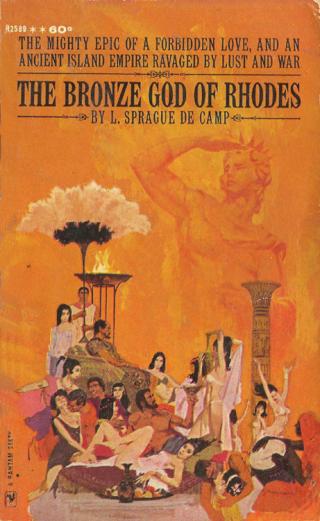
The Bronze God of Rhodes
- Автор: Де Камп Лайон Спрэг
- Год: 1963
- Язык: английский
- Год: Bantam Books
- Жанр: Научная фантастика

Электронная книга - «The Bronze God of Rhodes». Краткое содержание книги:
From the sea in thousands of ships they came, the brutal legions of Antigonos, a giant lusting for the power of Alexander the Great. For endless weeks and months they battered at the tiny island city, smashing it with monstrous weapons, crushing it with the terrible weight of their numbers.
Among the handful of grim defenders was one man who fought for a dream, a vision of a great statue that would stand above the highest towers as a monument to his city's grandeur.
He was Chares, soldier, adventurer, a man tormented by passion, a wanderer in strange, deadly lands—an artist who lived to see his incredible dream become one of the seven wonders of the world.
"Why, compute it for yourself. The Tarentine Zeus must weigh over a thousand times as much as a life-sized statue, as it's more than ten times as high."
"Is its skin ten times as thick?" asked Lykon. "That, it seems to me, would make an extravagantly costly construction."
"Not quite, but the difference is made up by the internal bracing needed. Someday I shall build an even bigger statue here in Rhodes."
"So?" said Lykon. "The Tarentine Zeus must be near the practical limit. You'll never erect a bigger one, even if you find some city so mad as to pay for the monstrosity."
"I will, too!" said I, smiting the table. "I'll erect a statue twice as tall as the Tarentine Zeus. You shall see!"
Lykon gave a short, derisive laugh. "I shan't want to be standing nearby when you take the scaffolding away."
Protogenes leaned over. "Boys! You are as silly as the old man and his wife who broke every dish in their house, fighting over the question of what they would have named a child if one had ever been born to them. Wait till Chares gets a contract for his superstatue before you quarrel over its design."
"Well," I said with a shrug that was meant to be magnanimous, "let's agree that mere size is less important than the revolutionary new methods of Lysippos and Lysistratos, which I shall tell you about later."
"Oh, pest!" said Strabon the potter. "Isn't it bad enough that we've got to learn this new Athenian trick of decorating pots with reliefs instead of painting, or get driven out of business, without you upsetting things even more?"
When the meal was over and the wine had been brought, Makar formally introduced me. "Chares will say a few words about his qualifications," quoth he.
I ought to have taken Makar at his word. However, I was still so full of my new ideas that I plunged at once into Lysippos' lost-wax method, in even more detail than I had given Diognetos that morning. I insisted that all the other methods of sculpture had been made obsolete, and that all sculptors would have to come to Lysippos or to those who, like me, had learnt from him.
"Were I mean and niggardly," I said, "I would keep this method secret. Instead, I offer it to all of you, asking but a reasonable payment for my time in teaching you. I advise you to apply soon, for otherwise you'll find yourselves hopelessly out of date."
Then I went on to tell of the various pieces that I had helped Lysippos with, such as his "Man Scraping Oil from Himself." I fear I enlarged on the part I had played in this work, until one might have thought that I had been the master and Lysippos the apprentice. I also boasted of my architectural and engineering studies in Athens.
So full was I of my message that I did not at first notice that my hearers had begun to squirm with impatience. At length their scowling, yawning, and whispering reminded me that I had been speaking longer than was altogether tactful. I finished my speech with a flourish of Lysippos' letter of commendation.
Somebody muttered: "If that's a few words, the gods protect us from a full-blown address!"
I expected that it would be moved that I be accepted into the Guild; that I be asked to step out while the matter was discussed and voted on; and that then all would be over but the congratulations. Instead, Protogenes stood up and said:
"As it is nearly midnight and too late for further business, I adjourn this meeting. Good night, blessed ones."
"But—" I said. "But what about me?"
Protogenes: "We will take up that matter at some future meeting. If we take any affirmative action, we will let you know."
"Don't hold your breath while waiting," said Lykon.
"Your mortal subjects bid you farewell, O god," said another.
"We shall see you again, we hope—after Protogenes has finished his 'Ialysos'," said yet another.
This brought a laugh, as Protogenes had been working on his huge picture for six years, and nobody thought he would ever complete it. I said to Makar:
"I'll see you home." When we were out of earshot, I asked: "What's wrong? They seem displeased."
"No wonder!" he said.
"But why?"
"Chares, are you out of your mind?"
"I think not. Why?"
"You come here, a young sprout just out of apprenticeship. You harangue the established artists of Rhodes for three hours, like you was a god teaching the first mortal men how to live civilized. You brag about how good you are and what wonderful things you're going to do. Then you wonder why they don't fall all over themselves welcoming you!"
"I only told them the truth!"
"That may be, but what do you suppose they think of your way of doing it?"
"I don't care what they think. I know my own worth and the value of my innovations, so it is for them to change their thinking, not me mine."
"You might as well say to a piece of clay that won't take the shape you want: 'It's for the clay to obey me, not for me to act humble to it.' But suit yourself. It's your life."
I trudged home in gloomy silence while the stalwart Kavaros walked ahead with his link. He said:
"Master dear, if you would only be listening to good advice, now—"
"Shut up!" I cried and aimed a kick at his shin.
The Kelt moved like a shadow. My kick went wide and caused me to stumble. As I recovered my balance, I heard a snicker. Grasping my walking stick in both hands, I swung. The stick struck Kavaros' shoulder and broke with a loud crack. The link fell to the ground and went out.
"Aral" he said. "That hurt, sir. Someday you will be doing that to a free man and it will not be well for you."
Although I was in a mood to kill anybody who crossed me, the quiet menace in Kavaros' tone made me pause. True, he was not likely to risk death by attacking me. But then, one could never tell with these irrational foreigners, and his execution would do me no good if I were no longer there to enjoy it.
With his usual lack of foresight, Kavaros had not brought any tinder to relight the link, so we groped our way home in darkness.
The next morning my father said: "The porter tells me that you came in after midnight. Your amusements are your own affair, but don't expect me to pay for them."
I told him what had happened, without hiding anything. He sighed. "I fear you learn only by the costliest mistakes, Chares. I wonder that Lysippos ever put up with you."
In fact, the Sikyonian had almost sent me packing thrice. My relations with him had been stormy. I exasperated him by my willfulness and by my insistence that I knew everything, while he goaded me to fury by teasing me about my size.
"Sculpture needs a big man with plenty of brute strength," he would say. "You, boy, would be better off as a dancer."
Or he would twit me about my Phoenician blood, saying: "That is Phoenician work, Chares. A Phoenician is all right if you want somebody to run a bank or sail a ship, but they have no more sense of beauty than a turtle. Having no art of their own, they can only make cheap copies of other nations' art."
I grimly stuck to my task, however, despite Lysippos' gibes. When we parted, he said: "You may make a sculptor yet, Chares my lad, if you do not cause someone to murder you first by that overweening manner."
Now I said: "It's unjust, Father. A man's fate should be determined impersonally, on the basis of his virtues and abilities alone, without regard to all these petty personal likes and dislikes."
My father replied: "Perhaps it should be but it isn't. If they like you, they'll excuse your faults; if they dislike you, they'll overlook your virtues."
"Then they're a lot of stupid fools!"
"Are you only just now learning that? But if they are, you won't change them, not in one lifetime. He wrongly Nature blames who suffers shipwreck twice."
"Well, I seem to have lost all my anchors. I can't get a commission from Diognetos until I can show him some work; I can't work without a studio; and I can't get a studio until I get a commission. Perhaps I ought to sell Kavaros and hire myself out to turn a stone in a gristmill, or take ship to Aspendos and enlist as a mercenary. I can bear my own oil flask if I must."