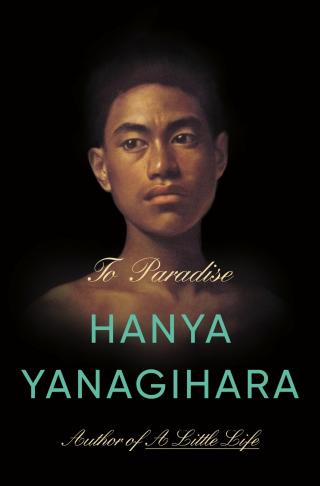
To Paradise
- Автор: Yanagihara Hanya
- Год: 2022
- Язык: английский
- Год: Knopf Doubleday Publishing Group
- Жанр: Современная русская и зарубежная проза

Электронная книга - «To Paradise». Краткое содержание книги:
In an alternate version of 1893 America, New York is part of the Free States, where people may live and love whomever they please (or so it seems). The fragile young scion of a distinguished family resists betrothal to a worthy suitor, drawn to a charming music teacher of no means. In a 1993 Manhattan besieged by the AIDS epidemic, a young Hawaiian man lives with his much older, wealthier partner, hiding his troubled childhood and the fate of his father. And in 2093, in a world riven by plagues and governed by totalitarian rule, a powerful scientist's damaged granddaughter tries to navigate life without him--and solve the mystery of her husband's disappearances.
These three sections are joined in an enthralling and...
But the man was surprisingly quick, and he darted out of the attendant’s way and ran instead toward our shuttle, and everyone on board, who had been silent and watching, gasped, as a single great intake of breath, and the driver, who had had to stop the shuttle so he didn’t hit the attendants, honked his horn, as if that might scare the man away. And then the man jumped up toward my window, and for just a moment, I saw his eye, the iris so large and glittering blue that I was very frightened, and I could finally hear what he was yelling, even through the window: Help me. And then there was a bang, and the man’s head kicked backward, and he fell out of my sight, and I could see the attendants running toward him; one of them had his weapon still held aloft.
After that, the shuttle started moving again, quite fast, as if driving faster could erase what had happened, and everyone became silent again, and I felt as if everyone were looking at me, as if they thought it was my fault, as if I had asked the man to try to communicate with me. People rarely spoke on the shuttle, but I heard a man announce, in a low voice, “He shouldn’t still have been on the island,” and although no one responded, you could feel that people agreed with him, and even I could sense that they were frightened, and that they were frightened because they were confused. But although people were often frightened about things they couldn’t understand, this time I agreed with them—someone that sick should have been sent away by now.
That day at work had been slow, which was unfortunate, because my mind kept returning to what had happened. But what I thought about most was not the man himself, or his bright eye, but about how, when he fell, he had made almost no noise at all, he was so light and soft. A few months after that, it was announced that the containment centers in Zones Eight and Nine were being relocated, and although there were stories about what that meant, we of course never knew for sure.
Since that day, there had been no further strange incidents in Zone Eight, and on this morning, I looked out the window and everything was the same, so predictable that it felt, as it sometimes did, less as if we were moving through it and more as if the city were a series of sets and performers moving past us on a track. Here came the buildings where people lived, and then the chain of children holding one another’s hands, and then Zone Nine, the two large hospitals now empty, and here the clinic, and here, just before the Farm, the row of ministries.
This was the sign that you were crossing into Zone Ten, the most important zone. No one lived in Zone Ten. Aside from some of the ministries, the district was dominated by the Farm, which had once been an enormous park that had bisected the island. It had been so big, this park, that it had accounted for a significant percent of the island’s acreage. I didn’t remember it as a park, but Grandfather had, and he used to tell me stories of how it had been crisscrossed with paths, both cement and dirt, and how people would run through it, and bicycle and walk, and have picnics there. There had been a zoo, where people would pay just to go look at strange, useless animals, who were expected to do nothing but sit and eat the food they were provided, and a lake, on which people would row small boats, and in the spring, people would gather to look at colored birds that had flown up from below the equator, and to find mushrooms and look at flowers. At various points there had been sculptures made of iron in whimsical forms that were meant to entertain children. A long time ago, it had even snowed, and people would come to the park and strap long, thin planks to their feet and shuffle across the low icy hills, which Grandfather said were slick and could make you fall, but not in a bad way—in a way that made people want to do it again and again. I know it’s now difficult to understand what this park had been meant for, but Grandfather said it hadn’t been for anything: It was simply for people to spend time in and enjoy. Even the lake was meant only for enjoyment—you went to float paper boats on it, or walk around it, or just sit and look at it.
The shuttle stopped at the main entrance of the Farm, and people got off and began queuing for the entrance. Only the two thousand or so people who were certified to work at the Farm could get in, and even before you joined the queue, you had to have a retinal scan to prove you had the right to enter, and there were always guards waiting with weapons in case someone tried to dash inside, which people occasionally did. You heard rumors about the Farm: that they were breeding new kinds of animals there—cows with two sets of udders, to produce double the amount of milk; brainless, legless chickens that could be packed, fat and square, into cages and would be fed by tubes; sheep that had been engineered to eat only waste, so that you wouldn’t have to use land and resources to grow grass. But none of these rumors had ever been confirmed, and if there were in fact new animals being made, we never saw them.
There are many other projects being worked on in the Farm as well. There are the greenhouses, where all sorts of new plants are being grown, both to eat and as possible medicines, and the Forest, where new kinds of trees are being raised, and the Lab, where scientists are working on creating new kinds of biofuels, and the Pond, where my husband works. The Pond is split into two parts: the animal-cultivating half and the plant-cultivating half. Ichthyologists and geneticists work in the first part, botanists and chemists work in the second. My husband works in the second, though he isn’t a scientist because he hadn’t been able to finish his graduate degree. He’s an aquatic gardener, which means that he plants the specimens that the botanists have approved or engineered—different algae, mostly—and then oversees the specimens’ growth and harvesting. Some of those plants will be developed as medicines, and some will be made into food, and the plants that can be used as neither will be turned into compost.
But though I say this, the truth is that I don’t actually know what my husband does. I think this is what he does—the planting and tending and harvesting—but I don’t know for certain, just as he doesn’t know for certain what I do.
This morning, as always, I looked out the shuttle window very hard, but, as always, there was nothing to see. The entire Farm is surrounded by a twelve-foot-high stone wall, and atop the wall, spaced a foot apart, are sensors, so that even if you were able to scale it, your presence would be detected almost immediately, and then you would be captured. Most of the Farm is beneath an enormous biodome, but there are a few feet near the southern wall that aren’t protected, and just beyond that wall are two rows of acacia trees that stretch along the entire border, from Farm Avenue West to Fifth Avenue. There were trees all over the city, of course, but you almost never saw them with leaves, which people picked—to boil for tea or broth—as soon as they appeared. Picking leaves was against the law, naturally, but everyone did it anyway. But no one dared to touch the leaves inside or around the Farm, and whenever the shuttle rounded the corner and turned east onto Farm Avenue South, you would see them, clouds of bright green, and although I saw them five days a week, I was always surprised when I did.