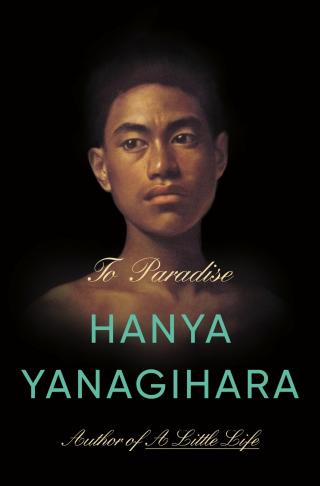
To Paradise
- Автор: Yanagihara Hanya
- Год: 2022
- Язык: английский
- Год: Knopf Doubleday Publishing Group
- Жанр: Современная русская и зарубежная проза

Электронная книга - «To Paradise». Краткое содержание книги:
In an alternate version of 1893 America, New York is part of the Free States, where people may live and love whomever they please (or so it seems). The fragile young scion of a distinguished family resists betrothal to a worthy suitor, drawn to a charming music teacher of no means. In a 1993 Manhattan besieged by the AIDS epidemic, a young Hawaiian man lives with his much older, wealthier partner, hiding his troubled childhood and the fate of his father. And in 2093, in a world riven by plagues and governed by totalitarian rule, a powerful scientist's damaged granddaughter tries to navigate life without him--and solve the mystery of her husband's disappearances.
These three sections are joined in an enthralling and...
You know what happened next, Kawika, perhaps better than I do. It was some months after you left—Uncle William told me it was seven months—that Edward drowned, and while his death was declared an accident, I sometimes wonder whether it was intentional. He had come there to find something, but he hadn’t had the strength to find it, and neither had I. I was meant to be his audience, and yet I hadn’t been able to, and without me, he had given up as well.
It was Uncle William who found his body on the beach on one of his visits, and it was that same day—after the police questioned me—that he had taken me back to Honolulu and to the hospital. When I awoke, I was in a room, and I had looked up and had seen the doctor, who was repeating my name and shining a bright white light into my eyes.
The doctor sat next to me and asked me questions: Did I know my name? Did I know where I was? Did I know who the president was? Could I count backward in increments of six from one hundred? I answered, and he wrote my answers down. And then, before he left, he said, “Wika, you won’t remember me, but I know you.” When I didn’t reply, he said, “My name’s Harry Yoshimoto—we went to school together. Do you remember?” But it wasn’t until that night, when I was alone in my bed, that I did remember him: Harry, the boy who had eaten rice sandwiches, and to whom no one had spoken; Harry, the boy I was grateful not to be.
And this was the end. I never returned to our house in the valley. After a while, they brought me here. Eventually, I lost the eyesight that remained; I lost the interest, and then the ability, to do anything. I lay in bed and dreamed, and time blurred and softened, and it was as if I had never made any mistakes. Even you—now, I was told, at another school, on the Big Island—even you, who never visited, even you I could conjure nearby, and sometimes, if I was very lucky, I could even fool myself into pretending I had never known you to begin with. You would be the first Kawika Bingham not to graduate from the school—who knew what else you would be the first Kawika Bingham to do? The first to live abroad, maybe? The first to be someone else? The first to go somewhere very far away, somewhere so far that it made even Hawai‘i look close to someplace else?
I was thinking about this when I woke today, to the sounds of someone crying—crying, but trying not to, her breath coming out in hiccups. “I’m sorry, Mrs. Bingham,” I heard someone say. “But it’s as if he’s willing himself to go—we can only keep him alive if he wants to be.” And then the sound again, that desperate, sad sound, and the voice once more: “I’m sorry, Mrs. Bingham. I’m sorry.”
“I shall have to write my grandson—my son’s son,” I heard her say. “I can’t tell him this over the phone. Will I have time?”
“Yes,” the man’s voice said, “but tell him to hurry.”
I wished I could have told them not to worry, that I was getting better, that I was almost well. It was all I could do to keep from smiling, from shouting with joy, from calling your name. But I want it to be a surprise—I want to see your face when you walk through the door at last, when you see me jump out of bed to greet you. How surprised you’ll be! How surprised they’ll all be. Will they applaud for me, I wonder? Will they be proud? Or will they be embarrassed, or even angry—embarrassed that they’d underestimated me; angry that I had made them into fools?
But I hope they don’t feel that way, for there’s no time to be angry. You are coming, and I can feel my heart pounding faster and faster, the blood thrumming in my ears. For now, though, I’m going to keep practicing. I’m so strong now, Kawika—I’m almost ready. This time, I’m ready to make you proud. This time, I won’t let you down. All along, I had thought that Lipo-wao-nahele would be the only story I could tell about my life, but now I know: I’m being given another chance, a chance to make another story, a chance to tell you something new. And so tonight, when it’s dark, and this place is quiet around me, I’ll get up, I’ll retrace my route to the garden, and this time, I’ll let myself out through the back door and into the world. I can already see the treetops, black against the dark sky; I can already smell the ginger all around me. They were wrong: It’s not too late, it’s not too late, it’s not too late after all. And then I’ll start walking—not to my mother’s house, not to Lipo-wao-nahele, but to somewhere else, the same place I hope you’ve gone, and I won’t stop, I won’t need to rest, not until I make it there, all the way to you, all the way to paradise.
book iii
ZONE EIGHT
PART I Autumn 2093
PART II Autumn, fifty years earlier
PART III Winter 2094
PART IV Winter, forty years earlier
PART V Spring 2094
PART VI Spring, thirty years earlier
PART VII Summer 2094
PART VIII Summer, twenty years earlier
PART IX Autumn 2094
PART X September 16, 2088
PART I
Autumn 2093
Normally, I catch the 18:00 shuttle home, which drops me off at Eighth Street and Fifth Avenue somewhere between 18:30 and 18:40, depending on disruptions, but today I knew there was going to be a Ceremony, so I asked Dr. Morgan if I could leave early. I was worried the shuttle would get stalled near Forty-second Street, and then who knew how long I would be delayed, and then I might be too late to buy dinner for my husband. I was explaining all this to Dr. Morgan when he interrupted me. “I don’t need to hear all the details,” he said. “Of course you have permission. Take the 17:00 shuttle.” So I thanked him and did.
The passengers on the 17:00 shuttle were different from the passengers on the 18:00 shuttle. The 18:00 passengers were other lab techs and scientists, even some of the principal investigators, but the only person I recognized on the 17:00 was one of the janitors. I even remembered to wave at her, just a second after she passed me, turning in my seat to do so, but I don’t think she saw me, because she didn’t wave back.
As I had predicted, the shuttle slowed and then stopped just south of Forty-second Street. The windows on the shuttle are covered with bars, but you can still see everything outside pretty well. I had chosen a seat on the right so I could see the Old Library, and sure enough, there were the chairs, six of them, arranged in a row facing the avenue, although no one was sitting in them and the ropes hadn’t yet been uncoiled. The Ceremony wouldn’t begin for another two hours, but there were already radio technicians strolling about in their long black coats, and two men were filling the wire trash cans with rocks from the back of a big truck. It was the truck that had stopped the flow of traffic, but there was nothing we could do except wait until the men had filled all the trash cans and then had climbed back into the truck and moved out of the way, and from there, the rest of the trip was very fast, even with the checkpoints.