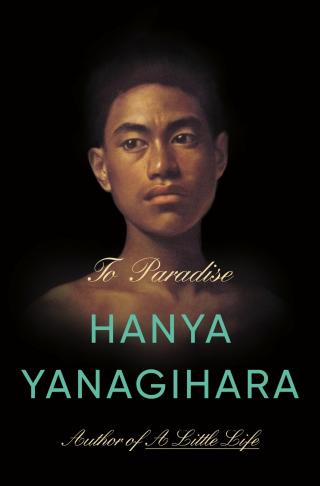
To Paradise
- Автор: Yanagihara Hanya
- Год: 2022
- Язык: английский
- Год: Knopf Doubleday Publishing Group
- Жанр: Современная русская и зарубежная проза

Электронная книга - «To Paradise». Краткое содержание книги:
In an alternate version of 1893 America, New York is part of the Free States, where people may live and love whomever they please (or so it seems). The fragile young scion of a distinguished family resists betrothal to a worthy suitor, drawn to a charming music teacher of no means. In a 1993 Manhattan besieged by the AIDS epidemic, a young Hawaiian man lives with his much older, wealthier partner, hiding his troubled childhood and the fate of his father. And in 2093, in a world riven by plagues and governed by totalitarian rule, a powerful scientist's damaged granddaughter tries to navigate life without him--and solve the mystery of her husband's disappearances.
These three sections are joined in an enthralling and...
We went to the kitchen and you began making us dinner. I sat and watched you move about, putting the shoots aside so I could eat them when you had left, taking the ground pork out of the refrigerator. Even then my eyesight was vanishing, but I could still sit and watch you and admire how handsome you were, how perfectly you had been made.
Jane had been teaching you to cook—just simple things, like noodles and fried rice—and when you came to stay with us, you were the chef. Recently, you had learned to bake, and on this trip, you had brought fresh eggs and flour with you, as well as milk and cream. The next morning you would make me banana bread, you said. The previous two times you had come, you had been surly and snappish, but when you arrived this morning, you were merry and light, whistling as you unloaded the groceries. I was watching you, so full of affection and yearning that I could barely speak, when I suddenly recognized your state of happiness—you were in love.
“Da, will you put the cream and milk in the refrigerator?” you asked. “I have some more supplies to bring in.” When you were young, Uncle William had never sent you with supplies, but now he sometimes did, and I would watch as you unloaded rolls of toilet paper and bags of food and even, sometimes, cords of wood, while your grandmother sat behind the wheel of the car, looking out the window toward the sea.
You left, and I remained on my chair (our only chair), staring at the kitchen wall, wondering who you were in love with and if she loved you back. I sat there, dreaming, until you called me again—you had to beckon us both like dogs by then, the two of us obediently answering to our names, trudging toward you—and I followed you to dig up the bamboo shoots.
I was thinking of this, that morning, your dreamy, inward smile, as you muttered to yourself, reaching into the refrigerator for the peppers and zucchini you’d need for your stir-fry, when I heard you curse. “Jesus Christ, Da!” you said, and I focused my gaze to see you holding up the bottle of cream, which I’d forgotten to put away when you told me to. “You left out the cream, Da! And the milk! Now they’re ruined!”
You slammed the cream down in the sink and turned back to me. I could see your teeth, your bright black eyes. “Can’t you do anything? The only thing I asked you to do was put away the cream and milk, and you can’t even do that?” You came over to me, grabbed me by the shoulders, and started to shake me. “What’s wrong with you?” you cried. “What’s the matter with you? Can’t you do anything?”
I had learned, over the years, that the best thing to do when you were being shaken was not to try to fight back but to go slack, and so I did, letting my head loll on its stem, letting my arms go limp, and finally you stopped and pushed me so hard that I fell from the chair to the ground, and then I saw your feet running away from me, and heard the front screen door bang shut.
When you returned, it was night. I was still lying where I had fallen. The pork, left on the counter, had spoiled as well, and in the glow of the lamp, I could see little gnats swarming above it.
You sat down beside me, and I leaned against your warm, bare skin. “Da,” you said, and I struggled to sit up. “Here, let me help you,” you said, and put your arm behind me and helped me sit. You gave me a glass of water. “I’m going to make something to eat,” you said, and I heard you throw the pork into the garbage can, and then begin chopping vegetables.
You made us two plates of stir-fried vegetables with rice, and we both ate them right there, sitting on the kitchen floor.
“I’m sorry, Da,” you said, eventually, and I nodded, my mouth too full to answer. “I get so frustrated with you sometimes,” you continued, and I nodded again. “Da, can’t you look at me?” you asked, and I lifted my head and tried to find your eyes, and you took my head between your palms and brought it close to your face. “Here I am,” you whispered. “Do you see me now?” And I nodded once more.
“Don’t nod, speak,” you instructed, but your voice was gentle.
“Yes,” I said. “Yes, I see you.”
I slept indoors that night, in your room, in your bed: Edward wasn’t around to tell me I couldn’t, and you were going to go night fishing. “What about when you come back?” I asked, and you said you’d just climb in next to me, and we’d sleep side by side, like we used to in our tent. “Come on,” you said, “take the bed,” and although I should have argued with you, I did. But you never came to join me, to keep me company, and the next day, you were quiet and distant, the joy of the previous morning disappeared.
That weekend was the last time I ever saw you. Two weeks later, I was sitting on the tarp and waiting for you when Uncle William drove up, and when he got out of the car, his arms and hands were empty. He explained that you couldn’t come this weekend, that you had a school function, something you couldn’t miss. “Oh,” I said, “will he come next weekend?” And Uncle William nodded, slowly. “I should think so,” he said. But you didn’t, and this time Uncle William didn’t come to tell me, and it wasn’t until another month that he arrived again, this time with food and supplies, and a message: You weren’t returning to Lipo-wao-nahele, not ever. “Try to see it his way, Wika,” he’d said, almost pleadingly. “Kawika’s growing up, son—he wants to be with his friends and classmates. This is too hard a place for a young man to be.” It was as if he was expecting me to argue, but I couldn’t, because everything he said was true. And I knew what he meant, too: It wasn’t that Lipo-wao-nahele itself was too difficult a place to be; the difficult part was being with me, the person I had become—or perhaps always had been.
A lot of people think they’ve wasted their lives. When I was in college on the mainland, it had snowed one night, and the following day, classes were canceled. My dorm room overlooked a steep hill that led to a pond, and I stood at my window and watched as my classmates spent the afternoon sledding and tobogganing, sliding down the hill before slogging back up, laughing and holding on to one another in exaggerated exhaustion. It was evening before they returned to the dorm, and through my door, I could hear them talking about the day they’d had. “What have I done?” I heard one boy groan, in mock despair. “I had a Greek paper to write for tomorrow! I’m wasting my life!”
They all laughed, because it was absurd—he wasn’t wasting his life. He would go on to write the Greek paper, and then pass the class, and then graduate, and years later, when he was seeing his own son off to college, he’d say, “Have fun, but not too much,” and he would tell him the story of when he was in college, and the day he’d wasted sledding in the snow. But there’d be no real suspense to the story, because they would both know the ending already.
I, however, had wasted my life. Aside from you, the only thing I had ever accomplished was not leaving Lipo-wao-nahele. But not doing something is not the same as doing something. I had wasted my life, but you weren’t going to let me waste yours as well. So I was proud of you for leaving me behind, for doing what I was unable to do—you wouldn’t let yourself be seduced or fooled or spellbound; you would leave, and not just leave me, and Lipo-wao-nahele, but you would leave everything else as welclass="underline" the island, the state, history, who you were meant to be, who you might have been. You would discard it all, and when you had, you would find yourself so light that when you stepped into the ocean, your footfall wouldn’t even sink but would instead skim atop the surface of the water: There you’d begin walking, east, toward a different life, one where no one knew who you were, not even yourself.