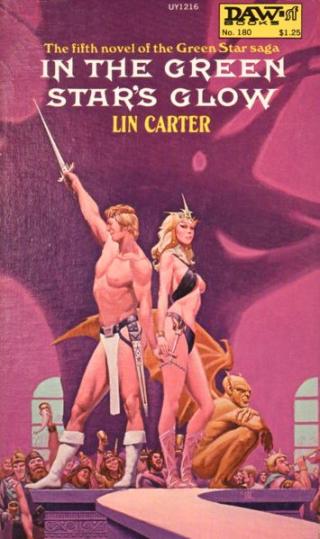
In the Green Star's Glow
- Автор: Картер Лин Спрэг
- Серия: Green Star Rises #5
- Язык: английский
- Жанр: Научная фантастика

Электронная книга - «In the Green Star's Glow». Краткое содержание книги:
But he was also an Earthling, whose helpless body lay in suspended animation in a guarded mansion in New England. It was his alien mind that drove Karn through perils that no other wold dare...
In the Green Star's Glow is a science fantasy novel in the tradition of Edgar Rice Burroughs. Written by American author Lin Carter, it is the final book in his Green Star series. It was first published in 1976.
“It serves no purpose to struggle against the grip of the flower, manling. Wiser to rest and conserve your strength, and wait for the fall of darkness,” said the monster insect.
Zorak jerked his head around in amazement. The metallic sounds while resembling speech, could only have come from the tongueless killer-ant. After a moment of dazed surprise, he spoke in return.
“Am I losing my wits, kraan, or did you speak just now?” he demanded.
The insect jerked its brow antennae toward him in a gesture very much like a human nodding acquiescence.
“Xikchaka spoke.”
Zorak muttered a dazed oath. “Never before have I heard that the mighty kraan of the restless hordes could converse with the tongue of men,” he observed.
“Nevertheless, it is so,” remarked the kraan, whose name seemed to be Xikchaka. “Among ourselves, we of the hordes have another means of conveying intelligence. But from those of your kind, manling, whom we have enslaved, we have gradually come to understand and to duplicate your mode of speech.”
This time, Zorak had listened closely and had also watched the mouth of the great ant. Its head was a featureless casque, a helmet of smooth, slick, horny chitin. Its eyes were like complex black jewels carved in many facets. The light of intelligence shone in those cold eyes, for all that the voice it uttered was devoid of inflection and the fact itself was incapable of any change of expression.
The mouth of the kraan was merely an opening in the underside of its tapering helmet of a head. Bladelike members sprouted in it, and at either corner of the orifice small mandibles branched, like the claws of a lobster. In reproducing the phonemes of human speech, the kraan cleverly manipulated these implements in a very complex manner. The harsher consonants were made by grating, clashing, or scraping the mandibles against the bladelike cutting surfaces within the orifice itself. The softer consonants and the vowels were accomplished by rasping the backside of the toothed claws against the smooth chitin of the creature’s muzzle. The soft plosives and the more breathy vowels were beyond the capabilities of the kraan to duplicate. This left gaps in its speech which took a little getting used to before you could clearly understand its words. The more they conversed, the easier it became for the Tharkoonian archer to comprehend the words of its weird and inhuman companion in peril.
After they had talked for a time, Zorak renewed his struggles against the many small, glossy tendrils with which the inner surfaces of the crimson petals were coated so furrily. Again, as before, his struggles resulted in failure. And again Xikchaka the giant ant cautioned him to conserve his strength and await the coming of night, or, as the kraan phrased it, the “dark-time.”
“Why?” Zorak asked peevishly. “What happens when night falls?”
“The flower petals close,” advised the insect-creature.
“I fail to see how that will benefit us,” said the bowman.
“As the petals begin to close, they will bring Xikchaka and Zorak within reach of each other,” said the kraan in its grating, clicking equivalent of human speech. “And then Xikchaka and Zorak may be able to loosen or free each other.”
Studying the manner of the petals, the Tharkoonian perceived what had already become obvious to the coldly logical insect. They were stuck fast to opposite petals, and, always taking into consideration that the petals when fitted together, would match tip to tip, they should then be so close to each other that Zorak with his fingers could pluck and tear loose the tendrils which clung about the many limbs of Xikchaka, while the insect-creature, for his part, could do the same for Zorak, using his pincers, claw-tipped mandibles, and other members in lieu of hands.
There was, then, nothing to be done before nightfall. The long, weary day dragged with interminable slowness toward its end. For the beginning period of his imprisonment, Zorak had nourished within his heart the hope that Niamh the Fair would fly the sky-craft down to effect his rescue. Since this had not as yet occurred, and as more than a few hours had passed since he had fallen into the clutches of the predatory flower, obviously something had interfered with her freedom of action. Or, quite simply, she did not possess the knowledge or skills required to pilot the flying vessel.
It did not, as it happened, even occur to Zorak that the Princess of Phaolon thought him fallen into the abyss and long since dead. From the position in which he was helplessly bound, he could not clearly see the great branch far above them, for if he had been able to observe its position, he would have realized that from the edge of the branch above him the girl simply could not see the great flower where it grew.
Night fell, black winged, smothering the light. As the huge red ant had predicted, the petals of the monstrous cannibal flower began to close together. They moved jerkily and in random spasms, but it was obvious to the stalwart bowman that soon he and the kraan would be face to face.
They had only a short time to set each other free, or both would smother in the thick, clinging maw of the man-eating monster.
Then the blossom closed, and suddenly Zorak found himself gasping for breath.
At the same moment he felt the cold touch of the kraan’s jaws grasping for his throat.
Had the skies of the Green Star World been eyed with stars instead of veiled behind perpetual mists, they might, after a time, have observed an unusual and unprecedented sight.
From a long rent torn in the underside of a monstrous flower there issued slowly and weakly into the open air the form of a man. From head to foot his body was smeared with a sticky fluid. His limbs and torso were scored with abrasions and bruises, but he lived and seemed uninjured.
Reaching back into the heart of the torn blossom, he helped another creature forth into the air. It was a gigantic scarlet insect, like a huge red ant grown to the size of a hippopotamus.
Despite its mighty proportions, this second creature to emerge from the throat of the vampire blossom moved feebly, its many jointed limbs twitching erratically, its chitin-clad form glistening with the slobber of the man-killing plant.
Man and insect helped each other farther up the surface of the mighty branch to which the flower, now wilting, fluids leaking from the long tear in its throat, clung with many rootlets.
For the first time in the long history of this strange and wondrous world of many marvels and mysteries, a child of the race of men had found an unlikely ally with one of the cold, logical, merciless kraan.
And for the first time since the evolution of their races, a member of the kraan hordes had an inkling of the meaning of a great and noble and very beautiful word; friendship.
8.
Escape to Peril
They spent that night together upon the great branch, nestling in the hollow socket from which a small bough had once protruded, burrowing among dead leaves.
Every instinct in the heart of Zorak the Bowman urged him to quit the company of the kraan, but the Tharkoonian closed his ears to those inner urgings and remained in proximity to Xikchaka. Although the ant and human were natural enemies, the huge insect-creature was greatly debilitated by his captivity in the toils of the cannibal flower and could hardly propel himself along the branch. Obviously, the great ant had been imprisoned in the blossom for days without food or drink.
Zorak assisted the kraan to the hollow place in the branch, then reconnoitered to find food and water. He found water in a natural cistern—one of the dead leaves which, dry and tightly curled, was as long as a canoe. He also found a giant acorn shell in which he carried water to the helpless kraan. For food he came upon and killed one of the immense tree-snails, whose tender meat sufficed for both of them.