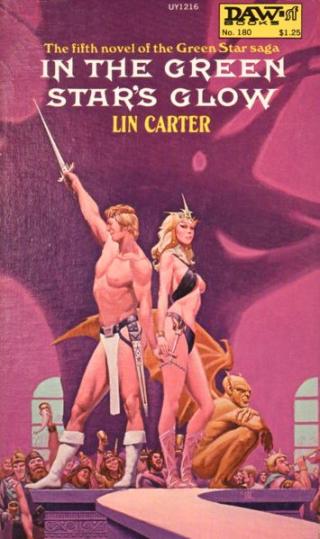
In the Green Star's Glow
- Автор: Картер Лин Спрэг
- Серия: Green Star Rises #5
- Язык: английский
- Жанр: Научная фантастика

Электронная книга - «In the Green Star's Glow». Краткое содержание книги:
But he was also an Earthling, whose helpless body lay in suspended animation in a guarded mansion in New England. It was his alien mind that drove Karn through perils that no other wold dare...
In the Green Star's Glow is a science fantasy novel in the tradition of Edgar Rice Burroughs. Written by American author Lin Carter, it is the final book in his Green Star series. It was first published in 1976.
As they came within clear view of the mighty branch below, Zorak saw a sight which plunged him, into the depths of gloom.
The branch was aswarm with literally thousands of the kraan.
Hope died within his breast at the sight. From a few of the giant insects, he might perhaps have won free by trick or luck or daring. But from amid the full number of the scarlet horde, a hundred men could not have battled to freedom.
A tether was looped about his throat by nimble mandibles. In no time he was added to the end of a line of Laonese captives. They were a ragged, half-starved, dispirited lot, and their woeful, cowed condition did not bode well for the immediate future of Zorak the Bowman. But that was not what bothered him; it was that Xikchaka paid not the slightest heed to his predicament, nor even deigned to look at him.
Enslaved to the ant horde, Zorak was led off with the other captives down the great branch.
9.
Preparations for War
Zorak the Bowman soon discovered the meaning of slavery. The kraan horde had many human captives, and among these he found men from several of the treetop cities. There were slaves from Kamadhong and from Ardha, the city of Akhmim the Tyrant where once Zarqa and Janchan and I had labored to rescue Niamh the Fair. There were even among the captives of the ant-army men from Niamh’s own city, Phaolon.
Some were hunters seized while far from their accustomed place; others were the survivors of war parties which had been attacked by the kraan; still others had been peaceful merchants, travelers, or traders en route between various of the Laonese cities.
There were even a certain number of forest outlaws—the homeless exiles, driven from their cities for one or another criminal offense, who had made a new home amid the wilderness of giant trees. Some, as well, were forest savages taken in war. There were many such tribes of primitive barbarians who dwelt in the giant trees; I, Karn, was one of these last.
It puzzled Zorak that the ant-army should bother taking captives at all, or, having taken them, that the red ant warriors should bother keeping them alive. But the stalwart bowman from far Tharkoon soon stumbled upon the reason for this peculiarly un-antlike behavior trait. The insect-creatures, although of considerable intelligence and admirably suited by nature to their environment, lacked certain skills which only their human slaves possessed.
The problem lay in the very nature of the kraan, as opposed to human beings. I have described the insect-creatures as red ants, grown to enormous proportions, and this indeed they were. A scientist of my native world, given the opportunity to study the kraan, might notice differences in anatomical details between the kraan and their minuscule Terrestrial cousins. But whether or not they were true ants down to the smallest detail, or merely resembled the Earthly insects so closely as to seem antlike to the untutored eye, is a matter of trifling importance. They were more antlike than not.
Now ants have multiple limbs, and these limbs terminate in mandibular extremities. However cunningly nature has devised these mandibles, they simply are not of the same construction as human hands. The kraan, therefore, are unable to manipulate objects with the degree of manual dexterity of which human beings are capable. Our hands, with their swivel-socket wrists and opposing thumbs, are uniquely designed for the use of tools. The mandibles of the kraan are not.
But the kraan were of sufficient intelligence to be tool-making and tool-using creatures. Their coldly logical minds were aware of the advantages afforded to those races which are equipped by nature to employ the use of tools and weapons. Lacking the ability to use instruments more sophisticated than mere sticks or poles limited the skills of the kraan and put them at a disadvantage compared to their principal enemies and rivals for dominance—which is to say, the race of men.
By themselves, the kraan were unable to control their environment. But through the use of human captives, whose skills were at the service of their insect masters, the kraan were as dangerous to the men of the treetop cities as they were to each other.
It had become the custom of the ant-army to take as many human captives as possible, and these slaves were employed in a variety of skilled crafts. They kept records and made mathematical computations for their insect masters; they devised tools and weapons adapted, wherever possible, to the structure of the kraan mandibles. They scraped the hides and intestines of beasts for the manufacture of bowstrings and catapult cables, manufactured a variety of sword-blades, spearpoints, knives and daggers; and in all ways served the kraan in those areas of endeavor for which nature had inadequately suited the limbs of the warrior ants.
Zorak was new to the treetop world, for his native city, Tharkoon, was built upon a spur of land which jutted out into the blue waters of the Komarian Sea. His race was a nation of landsmen who tilled the soil and fished the seas. The unique perils and protections afforded to those of the Laonese who dwelt a mile or more aloft on the branches of the arboreal giants were matters upon which the bowman had never before found reason to ponder. But even he, as inexperienced in this setting as he was, could realize the enormous menace the kraan represented to the tree kingdoms.
On their own, the giant insects were fearsome and dreaded opponents. Armored entirely in tough, horny chitin, they were shielded from the bows and spears of human armies. With a logical, unemotional intelligence comparable to that of the human brain, they were as cunning and skillful tacticians as were their human foes. Armed with sharp clawlike extremities, bristling with powerful many-jointed limbs, each ant warrior, could hold at bay three or even four human soldiers.
But when, to these inherent advantages, was added a full use of the crafts and skills possible to their human slaves, the scarlet horde became a double threat to the survival of the kingdoms of men.
It was not a pleasant thought to think upon, and the sleep of Zorak that first night was troubled by dark and ominous dreams.
During the next day the brave bowman struck up a friendship with one of the smiths, a burly-chested fellow who called himself Xargo of Kamadhong. The smith told Zorak that he had been captured by the horde about a year ago, as nearly as he could measure the passage of time, which was without any particular accuracy, as I have elsewhere explained.
Xargo had been employed all this while, he told Zorak, in the manufacture of sword-blades and spear-tips, and in the making of arrowheads. Quite a considerable number of the other slaves of the kraan were employed in similar warlike manufacture, very many of which captives Xargo himself had taught the art of smithery. He began to instruct Zorak in the requisite skills, for it was the goal of the leader of the horde that every kraan in the giant army should be fully equipped for war.
The Laonese manufacture metals, but do not mine for ore. The only exception to this practice may be the Komarian isles and seacoast cities, but I cannot say for certain. At any rate, in lieu of bronze, copper, iron, or steel—all of which metals can only be obtained by surface or subsurface mining—the Laonese employ a peculiar transparent metal like glass hardened to the toughness, the resilience, and the sharpness of steel.
In the treetop cities, these metals are derived from the sap of the giant trees by a method of chemical distilling for which I can find in the English language no precise equivalent. Metals are held in suspension within the sap of the forest giants, and are “grown” in molds like some manner of organic crystals. I have never actually seen this done, due to the brevity of my stay in any of the Laonese cities I have yet visited, and therefore cannot describe with more precision just how it is accomplished. But, however the thing is done, Xargo soon began teaching the skills to Zorak, on instruction of the insect-creatures.