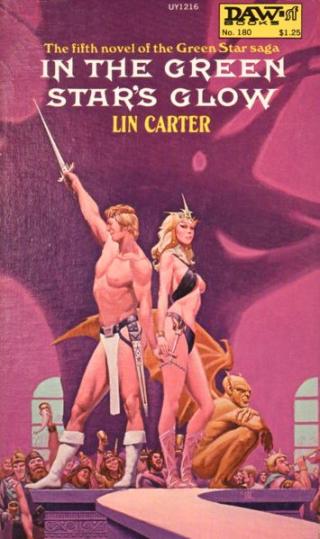
In the Green Star's Glow
- Автор: Картер Лин Спрэг
- Серия: Green Star Rises #5
- Язык: английский
- Жанр: Научная фантастика

Электронная книга - «In the Green Star's Glow». Краткое содержание книги:
But he was also an Earthling, whose helpless body lay in suspended animation in a guarded mansion in New England. It was his alien mind that drove Karn through perils that no other wold dare...
In the Green Star's Glow is a science fantasy novel in the tradition of Edgar Rice Burroughs. Written by American author Lin Carter, it is the final book in his Green Star series. It was first published in 1976.
The horde progressed on forced daily marches through the sky-tall forest, growing ever nearer and nearer to unsuspecting Phaolon. The ant warriors became increasingly familiar and expert in the use of the weapons manufactured by Xargo and his assistants.
Many times during the march Zorak saw Delgan from afar, but the traitorous blue man was always amid the retinue of the king-ant and did not seem to observe or to recognize the Tharkoonian bowman.
On more than one occasion, Zorak encountered his former fellow captive, Xikchaka. Generally, this occurred during one or another of the errands he performed at the request of the master-smith. On none of these occasions did he have the opportunity to exchange any words with Xikchaka—not that he felt particularly inclined to exchange polite words with the kraan he had rescued and tended, and who had then betrayed him into the captivity of the horde.
The motives of Xikchaka in this act of betrayal were quite beyond the imagination of the bowman. Men such as he prize the bond of friendship, loyalty, and comradeship beyond most other allegiances. Zorak would far rather have betrayed his allegiance to Prince Parimus, or to the city of Tharkoon itself, rather than betray a friend.
He was aware that concepts such as loyalty and friendship between comrades were alien to the emotionless mentality of the kraan, and therefore he could not exactly come to hate Xikchaka, who remained true to the instincts of his kind. The kraan, like the Earthly insects they so closely resemble in all matters save that of size, share the so-called hive mentality. They are not so much individual entities as they are units in a group or community. To that community they owe primary obligations which vastly outweigh individual whim or debt or inclination. It is like the difference between a slave state and a free republic; in the slave state, the individual exists only to serve the state, and his personal inclinations are of distinctly secondary importance; but in the true republic, the state exists primarily to serve the individual, whose first obligation is to himself. So Zorak could hardly blame the cold, emotionless kraan for what seemed to him a betrayal; their friendship had been too brief, it seemed, for him to have taught the warrior ant the meaning of that noble and beautiful word—“friendship.”
As the horde approached the outskirts of that portion of the world-forest under the dominance of Phaolon, the kraan began taking extraordinary precautions to avoid premature discovery by the Phaolonese.
Chevaliers of Phaolon, mounted on fleet-winged zaiph, ranged as scouts over that portion of the forest which lay in proximity to the Jewel City, ever alert to danger. The ant horde concealed itself as best it could during the hours when the Green Star was aloft, and only under cover of darkness did the horde advance toward the city of Niamh the Fair.
It was an uncanny experience to Zorak. By night, when the moonless gloom lay thick and unbroken upon the whispering forest, the chittering and rustling horde of monster insects poured like a crawling tide down the branches of the great trees, with the human captives borne helplessly along amid the flowing wave of insect-creatures.
Security was at a maximum pitch now, and vigilant ant sentries kept careful watch on the slave population.
The only hope the human captives had for making a break for freedom lay either in the moment of attack upon the city, when the ant horde would be otherwise engaged and much too busy to watch over their slaves, or in some unexpected diversion which might occur between the present moment and the attack.
What this diversion might be, Zorak had no way of guessing in advance. But he watched and waited, and so did his fellow captives. Even those who had been imprisoned so long they had grown apathetic became infected with Zorak’s determination for escape. The humans whispered among themselves and laid their plans with care, largely ignored by the kraan, who held men in contempt and considered themselves to be the evolutionary superiors of humanity.
Zorak believed that such a diversion could come at any moment, and organized the captives to be ever on the alert and ready to strike boldly for freedom when the diversion came.
Day broke, and the ant horde concealed itself on the underside of the gigantic branch, or hid motionless beneath thick canopies of verdure.
Night fell, and the horde marched upon Phaolon.
And then came the moment for which Zorak had so long waited.
The Third Book
IN THE OPAL TOWER
11.
Karn in Chains
The girl savages, who had found me asleep in the skysled and had made me their captive, had their camp far out on a branch of the mighty tree, where several smaller branchlets diverged from the central bough.
Here leaves sprouted in thick clouds of tissue-of-gold, forming a screen which effectively shielded their settlement from chance scrutiny.
The camp itself was an exceedingly ingenious complex of huts and cabins built on several levels, and connected by aerial walkways and rope-bridges, with porches and verandas roofed by leaf-bearing twigs cunningly bent awry, and all manner of ladders and steps leading from one level to another. All of these structures were built of the same wood as the branches themselves, which served as additional camouflage to conceal the existence of the camp from the eyes of enemies bestial or human.
The wild girls had stripped me to the buff in order to amuse themselves by shaming and humiliating me, but I endured my captivity and their scorn with whatever stoicism I could muster.
Wearying at length of making sport of me, my mistress, the thirteen-year-old hoyden they called Varda, assigned me to menial tasks. I was set to work scrubbing the cook-pots and cleaning the acorn-cup dishes and other kitchen implements, and at mealtimes I brought food to the tables where the girls ate.
As nearly as I could tell there were twenty or more of the Amazon girls in the encampment. As I came to know them better, I decided that Varda’s chief rival for the chieftainship, the girl called Iona, was probably older than the rest, being at most fifteen. I have elsewhere described Iona, but I will reiterate by saying that she was not tall for her age, but more firmly fleshed and a bit more voluptuous of bosom, hips, and thighs than the other, mostly younger, girls of the band. Her skin was the color of old parchment, and she had huge eyes of tawny amber, and floating hair of thistledown-silver. Unlike the littler girls, who scampered about naked except for a bit of hide twisted about their loins, she went decently covered.
Varda, the girl who “owned” me, was about two years her junior, a snub-nosed, wide-mouthed, freckle-faced young tomboy with supple, nimble limbs and a firm if shallow bosom inadequately covered by the tanned hide she wore strapped about her with thongs. Whereas Varda treated me scornfully, brusquely ordering me about and gleefully seizing upon every conceivable excuse to punish me or insult me, Iona bore an ill-concealed hatred of me, seemingly because I was of the male sex, with no other reason ever enunciated. Iona would have killed me had she dared, but Varda and the other girls wished to keep me alive if only as something to bully and mistreat.