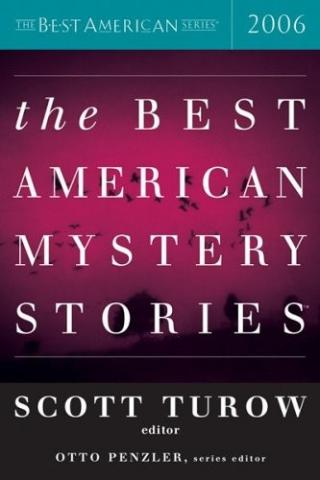
The Best American Mystery Stories 2006
- Автор: Дивер Джеффри, Хантер Эван
- Год: 2006
- Язык: английский
- Год: Houghton Mifflin Harcourt
- ISBN: 978-0-618-51746-6
- Жанр: Другие детективы

Электронная книга - «The Best American Mystery Stories 2006». Краткое содержание книги:
I bought Henry a soda and let him harangue me about the lush Scotch on the rocks I was nursing. I endured him waving the glass under my nose, thick finger outstretched, as he delivered a sermon about the Rules of Polite Society and how you treated people the way you wanted to be treated yourself. Finally, he sighed piteously and bought me a drink, and I jumped in to bring up business before he could gather his energies for the standard higher-power sermon Henry liked to end ail his tirades with these days.
“I’ve been hearing a lot about an old piece of business, Hankie, but I can’t seem to place the details.”
“What business would that be?” he asked, sagging slightly until he seemed to be hanging off the bar.
“Somebody named Murray, gone to lavender a few years ago.” He closed his eyes and settled himself on the stool. Watching Henry think was more interesting than expected. He went into a trance and fidgeted, twitching and raising his eyebrows, scanning back through his photographic memory.
“Okay,” he said, his eyes popping open. “I think I’ve heard about this.”
“Good. How far back did you have to go?”
“Oh — about ten.”
I nodded. A hundred bucks was cheap. And, it meant that he didn’t see much value in the information, so was offering it at a discount. “Good number.”
He closed his eyes again. “Andrew Murray, pickpocket. Worked the East Side, mostly. Subsistence kind of career, only big scores were accidental, whatever he happened to pinch. Not real smooth, either. Got caught several times, never arrested, beaten up a few times. Found dead in a public lavatory in Grand Central Station seven years ago, apparently beaten to death with a blunt instrument. Police assumed it was a pocketing gone wrong and didn’t wind themselves looking into it. Case remains open.
“Word around town is that it was a fellow grifter did it. No names, just rumors. Doubt that some civilian could have whacked him, posed him in the can, and not leave a trace — must have been someone with skills. He had a lot of enemies, could have been anyone that he owed money to, which were plenty. He drank and gambled and liked to have whores on hand. He liked to live a flashy life on a very small income, and got in deep with shylocks, not to mention anyone dumb enough to give him a friendly loan. Drank like a fish and it sank him in the end. Your basic black hole. We’ve all known this guy and kept our distance. I used to be this guy.”
He looked at me meaningfully, trying to communicate, no doubt, that he thought there was a little bit of black hole in me. I rattled the ice in my drink as a talisman and nodded, amazed — I wondered briefly what Henry would have been capable of if he hadn’t soaked his brain in liquor for thirty years. But I was satisfied. Nothing unexpected.
“As you know,” Henry went on after a moment, “your name comes into it.”
I froze, careful not to reveal the shock. I took a sip from my drink, nodding.
“Let’s talk about that.”
Without opening his eyes, he raised both eyebrows, “Indeed. Let’s. There’s no direct connection, I don’t think. It’s a case of degrees of separation. The last person the police believe saw Murray was Miles Tucker. Tucker couldn’t be tracked down for years; he’d left the city, and efforts to locate him and his various names and pseudonyms — as lackluster as they were — were fruitless until a week ago when Tuck reappeared at some old haunts, cheerful and buying drinks. Scooped up by some bored crushers, he provided your name as a get-out-of-jail-free card.”
“Oh shit,” I exhaled, draining my glass. I remembered Tuck, vaguely. Hadn’t known him well and couldn’t remember if he’d been there that night, but it was possible. It was feasible. I spent my whole life spinning the feasible into reality. I knew how it worked.
“Dismayed, Walt? That’s either a fabrication or an inconvenience to you. Either way, the police will no doubt haunt you for a bit.”
I nodded, signaling the bartender for another round. The fucking cops hadn’t mentioned this guy’s alibi to me, but that just meant Tuck wasn’t very reliable and the cops were shaking the tree, seeing what fell out.
I dug out two more C-notes and slid them over to Henry. He looked at me.
“Tuck’s real name,” I said, accepting a fresh drink from the bartender gratefully. “And where he might be found.”
Henry made the bills disappear. “Indeed,” he said, managing to sound aggrieved about earning money.
After leaving Henry, I let the cops watch me go home. I fixed myself a cup of coffee and sat at the kitchen table for an hour, drinking and thinking. No one gave a shit about this clown Murray. The cops were looking for a quick and easy clearance. They wanted names they could take to court, and I doubted they cared much about the truth. And there I was, plain as day, for the cops to turn over and see what crawled out. I intended to remove myself from the equation.
My coffee finished, I changed into an old suit, opened up the bathroom window, and climbed out. From there, I was able to climb up onto the roof of the building next door. It was dangerous, but I’d done it before. I ran across my building and jumped over to another roof. Three more jumps, and I was able to climb down a series of fire escapes and emerge on the street several blocks away. I hailed a cab, gave the driver an address a few blocks away from the one Henry had given me. Then I spent some time looking out the back window for pursuit. I didn’t see any, so I relaxed, watching the city go by.
The taxi let me off in a dingy, rundown neighborhood — I knew this one, knew where it was safe to spend my money and where I’d get broken hands for my trouble. I walked briskly to the address Tuck was using, bristling with anger. I remembered this fuck. We had nothing between us, I thought, but here he was, trying to jam me up. It pissed me off.
His brownstone, weathered and chipped, was in the middle of the block. The streetlight was broken, leaving the house in a shadow. This wasn’t the sort of work I was used to doing, but I did what I had to do.
I walked up and rang the bell. The rest happened quickly.
The door opened, and an unfamiliar shape filled the space. I didn’t pause to be sure, or to be clean. My knife came out, and I leaned in. I pushed it forward and up, pulled it out, then back again, punching him. He leaned backward, trying to climb up off my blade, but he leaned too far, and he toppled over. I stepped in and shut the door behind me. I looked down at Tucker. I was glad he wasn’t some poor ass who got in the way, but regardless, this is how it had to be done — fast and thoughtless.
Sometimes, I cut a corner each off of four twenty-dollar bills and pasted the corners onto a one-dollar bill. It’s surprising how often this works when a cashier is busy or stressed. It’s a quick, dirty, and dangerous way to make a fast $100 or so; making people see something that isn’t there.
This is what I did. I moved quickly through the house, and when I was sure there was no one else I left the knife in the sink and climbed out the bathroom window. I got home in an hour, walking the whole way. I didn’t see any blood on me, but I wouldn’t be sure until I got home. I climbed back in the way I’d gone out, inspected myself, and stripped, tossing everything into the garbage.
After a hot, hot shower, I stepped into a robe and felt good. I peeked out a window and checked out the cops, reliable as the sun.