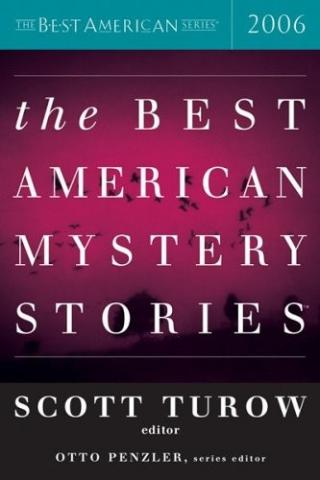
The Best American Mystery Stories 2006
- Автор: Дивер Джеффри, Хантер Эван
- Год: 2006
- Язык: английский
- Год: Houghton Mifflin Harcourt
- ISBN: 978-0-618-51746-6
- Жанр: Другие детективы

Электронная книга - «The Best American Mystery Stories 2006». Краткое содержание книги:
Mr. O’Malley plans to harvest the timber and eventually offer parcels of the land as multiple homesites in a division to be called Kissing Ridge. The area harbors some of the most majestic white oaks, locusts, and hickories in proximity to Lexington, and it will be a shame to see them laid waste, but the council decided unanimously that continued suspension of taxes would be a burden upon the community budget, and as Chair Wheeler Sherburne remarked, “The time of outlaws like Painter and Pogue has passed, and it would be a relief to see a commercial venture usher the infamous Irish Creek region into the twentieth century.”
Jeff Somers
Ringing the Changes
From Danger City
Henry used to be a jolly bastard and a lot of fun, but he’d taken the pledge and turned out to be dull as dust when he didn’t have a drink in his hand. All he could talk about was his salvation, his sobriety. It was boring stuff. A million weak bastards before him had had the same revelation, and a million more were lining up to dry out after him. Nothing special about it, really, yet people always went on and on about it as if God had reached down and waggled a finger at them and no one else.
At least I was still working, and Henry was pretty good cover. Plus, there wasn’t much Henry didn’t know about what was happening in outline; his moment of clarity had apparently made old Hankie a good listener, so I felt it was a good idea to stay on his good side, in case I ever needed information. We used to be tight, and he used to be a grand time, so I gave him a little ear-time. I bought him a steady stream of club sodas, which he drank exactly as he’d drunk booze: never putting the glass down, using it to gesture his points, and killing it with a million little sips. If you weren’t listening to his endless sermon about giving up The Drink, you’d think his glass was a vodka tonic or a gimlet.
It was slow, and I wasn’t making much, so I hurried Henry along. I waved my hand at the bartender and looked at Henry, the dry old bastard.
“Want another?”
“Sure. You shouldn’t go so hard, buddy. Believe me, I know.”
I nodded, glancing at the bartender. “Another bourbon, kiddo.” He looked down at the pile of money on the bar, a crisp fifty right on top, and took my empty glass away. Keeping an eye on him, I inched my hand over and switched the fifty with one of mine from the bottom.
This is what I did. I made people see what I wanted them to see. Even Henry, who didn’t notice that my glass was mostly melted ice and watery booze, hardly touched.
The bartender brought my drink and set it in front of me.
“You should charge more for nonalcoholic drinks, buddy,” I said, catching his eye. “Discourage the teetotalers, eh?”
He shrugged, plucking the bill off the top, his eyes on me. “Nah. We don’t get many in here anyway.”
Without glancing at the money, he carried it to the register and rang up my change, bringing back forty-six real dollars and dumping them on the bar. I left them there for a bit, not even looking at them. After a while I’d collect them and put the fifty back on top. For the time being, I studied Henry as if he was the most interesting guy in the world.
“How long’d you do in Rahway?”
Henry nearly lost control of his glass, gesturing. “Three years. Best thing that ever happened to me.”
Henry dried out in prison. At first it wasn’t voluntary, of course, but then he hooked up with a substance-anonymous crowd and took the pledge. He was going on four years sober now — four sad, desultory, plodding years, but years he was proud of nevertheless.
“Nothing to do but think in prison,” he went on. “Not for me, anyway. Some guys found other distractions, but I never had anything except booze.”
Henry had no idea how true that was, I suspected, considering his gray, lifeless demeanor post-booze.
“At first all I thought about was booze. You could get some in prison, but I never could do it. I never had anything to pay with, except my ass, and I wasn’t that far gone. So I thought a lot. And I realized that I was in jail because of liquor.”
I knew this speech pretty well. Henry got pinched because he’d been loaded. It was pure professionalism that drove the man sober. He never wanted to fuck up again and land back in a place as boring as jail. Henry liked his cable TV.
I stopped listening, letting it wash over me.
Mine wasn’t a high-rolling life. I made enough to pay the rent and keep things moving. There were no big scores to be had, I knew this, but there were also few chances at getting killed or arrested if I played it straight. Didn’t get fancy. Counterfeit money got traced or sometimes spotted, and a lot of time people remembered me as the guy who spent a lot of fifties. I had to go to different places, work different neighborhoods. If I went to the same place twice, I could get pinched.
My man the bartender wasn’t the brightest fellow in the bar, but I didn’t think I could pass more than one or two more fifties his way anyway, and Henry was only on chapter one of “How I Won the War,” just getting warmed up. So, I gathered up my cash, left a good tip, and stood up. Henry didn’t care. He didn’t even pause for breath, he just barreled on, giving me the background on his conversion from lush to self-satisfied teetotaler. I knew how it ended — with a lecture from him on why I was a fool to keep drinking.
Which was annoying, since I didn’t.
I spoke right over him. “All right, Hankie, I gotta roll.”
He trailed off and looked away, insulted. “Yeah, okay.”
Walking out of the place, I felt sad. It was a good bar: dark and smoky, wood everywhere, and not filled with complainers. Good jukebox.
The Wallace Hotel was hovering between worlds — middle-class decay on the one hand, and people like me on the other. Cheap tourists stayed a few days at a time, or stylish tourists who liked the old-fashioned look of furnishings that hadn’t been changed in fifty years.
And then there were people like me. We didn’t have jobs or paperwork. We had cash, and an aversion to questions. I’ve lived there for two years and some weeks, and I’ve never once spoken with a neighbor. We were all perfect tenants because we didn’t shit where we lived. We picked our messages up at the front desk, kept to ourselves, and paid our rent on time. The Wallace, no doubt, wanted more criminals to move in.
I had three rooms, a suite. It was cheap and clean, with a strongbox filled with cash hidden under floorboards beneath the bed: thirty-three thousand dollars, socked away a little at a time. It wasn’t a fortune, but it was an insurance policy, a bit of scratch to carry me through a rough patch. I’d earned it all through small, safe grifts. I was careful, slow, and steady.
There was a coffee can in the cupboard with two grand in it. To look at the place, you’d think two grand’s about the best I could do. I figured if anyone came snooping, they’d find the coffee can in about five minutes and think that was it.
I worked neighborhoods, using color-copy big bills — twenties and fifties. It wasn’t very sophisticated, and it wouldn’t pass muster with anyone who knew their currency, but it worked with distracted register jockeys untrained in catching counterfeits. I still got caught from time to time, but I found that I could usually bluff my way out by appearing as surprised as they were. Color-copy counterfeits, even on linen paper, didn’t feel like real money, or smell like real money, but since I didn’t get greedy, I pulled it off. I’d only print $5,100 in fifties, which is thirty-four double-sided copies. That’s two bucks each on a self-serve machine unless I could scam free ones. So, for maybe seventy bucks, I had $5,100 in worthless money, which I then cut at home, carefully. Then I went shopping.