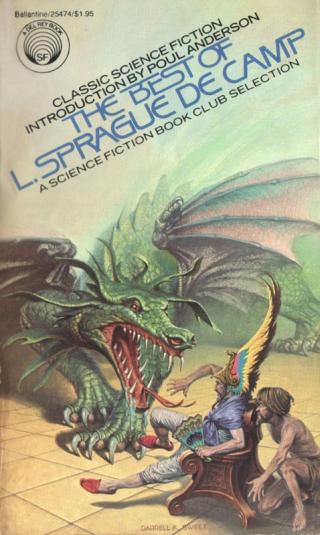
The Best of L. Sprague de Camp
- Автор: Де Камп Лайон Спрэг
- Год: 1978
- Язык: английский
- Год: Del Rey / Ballantine
- ISBN: 0-345-25474-0
- Жанр: Научная фантастика

Электронная книга - «The Best of L. Sprague de Camp». Краткое содержание книги:
The mistake that some writers make is to think one can convincingly describe an exotic milieu from a mere smattering of knowledge, such as one gains by reading others' fiction laid in that milieu, with neither personal experience nor intensive research. A weakness of Robert E. Howard as a writer was that he wrote stories laid in Afghanistan and other oriental lands without ever having been out of the American Southwest. Hence he admitted that his fictional Orientals were merely "Englishmen and Irishmen in turbans and sandals."
If personal experience is impossible, then one must hole up in the library and dig like a mole, noting every aspect of the milieu in question: weather, topography, fauna, flora, custom, costume, language, and so on. Of course, no amount of research guarantees the writer against any mistakes. In Lest Darkness Fall, laid in sixth-century Rome, I caused one of my characters to say a few words in Gothic. A scholarly reader wrote to point out that I had made this Goth use the nominative case where he should have used the vocative!
Like others, I have used my own experiences in my fiction. Naturally, as I have lived longer, I have had more experiences to draw upon. Since most of the present stories are relatively old—more than half go back before the Hitlerian War—their content of personal experience is smaller than in many later pieces.
"Nothing in the Rules" was suggested by a swimming meet at the YMCA where I lived for a while in New York. In "The Hardwood Pile" and "The Reluctant Shaman," I leaned on my firsthand knowledge of the Andirondacks, where my father was in business and where I spent much of my boyhood and youth. There I have hiked, climbed, ridden, hunted, fished, worked in a sawmill and on a survey gang, and even prospected by airplane for uranium.
"The Guided Man" uses some of my trade-journal experience. Other stories, not represented here, have used other bits out of my own past. I drew on my correspondence-school days for the fantasy novelette "Mr. Arson" and on my war service in a Naval research center for my historical novel, The Arrows of Hercules. Recently I have drawn upon my travels for the backgrounds of some of my Willy Newbury stories, and on my experience as a guidee on many guided tours for my new Krishna novel, The Hostage of Zir.
The story that comes the nearest to being autobiographical is "Judgment Day," in which several incidents are taken straight out of my boyhood. It was, as you can infer, not a very pleasant one. Many other elements of the story, such as the narrator's parents and wife, are imaginary. From what colleagues tell me, this boyhood must have been fairly typical for a writer. Boys who are more athletic, extroverted, boisterous, and mischievous to begin with are, I suppose, less likely to take up the scrivener's solitary trade.
This collection is skewed in another way. Twenty years ago, with "Aristotle and the Gun," I took a vacation from writing science fiction sensu stricto for over a decade and a half. In the interim I was busy with historical novels, nonfiction books (popularizations of science and history, biography, and miscellaneous works), and fantasy stories, many of them collaborative tales in the Conan saga. Lately I have been getting back to science fiction proper, with a couple of novels in press. As a result, of my eighty-odd books, about half are fiction and half nonfiction. Of the works of fiction, deducting the five historical novels, about half the remainder are science fiction and half fantasy.
A standard problem of writers is that as they get along in years, they find that their writing techniques become sharpened but their ideas come with more difficulty. As a wise editor once said, fiction is the only trade that gets harder with practice. The reason is that when you conceive an idea and exploit it in a story, that idea is used up. You cannot (or rather, you had better not) use the same idea in the next story. Readers and editors soon catch on to the fact that you are repeating yourself. Therefore you have to dig up a new idea, and for each successive story idea you have to dig deeper and deeper into your unconscious.
Well, I do not think I have yet run out of ideas. In fact, the ideas are still far ahead of the time available to get them on paper. I do, though, think that I have learned a few things in the last forty years about composing English prose. When I reread some of my early stories, I shudder: awkward sentences, ill-chosen expressions, disregard of rhythm, erratic punctuation, and so forth. Now, if I could have as simple and powerful an idea right now, how much more felicitously I could express it ...
But the river of time flows one way only. I agree, at least in part, with George Washington when he said: "We ought not to look back, unless it is to derive useful lessons from past errors." So I hope there will be many more stories where these came from, and that readers will like them even better than they did their predecessors.
— L. Sprague de Camp
Villanova, Pennsylvania
June, 1977
Book information
EMPEROR TSOTUGA'S
MAGIC FAN
From his ragged sleeve, Ajendra produced a large painted fan. "This," he said, "was made for the king of the Gwoling Islands by the noted wizard Tsunjing. By a series of chances too long to bore Your Imperial Majesty with, it came into the unworthy hands of this inferior person."
The Emperor was not impressed. "It looks like any other fan. What is its power?"
"Simple, O superior one. Any living thing that you fan with it disappears."
"And whither go the victims," the Emperor asked, interested.
"One theory of my school is that they are translated to a higher dimension, coexistent with this one. Another, holds that they are dispersed into constituent atoms, which however, retain such mutual affinities that they can be reassembled. Would you like to see a demonstration?"
"Very well, good wizard," the Emperor replied. "Just be careful not to wave that thing at us."
THE BEST OF
L. Sprague de Camp
Introduction by
POUL ANDERSON
A Del Rey Book
BALLANTINE BOOKS – NEW YORK
To Fred and Karen Anderson: skaal!
A Del Rey Book
Published by Ballantine Books
Copyright (C) 1978 By L. Sprague de Camp
Introduction: L. Sprague de Camp-Engineer and Sorcerer
Copyright (c) 1978 by Poul Anderson
All rights reserved under International and Pan-American Copyright Conventions. Published in the United States by Ballantine Books, a division of Random House, Inc., New York, and simultaneously in Canada by Ballantine Books of Canada, Ltd., Toronto, Canada.
Library of Congress Catalog Card Number: 77-26949
ISBN: 0-345-25474-0
Printed in the United States of America
First Ballantine Books Edition: May 1978
Cover by Darrell Sweet
-
ACXNOWLEDGMENTS
"Hyperpilosity," copyright (c) 1938 by Street & Smith Publications, Inc., for Astounding Science Fiction, April 1938. Copyright renewed 1965 by L. Sprague de Camp.
"Language for Time Travelers," copyright (c) 1938 by Street & Smith Publications, Inc., for Astounding Science Fiction, July 1938. Copyright renewed 1965 by L. Sprague de Camp.
"The Command," copyright (c) 1938 by Street & Smith Publications, Inc., for Astounding Science Fiction, October 1938. Copyright renewed 1966 by L. Sprague de Camp.