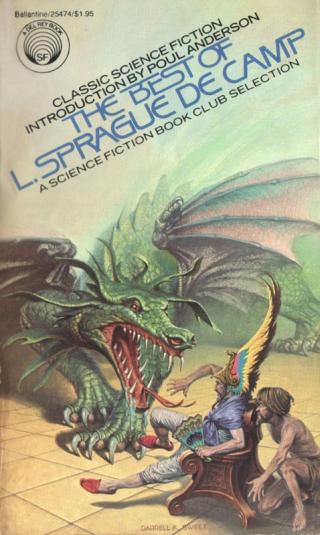
The Best of L. Sprague de Camp
- Автор: Де Камп Лайон Спрэг
- Год: 1978
- Язык: английский
- Год: Del Rey / Ballantine
- ISBN: 0-345-25474-0
- Жанр: Научная фантастика

Электронная книга - «The Best of L. Sprague de Camp». Краткое содержание книги:
When I lived in Scranton, my friend and college roommate, Dr. John D. Clark, was job-hunting in New York. He was then a more faithful reader of the science-fiction magazines than I. To keep on eating, John wrote a couple of science-fiction stories, on whose plotting I helped him on weekend visits. He sent them to Astounding Stories (then edited by F. Orlin Tremaine) and, to our delighted surprise, sold them.
So, thought I, if he can, why not I? I wrote a couple and sold them, too. I also started collaborating with P. Schuyler Miller on the novel that eventually became Genus Homo.
When I made my first sales, I thought: Whee! Why hasn't somebody told me about this? It sure beats working! When I got fired from the Fowler-Becker Publishing Company, I reasoned that if I could make so much money by writing for five hours a week, for fifty hours I could make ten times as much.
There is a fallacy there, since one soon runs into a law of diminishing returns. But I tried it, found I did about as well financially as I had been doing, and discovered that I preferred to be my own boss. Save for the Second World War and a few temporary jobs, I have been at it ever since.
The first story herein, "Hyperpilosity," is one of those two first stories that I wrote in Scranton. (There was one other, an amateurish little caveman tale eventually published in the short-lived magazine of historical adventure, Golden Fleece.) The next two items were composed after I had moved back to New York. The dates of the others you can get from the copyright page.
John W. Campbell replaced F. Orlin Tremaine as editor of Astounding Stories (soon changed to Astounding Science Fiction) at about the time I broke into that magazine. Campbell taught me much of what I think I know about fiction writing-he, and my longtime collaborator Fletcher Pratt, and the Bread Loaf Writers Conference in 1941, which I attended as a Fellow.
The article "Language for Time Travelers" made a bit of a stir, I suppose, because nobody in the science-fiction field had given the matter of future languages much serious thought. I had made a hobby of phonetics and knew at least something about linguistic evolution, when my contemporaries were equipping their heroes for strange milieu by endowing them with telepathy or electronic translators or some such easy solution. Seventeen years later, I went over the same ground in another article, written in the light of fuller knowledge: "How to Talk Futurian" (Fantasy and Science Fiction, October 1957).
"The Command" had no special inspiration, unless one counts visits to the Central Park Zoo. It was the first of a series of four sequels. I learned the hard way that each story of a series must top its predecessor or it will look less good. In this case, the series ran down; Johnny Black starts out by saving the world and ends up saving his boss's job. It should have been the other way around, but that would have meant planning the whole series in advance. This would have been wise, but I did not then know that.
"Employment" reflects a longtime interest in paleontology. As a high-school student, I intended to be a paleontologist. This ambition dismayed my mother, who was sure that the occupation would not provide the income and social position that she thought desirable. My father offered a sensible compromise: that I should get an engineering degree and so be able to earn a living. (He did not foresee the effect of the Depression on the engineering profession.) Then, if I still wished to go into pure science, it would be time enough to get the advanced training required.
As things turned out, I was never able to practice real engineering until the Hitlerian War and never to practice paleontology at all. I have consoled myself by writing books and articles on prehistoric life and putting paleontological elements into a few of my stories.
"Employment," by the way, is my only story published under a pseudonym. Campbell demanded it because, in that issue of Astounding, he was running the first installment of my long article "Design for Life," and there is a tabu against letting an author's name appear more than once on the contents page. So I chose "Lyman R. Lyon," the name of a great-grandfather. L.R.L. was a big man in upstate New York around the time of the Civil War. He once horsewhipped his brother Caleb, an eccentric politician-adventurer, in the streets of Rome, New York. Walter Edmonds fictionalized the incident in his novel The Big Barn (Little, Brown, 1930). My great-aunt used to protest that Edmonds had made her father (as "Ralph Wilder") much more of a hick than he really was. He was, she would have you know, an educated, cultivated man.
Otherwise I have practically not used pseudonyms. With a bogussounding name like mine, who needs one? When I started writing fiction, readers wrote in asking who this "L. Sprague de Camp" really was. Was he Henry Kuttner? Or L. Ron Hubbard? It took them a while to accept the idea that such a person existed.
"The Merman" is set in the old New York City Aquarium, a converted fort at the southern tip of Manhattan. I knew the place well but did not foresee that Robert Moses would demolish the structure and build a new aquarium at Coney Island, more than an hour by subway from Manhattan. So easily are prophetic stories dated by events!
"The Gnarly Man" has a little story. In December 1938, P. Schuyler Miller came from his home in Schenectady to New York for a meeting of the American Anthropological Association and other learned societies. I had just returned to New York after a year in Scranton and met Schuyler. I mentioned that I had been playing with an idea for a story about an immortal Neanderthal man. That's funny, said Schuy; he had been toying with the same idea.
For a while, we played Alphonse and Gaston: You write it! No, you write it! At last we agreed that we should both write it whenever we got around to it. Schuyler urged me to write my story first, since he was busy with other things. In addition, he generously gave me anthropological information on the man of Neanderthal. The result was "The Gnarly Man," followed a year and a half later by Schuyler's "Old Man Mulligan" in Astounding.
Biographies of writers usually make much of the connection between the writer's experiences and his fiction. John Livingston Lowes wrote a celebrated book, The Road to Xanadu, tracing everything in Coleridge's poems to things that Coleridge had read.
Actually, most fictions are composites of things the writer has experienced, seen, heard about, and read, put together in various combinations to make a new sequence of imaginary events. A writer may get all the material for one story from the library, while for another he uses his own life, with himself (thinly disguised) as protagonist. In the latter case, we may speak of the story as autobiographical. We should not, however, use the term if a story contains merely a few elements from the writer's own life amid many elements from other sources.
Compared to vicarious experience, personal experience is generally more useful to a writer. With many experiences, such as being in love, or in a battle, or in a storm at sea, or in a surgical operation, no amount of research will give one quite the feel of the experience that going through it will.
The trouble is that a writer does not live long enough to have all the experiences that he may wish to use in his stories. The man who spends a lifetime at one occupation and then writes a novel based on his experience may produce a good story but is likely to prove a one-book author. So a practicing writer must pad out his personal experience with vicarious experience. This he does by reading, talking with others, or even watching documentaries on television. Reading is the most fruitful source, but it all helps.
One can sometimes fool knowledgeable readers by research. An early story of mine, "The Blue Giraffe," was set in South Africa, where I had never been. You can imagine how pleased I was when a South African reader wrote to say that I must have once lived "in this sunny land of ours."