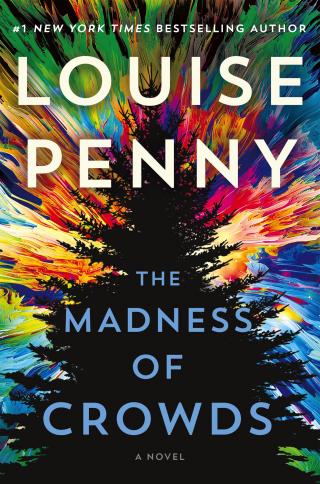
The Madness of Crowds
- Автор: Пенни Луиза
- Серия: Chief Inspector Gamache #17
- Год: 2021
- Язык: английский
- Год: St. Martin's Publishing Group
- ISBN: 9781250145284
- Жанр: Другие детективы

Электронная книга - «The Madness of Crowds». Краткое содержание книги:
You're a coward.
Time and again, as the New Year approaches, that charge is leveled against Armand Gamache.
It starts innocently enough.
While the residents of the Québec village of Three Pines take advantage of the deep snow to ski and toboggan, to drink hot chocolate in the bistro and share meals together, the Chief Inspector finds his holiday with his family interrupted by a simple request.
He's asked to provide security for what promises to be a non-event. A visiting professor of statistics will be giving a lecture at the nearby university.
While he is perplexed as to why the head of homicide for the Sûreté du Québec would be assigned this task, it sounds easy enough. That is, until Gamache starts looking into Professor Abigail Robinson and discovers an agenda so repulsive he begs the university to cancel the lecture.
They refuse, citing academic freedom, and accuse Gamache of censorship and intellectual cowardice. Before long, Professor Robinson's views start seeping into conversations. Spreading and infecting. So that truth and fact, reality and delusion, are so confused it's near impossible to tell them apart.
Discussions become debates, debates become arguments, which turn into fights. As sides are declared, a madness takes hold.
Abigail Robinson promises that if they follow her, ça va bien aller. All will be well. But not, Gamache and his team know, for everyone.
When a murder is committed, it falls to Armand Gamache, his second-in-command Jean-Guy Beauvoir, and their team to investigate the crime as well as this extraordinary popular delusion.
And the madness of crowds.
“All the animals, yes. I was never involved in the actual experiments.”
“But you knew what was happening.”
“What’s this got to do with your suspicions about Professor Robinson and the death of her friend?”
She got up. “You’ve been very helpful, sir. Merci.”
Isabelle Lacoste left Vincent Gilbert looking far less smug than when she’d arrived.
Jean-Guy Beauvoir found it an hour later. Not in the basement of the Roberge home. Not in the boxes in the attic.
It was in plain sight and, as a result, completely overlooked.
When he realized what it was, he placed it in a plastic cover and took it to Gamache, who was in the process of opening and shaking out the thousands of books in the Roberges’ collection.
It was something he’d learned early on in his career with the Sûreté. Not from his first Chief and mentor. He’d learned it from his fiancée, Reine-Marie Cloutier.
The trainee librarian had told him that people put all sorts of things between the leaves of books. Stashes of money. Dried and pressed flowers. Letters.
Some they want to keep. Some they want to hide.
“Where did you find it?” Armand asked, taking the letter in the plastic sleeve and putting on his reading glasses.
“In this.” Jean-Guy held up the book. “Extraordinary Popular Delusions—”
“—and the Madness of Crowds,” said Armand, grinning and shaking his head. He looked around at all the volumes he’d just spent an hour shaking out. Having ignored the most obvious one.
“It was at the beginning of a section on ‘The Drummer of Tedworth.’ About a ghost.”
Jean-Guy looked anything but pleased about the find, and as Armand read it, over by the window in the natural light, he knew why.
When he’d finished, he slowly removed his glasses, heaved a sigh, and turned to Jean-Guy.
“Where is she?”
“In the kitchen with her husband.”
They found the Roberges having a cup of tea, heads bowed over a jigsaw puzzle. It was, Armand saw, the one he’d assumed was for the children.
The image was a basket of puppies.
“Can we have a word, please?” he asked, and held the document in such a way that the Chancellor would see it.
She pressed her lips together, paused, then got up. Kissing her husband on the top of his head as he bent over the puzzle, engrossed, she said, “I’ll just be over by the woodstove.”
He didn’t answer.
Once they sat down, Armand handed her the letter in the plastic cover.
“So you found it.”
“Inspector Beauvoir did.”
She looked at him, and for some reason Jean-Guy felt he’d done something wrong.
“Evidence, Armand?” She sounded almost amused as she noted the tag.
“Would you like a lawyer?”
Now she did laugh. One humorless grunt. “No need.”
“Tell us about the letter.”
“Isn’t it self-explanatory?”
“Please, Colette.”
She looked at it, then carefully placed it on her lap and folded her hands over it.
“I haven’t seen this in years. Not since he died. Well, that’s not completely true.” She looked directly into Armand’s eyes. “I got this in Oxford, along with the book. It arrived the day after Paul died. The mail was much faster then, but not fast enough. Have you read it?”
Armand nodded, as did Jean-Guy.
“Then you know what it says. Paul admits to killing Maria. Smothering her with a pillow while Abigail and Debbie were out riding their bikes. Then he put a peanut butter sandwich down her th—” She stopped and took a series of short breaths, but seemed unable to catch it. She dropped her eyes, then slowly, deliberately, with trembling hands she moved the letter off her lap, to the sofa. Banished.
With what seemed a supreme effort, she raised her eyes. “He loved that child. Can you imagine?”
She managed to take a deep breath, while across from her the two men tried not to imagine.
Tried to remain police officers, while the father in them fought to get out.
It was a losing battle. The father would always win. And both were swept away by the thought, the very idea, of doing what Paul Robinson had done that day. Putting a pillow over their child’s face. But perhaps especially, grotesquely, the sandwich.
It was what they’d suspected happened, since seeing the word “petechiae” in the autopsy. That the sandwich was postmortem.
That Maria’s death wasn’t some terrible accident.
Gamache had toyed with the idea that either Abigail, or more likely Debbie, had done it. But the letter made it clear. Maria’s own father, driven by desperation, had killed her.
To read it in his own handwriting, stated so simply without embellishment, made it all the more horrific.
Colette removed her glasses and wiped her eyes, then startled slightly when a hand landed unexpectedly on her shoulder.
“It’s all right. I’m here,” said Jean-Paul. He turned mild eyes on their visitors. “Have you upset her?”
Colette put her hand on top of his. “No. They’re friends. Here to help.”
“With the packing?”
She smiled at him. “Never. That’s your job. No one does it better. Please, come sit.”
“Are you sure?” asked Armand.
“Jean-Paul knows it all, don’t you?”
“Yes.”
His eyes were kindly, but blank.
“You said the letter reached you the day after Paul Robinson died?” said Beauvoir.
“Yes. It came with the book. I knew what it was after the first line. It was so clearly a suicide note, admitting that he killed Maria and couldn’t live with himself any longer. As he says, he’d known the moment it happened that he’d have to take his own life, but he also knew he’d have to wait until Abigail was grown and out of the house. He sent her to me at Oxford, and asked that I look after her.”
“Which you did,” said Armand. “And earned his eternal gratitude.”
“Oui,” she said quietly. “Jean-Paul and I had rented a cottage in nearby Lower Slaughter. Abby came every weekend and stayed until after Sunday roast. She’d often bring a friend. Abby was a bright, happy young woman. Ambitious, but most at that level are. And then this”—she glanced at the letter—“happened.”
“What did you do when you read it?” Armand asked.
“I called him. I thought maybe … But it was already done. A neighbor answered and told me Paul was gone. It looked like a stroke or heart attack, but of course, I knew.”
“And didn’t say anything.”
“No, why would I? If he’d wanted people to know, he’d have left a note there, but he didn’t.”
“But he did send one to you. Why was that?”
“I’ve wondered myself. The closest I can come is that he felt the need to confess. To tell someone who loved him, and might even understand, what had happened.”
“But,” said Armand, leaning forward, “he also says at the end that you should let Abigail read the letter.”
“Yes.”
“Why? Why would he want her to know what he’d done to her sister? Surely that’s something he might, at a stretch, want you to know, but not his other daughter.”
His eyes were imploring her to explain it to him.
Colette smiled a little, a sort of grin. “You didn’t know Paul.” She looked at her husband, who was pulling tissues from the Kleenex box and folding them methodically.
“He was a scientist. Meticulous in his research, in his notes, his files. Always neat and clear. He was dedicated to the truth. I think he wanted someone to know.”
“Someone, yes,” said Armand. “But Abigail?”
“She’s cut from the same cloth. You can see that, in her insistence that her findings get a proper airing, no matter how foul. I think he knew she’d want the truth. It’s possible he thought she already suspected, and wanted to end her speculation, so she wouldn’t spend the rest of her life wondering.”