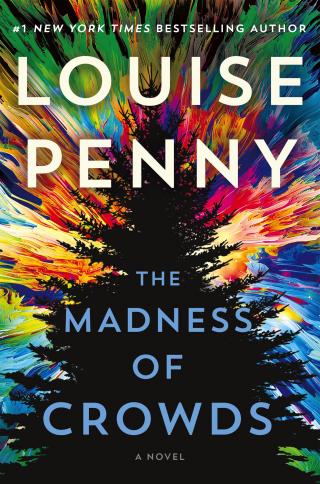
The Madness of Crowds
- Автор: Пенни Луиза
- Серия: Chief Inspector Gamache #17
- Год: 2021
- Язык: английский
- Год: St. Martin's Publishing Group
- ISBN: 9781250145284
- Жанр: Другие детективы

Электронная книга - «The Madness of Crowds». Краткое содержание книги:
You're a coward.
Time and again, as the New Year approaches, that charge is leveled against Armand Gamache.
It starts innocently enough.
While the residents of the Québec village of Three Pines take advantage of the deep snow to ski and toboggan, to drink hot chocolate in the bistro and share meals together, the Chief Inspector finds his holiday with his family interrupted by a simple request.
He's asked to provide security for what promises to be a non-event. A visiting professor of statistics will be giving a lecture at the nearby university.
While he is perplexed as to why the head of homicide for the Sûreté du Québec would be assigned this task, it sounds easy enough. That is, until Gamache starts looking into Professor Abigail Robinson and discovers an agenda so repulsive he begs the university to cancel the lecture.
They refuse, citing academic freedom, and accuse Gamache of censorship and intellectual cowardice. Before long, Professor Robinson's views start seeping into conversations. Spreading and infecting. So that truth and fact, reality and delusion, are so confused it's near impossible to tell them apart.
Discussions become debates, debates become arguments, which turn into fights. As sides are declared, a madness takes hold.
Abigail Robinson promises that if they follow her, ça va bien aller. All will be well. But not, Gamache and his team know, for everyone.
When a murder is committed, it falls to Armand Gamache, his second-in-command Jean-Guy Beauvoir, and their team to investigate the crime as well as this extraordinary popular delusion.
And the madness of crowds.
“Now we just have to prove it,” said Beauvoir.
“Not quite so fast,” said Gamache. “There’s a problem.”
Not just one, thought Lacoste, but managed to restrain herself.
“I’ve cross-country skied down that trail,” said Gamache. “There aren’t any handy pieces of wood lying around.”
“It’s a woods, patron,” said Beauvoir. “There’re trees everywhere. Trees are made of wood.”
“Merci, Jean-Guy. But Debbie wasn’t hit with a tree. Or even a branch. And any that had fallen would’ve been covered with snow. No, according to the coroner, Debbie was hit with a fireplace log, cut at a certain angle.”
Gamache created the wedge with his hands.
“Where did Abigail get the log?” asked Isabelle.
“Exactly.”
Beauvoir thought for a moment. “There’s a stack by the fireplace in the living room, and there was a pile by the bonfire. The problem is, both are pretty public. I think someone would notice if Abigail Robinson picked up a log and walked away with it.”
“There is another place,” said Isabelle. “The library has a fire. And it’s private.”
“That would mean the killer took the weapon with them,” said Jean-Guy. “And that would make it premeditated. You don’t just stroll around with a log.”
“Well, not very pre-,” said Gamache. “But yes, it wasn’t the sudden lashing out we’d assumed. The killer approached Debbie prepared, if not actually committed to killing her.” He turned to Isabelle. “There was someone alone in the library at that time.”
Lacoste threw her mind back over the interviews they’d done. “Vincent Gilbert.”
“Yes,” said Gamache. “He said he’d gone in there for some peace and quiet.”
“Gilbert might’ve seen who he thought was Abigail out the library doors,” said Isabelle. “And saw his chance. He picked up the log, followed her into the woods, and killed her. Only it was Debbie Schneider. Are you saying you now believe it was Vincent Gilbert?”
“I’m saying what I’ve said all along. We need to look at everyone. Which brings me to something I wanted to show you two.”
He woke up his laptop and Paul Robinson again popped onto the screen. He was in a suit and bow tie, standing proudly, almost comically, in front of a poster of his work. An exaggerated look of delight, like a showman at a carnival.
“We’ve seen that, patron,” said Isabelle. “It was taken the week Maria died.”
“Yes, but did you notice what he’s standing in front of?” Gamache zoomed in tighter.
Lacoste and Beauvoir leaned closer.
On the poster was a series of graphs showing comparisons of statistical studies.
Isabelle stood up and turned to the Chief. “Is this a joke?”
The top graph showed that there was a direct correlation between the per capita consumption of mozzarella and civil engineering doctorates awarded.
“I’m not the one joking, if that’s what you mean,” said Gamache.
The next graph showed a correlation between people who drowned after falling out of a fishing boat and the marriage rate in Kentucky.
Lacoste and Beauvoir looked at each other.
“But this’s ridiculous,” said Beauvoir. “It doesn’t make sense.”
“Exactly,” said Gamache. “They’re spurious correlations, you can just make out the title of the poster. And I’m willing to bet Paul Robinson had a coauthor. The person taking the photograph. I think it’s Colette Roberge.”
“The Chancellor?” asked Lacoste.
“Yes. Chancellor Roberge mentioned the phrase ‘spurious correlations’ several times.”
“Including last night,” said Beauvoir.
“She also said they’d collaborated on several studies,” said Gamache.
“Could that really be called a study?” asked Isabelle. “It’s more like a joke. How could this be important?”
“If she was the coauthor, it means she was with Paul Robinson around the time his daughter died. She might have even been there.”
“Are you saying you think the Chancellor killed Maria?” asked Jean-Guy.
“They spent time coming up with jokes,” said Isabelle. “That shows a closeness. Even, maybe, an intimacy.”
Beauvoir was tapping away on his laptop and now turned it around for them to see. “There’s a website called Spurious Correlations. It’s by some guy named Tyler Vigen.”
Gamache got up to look closer but stopped. The name meant something. Something. And then he gave one small laugh.
“What is it?” asked Isabelle.
“Tyler Vigen. It’s the name Chancellor Roberge used on the request form when reserving the gym for the event. Is he a real person, or an alias Colette and Paul Robinson used?”
They huddled around the site.
“Looks like a real person,” said Beauvoir. “At the bottom he credits two professors, Paul Robinson and Colette Roberge, with giving him the idea.”
“I think in repeating the phrase Colette was trying to guide me to this,” said Gamache. “If not the site, then the concept.”
“What concept?” asked Isabelle.
“That Abigail Robinson’s conclusions were no more legitimate than the connection between”—he bent down and read off Beauvoir’s screen—“per capita cheese consumption and people who died after being caught up in their bedsheets.”
“Really?” Beauvoir leaned closer. He himself often woke up in the night, entangled. And he liked cheese.
Gamache now wondered if the Chancellor had also been trying to warn him about making connections that did not exist. It was, of course, the bane of any investigator. To misinterpret, to overinterpret.
Was he connecting two things that were not related? The death of Maria Robinson and the murder of Debbie Schneider forty years later. Was he making a spurious correlation?
He didn’t know. What he did know was that yet another thread led back to the Chancellor.
“We need a search warrant,” he said as he moved to the door. “For Colette Roberge’s home.”
It was time to give that thread a tug.
CHAPTER 41
“Colette?” said her husband. “Who are these people? Why’re they searching our home?”
He stood in the kitchen, a seventy-six-year-old man, bewildered.
Armand, who hadn’t spoken to Monsieur Roberge in a few years, and had only seen him from a distance in his recent visits, looked from him to Colette. It was clear that Jean-Paul Roberge, who’d risen to the top of a large Montréal accounting firm, was now living with dementia.
“I didn’t know,” Armand said to Colette.
“Would it have changed anything if you had?” she asked.
“It might have.”
While Inspector Beauvoir led the search, Armand went for a walk outside with Jean-Paul and Colette, getting the older man away from the activity that was so clearly agitating him. Armand was on one side of Monsieur Roberge, taking his hand, while Colette took the other. Holding him steady and upright in case of ice underfoot.
Armand listened as Jean-Paul told him about his recent visit with his mother. And his plans to take Colette to Prague for their honeymoon.
Jean-Paul stopped and turned bright blue eyes on Armand. “Are you my brother?”
“No, sir. I’m a friend.”
“Are you? Really?” asked Monsieur Roberge.
Standing beside her husband, Colette stared at Armand, clearly asking the same thing.
“I hope so,” he said. He could see Beauvoir at the door, his hand up to get his attention. “Perhaps we should go inside.”
“Yes,” said Jean-Paul. “We should pack.”
“Good idea,” said his wife. “I’ve put the suitcases on the bed. Maybe you can start.”