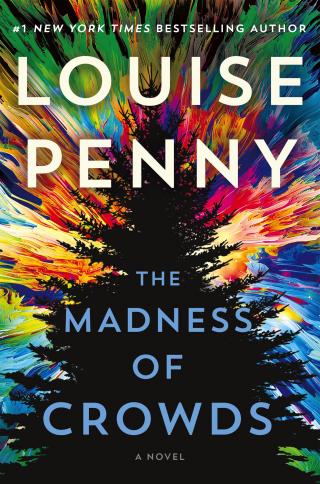
The Madness of Crowds
- Автор: Пенни Луиза
- Серия: Chief Inspector Gamache #17
- Год: 2021
- Язык: английский
- Год: St. Martin's Publishing Group
- ISBN: 9781250145284
- Жанр: Другие детективы

Электронная книга - «The Madness of Crowds». Краткое содержание книги:
You're a coward.
Time and again, as the New Year approaches, that charge is leveled against Armand Gamache.
It starts innocently enough.
While the residents of the Québec village of Three Pines take advantage of the deep snow to ski and toboggan, to drink hot chocolate in the bistro and share meals together, the Chief Inspector finds his holiday with his family interrupted by a simple request.
He's asked to provide security for what promises to be a non-event. A visiting professor of statistics will be giving a lecture at the nearby university.
While he is perplexed as to why the head of homicide for the Sûreté du Québec would be assigned this task, it sounds easy enough. That is, until Gamache starts looking into Professor Abigail Robinson and discovers an agenda so repulsive he begs the university to cancel the lecture.
They refuse, citing academic freedom, and accuse Gamache of censorship and intellectual cowardice. Before long, Professor Robinson's views start seeping into conversations. Spreading and infecting. So that truth and fact, reality and delusion, are so confused it's near impossible to tell them apart.
Discussions become debates, debates become arguments, which turn into fights. As sides are declared, a madness takes hold.
Abigail Robinson promises that if they follow her, ça va bien aller. All will be well. But not, Gamache and his team know, for everyone.
When a murder is committed, it falls to Armand Gamache, his second-in-command Jean-Guy Beauvoir, and their team to investigate the crime as well as this extraordinary popular delusion.
And the madness of crowds.
Armand and Jean-Guy turned to her.
“Well, yes,” said Jean-Guy. He pushed the plastic encased letter from Paul Robinson across the conference table. “There is a small clue in the suicide note.”
“But is it a confession?”
Now Beauvoir laughed, then looked at her with suspicion. “Of course it is.”
“What are you thinking, Isabelle?” asked Gamache.
“Something’s been bothering me about this.” She pulled the letter toward her.
Gamache moved around the table until he was beside her, while Beauvoir moved to her other side.
“Why didn’t Paul Robinson leave a note with his body?” asked Isabelle. “Most suicides do. Not all, but most. Or he could’ve easily made a copy of this note and left it in a safety-deposit box. In case the other got lost. Everyone describes him as a methodical scientist. Wouldn’t he make sure there was a copy of something so important? And why write to Colette, but not Abigail? It’s not like she was a child. She was twenty.”
“Maybe he wanted to make sure there was someone with her when she read it,” said Gamache.
“Could be, but he could’ve included a separate letter to Abigail in the same envelope, just saying he loves her and is sorry. What’s it going to do to a young woman, knowing she was the reason her father killed her sister, then took his own life? Did that really need to be said?”
“The whole thing seems strange,” admitted Jean-Guy. “I mean, why confess at all, so many years later?”
“That’s the other thing, though,” said Isabelle. “He doesn’t really confess.”
“But he does.” Gamache pointed to the letter. “It’s right there.”
“No, it isn’t.”
As one, the three of them bent their heads over the letter.
Isabelle could feel Jean-Guy’s shoulder touching hers, and she could smell the Chief’s faint scent of sandalwood with a hint of rose. The bit of his wife he carried with him always. Like breath.
“I’ll be damned.” Gamache stood up and, bringing his hand to his mouth, he stared at the page.
“You’re right,” said Jean-Guy. “Nowhere in this does he come right out and say, I killed Maria. What he does say”—he reached for the letter—“is that he’s responsible. That it’s his fault, that he can’t live with what he did.” Looking up again, he stared at the other two. “Knowing it was a suicide note, we filled in the blanks.”
“And he still might have done it,” said Isabelle. “But it just struck me that he never actually says it.”
“He also says,” Gamache read out loud, “It wasn’t deliberate. I know that.” Gamache looked at Isabelle and Jean-Guy. “Isn’t that strange wording?”
They nodded. Slowly.
“Wouldn’t he leave it at, It wasn’t deliberate?” asked Jean-Guy.
They all, in unison, went back to staring at the letter.
Gamache, his eyes narrow in concentration, was trying to think it through.
Why didn’t you clearly confess? he asked a man long dead but still very much present. Why did you send the letter to Colette Roberge? Why did you say you knew Maria’s death wasn’t deliberate?
Why did you really kill yourself?
In the gloom of the basement, an idea was forming.
“We need to have that”—he nodded toward the letter—“fingerprinted and checked for DNA.” He handed it to Isabelle. “And have the handwriting analyzed.”
“Oui, patron.”
He watched as she made a copy. Then, putting it into a secure envelope, she gave it to an agent to take to the lab in Montréal.
As the letter left the confines of the basement, Armand’s thoughts chased after it.
Did you really kill Maria?
Did you really kill yourself?
He walked over to the large board, placed in the Incident Room by the technicians. Photographs had been pinned up there. Of the murder scene. Of the body. There were schematics of the crime scene, the trail, the Auberge. The bonfire. Movements and relationships between various people.
Down the side of the board were other photographs.
From the shooting in the old gym.
The mug shots of a stunned Édouard, Alphonse, and young Simon Tardif.
The portrait of Ewen Cameron.
And now, two more had been added. Paul Robinson in front of the silly pseudo-scientific poster of spurious correlations, and the last one, of Maria, Paul, Abigail, and Debbie.
Picking up a black felt pen, he turned to the others.
“Let’s try to clarify. We have several scenarios. One. The intended victim on New Year’s Eve was Abigail Robinson.”
As he spoke, he wrote her name, under the heading, Victim.
Then, next to that, under Motive he wrote, Mass Euthanasia Campaign/Blackmail.
Under Suspects he wrote: Vincent Gilbert, Colette Roberge.
“With a possibility being Simon Tardif,” said Isabelle. “Though he’s pretty far down the list.”
“Agreed. The other scenario,” Gamache continued, “is that Madame Schneider was the intended victim all along.”
“And the motive?” asked Jean-Guy. “We’d thought maybe she’d killed Maria, but with the letter from Paul Robinson…”
“We don’t know for sure it is a confession,” said Isabelle. She leaned forward, putting her elbows on the conference table.
“Abigail believed all this time that her father killed Maria,” said Gamache. “But we’re back to the other theory. Maybe, in clearing out his things, she finds something that tells her he hadn’t. That tells her the truth.”
“That Debbie did it,” said Beauvoir.
Armand pointed the pen at him, then turned and circled Debbie’s name.
“And the motive?” he said. “In Abigail’s mind, Debbie not only killed a sister she loved, but also, by association, her father.”
“He sent the letter to Madame Roberge,” said Beauvoir, “and told her to show it to Abigail, believing she’d killed Maria. He wanted Abby to know she was safe.”
“Except she didn’t do it,” said Isabelle. “Can you imagine how she’d feel if she realized her father had lived with that belief for so many years? That he believed she’d killed her sister? Then he’d taken his own life for no reason. How she’d feel about Debbie?”
“She’d hate her,” said Beauvoir.
Isabelle, though, was shaking her head.
“I think we’re making this much more complicated than it needs to be. I think the motive has to be something that’s recent.”
“But it is recent,” said Beauvoir, “for Abigail.”
“Go on,” Gamache said to Isabelle. “What do you think happened.”
“I think your first scenario is right. Abigail was the intended victim. I think someone saw her at the party. They hated the agenda she’s pushing. They saw their chance to stop her, and they took it.”
“Anyone in mind?” asked Beauvoir.
“Vincent Gilbert, maybe with Colette Roberge’s help,” said Isabelle. “They had motive and opportunity.”
Gamache turned around and studied the board, the pictures, the schematic. Something didn’t fit. Some small piece.
Then he walked to the table and reread the letter. He was beginning to see what.
“There’s someone else, patron,” said Jean-Guy, taking Gamache’s place at the board.
Picking up a red felt pen, he wrote, Haniya Daoud.
Gamache’s brows rose. How could he have forgotten her? Was it because while the others were standing in plain sight, practically jumping up and down for their attention, Haniya Daoud was sneaking up. Machete in hand. Unseen in the dark.