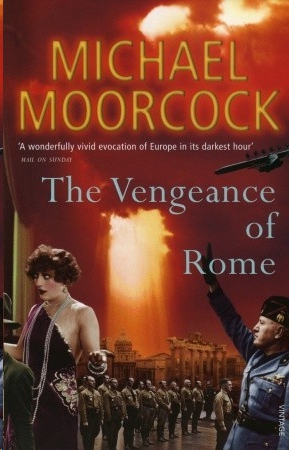
The Vengeance of Rome
- Автор: Муркок Майкл
- Серия: Between The Wars #4
- Язык: английский
- Жанр: Научная фантастика

Электронная книга - «The Vengeance of Rome». Краткое содержание книги:
‘I don’t give a shit if you’re a wop, a dago, a Yid, a Yank or all four,’ she said suddenly. I was alarmed by the coarseness of the language issuing from that perfect mouth. Her manner was the norm among the young in Germany. A cynicism, an aggression, a hardness was cultivated by these girls. You could not, I suppose, blame them, given the world they had grown up in.
Kitty put out her cigarette and stepped rapidly towards me. Her golden face moved close to mine. I smelled something delicate on her breath. She kissed me lightly on the lips.
‘You don’t want to get in too deep with the Nazis anyway,’ she said. ‘You might find it’s hard to get out again. They have a lot of funny friends.’
She opened the door, paused, shrugged and was gone. Almost immediately I regretted not seizing my opportunity. She was ten times the woman her mother was. She was right. I had made a mistake in returning to Munich. I cursed my own impatience. I had never needed a real friend more.
Mrs Cornelius sits in the corner near the dartboard. Her sons have disappeared. She looks up at the television over the bar and sips a small port and lemon. ‘Egypt was your moment, Ive,’ she tells me. ‘You should ‘ave turned rahnd and gone ‘ome.’ I cannot follow her. They are showing a newsflash. A politician has been shot in Cairo.
Egypt, I will admit, was a watershed. In some ways I still feel as if I am living on borrowed time. I had grown reconciled to death there. I had begun to desire it. If Kolya had not rescued me I would have been blinded, then maimed, then left to die, rotting, in al-Habashiya’s garden, mulch for his cruel roses. I have been in a thousand nightmares in the course of my life, most of them before I was forty. Sometimes they merge together. They know only so many ways, after all, of brutalising a human being. But perhaps God was training me for my task. What I learned in Egypt helped me survive in Dachau.
‘Time!’ cries Collier suddenly, his head below the bar. ‘Time, ladies.’ The Bishop looks at his watch. ‘It’s nowhere near Time, Mo.’
Scowling, Collier straightens up. He tells Beesley he was quoting Eliot.
The crowd in the pub thins out now as the nine-to-fivers go back to their jobs. Soon there are only the customers who do not work regular hours. They consist chiefly of Irish drunkards, Caribbean pimps and drug dealers, cockney scroungers, hippie layabouts, complaining old crones, whining pensioners, unemployed criminals and people like ourselves, who were here when the area was more respectable. Not so long ago it seems you never saw a black face in this pub. And everyone drank out of glasses or mugs. Now you are offered the choice of the bottle or a glass. Another blow for progress and against civilisation.
Almost every evening we saw pretty much the same crowd, reading its papers, playing darts and shove-halfpenny, intermittently chatting. The pub made a profit. Everyone was happy. But now jukeboxes, stand-up nights, stripteasers fill the place with noise. We are all consumers and consumed. They tell us we cannot afford to slow down. In the old days the carpets and curtains might have grown a little threadbare with the years, but the quality was unmistakable. Nowadays we see no such thing as quality. They know only cheap, bad ways of making things. We are soon due for extinction at this rate. We are creating a generation that will not read or write but will spend its time picking consumer goods from a TV catalogue. All it needs is a picture to point at. The Americans lead the field in this, which is probably why the Voice of America seems to grow increasingly less intelligent as the years go by. Once they addressed me as an adult. Now I am a ten-year-old. And as they speak less and less of any substance, their voices grow steadily louder. They substitute volume for content. Is it because they have to yell across those wide spaces?
I came to relish solitude in the desert.
I could not go back to the United States. Yet I still long for Hollywood as it was in its Golden Age, in the years of my fame. Perhaps if I had been content with fantasy, I would still be there, an honoured has-been taking cameo parts on Rawhide and I Love Lucy. But my interest was always in reality. I had vision and skill. I wanted only to put my talents to practical use, for the good of humanity. My cities would fly. The world would be rich with growing things. Disease would be banished. Death would be defeated. There would be no pain. No polluted air. No fear. No hunger. No melancholy. Individuals would all work together for the common good. None among us would be disadvantaged in favour of another. The slavery of interest, of usury, would be abolished.
I think my mistake was to put too much trust in others.
Visionaries like myself and Röhm were inclined in our innocence to believe we should support politicians to fulfil our dreams. But politicians are by nature compromisers. This means that they are forever looking for the middle ground. Therefore they always disappoint us. But what moves societies forward are leaders who disdain the happy mean, who seek the extremes of social experiment. Very rarely are we given a Mussolini or a Hitler, whose ideas match our own, who are not compromisers. Yet even these, as I believe I have shown, are subject to the machinations and petty ambitions of followers who eventually bring them low. Even these fail in the end.
I suppose I am one of the very few people who ever heard Hitler say he was sorry.
Röhmannsvilla became a retreat for me. Nowhere else was I welcome. I got there as soon as I could, taking my luggage. Tom Morgan had been in touch telling me to lie low. He would try to establish my innocence, but I heard nothing. Too many other things were going on. The whole of Europe was growing increasingly agitated. Political assassinations became unremarkable, the order of the day. More and more were out of work. Civil strife increased. First the great Austrian banks went down. Then the German banks were closed. Then the great Allianz insurance company. Every institution that had been rock-solid a few days earlier was now discovered to be a crumbling facade hiding a stinking mountain of unpayable debts. Newspapermen were being moved to new locations. Nazis who had never had their names in the newspaper were giving interviews to the foreign press, which meant that Putzi was kept permanently in Berlin. Only Röhm had any time for me. I was his comfort, he said. His relief.
Röhm was not the swaggering gamecock later journalists made of him when he could no longer defend himself. Time magazine might refer to him as a ‘plug-ugly pederast’, but that was because his enemy Goebbels had taken over the propaganda arm from Strasser, whom he hated. Röhm usually disdained interviews. He was actually a subtle, contemplative human being who had reasons for every position he held. One of the reasons he had never wanted anything to do with women, he said, was because they really did soften a soldier. A man who gives up any of his power to a woman immediately loses a disproportionate amount of his power; useful, directed, positive, aggressive power. The same power in a woman becomes diffused, negative, random, passive.
‘They waste every part of a man.’ He knew that I was very fond of women. I think he believed he could persuade me to his viewpoint. Of course, his main concern was Hitler. He was not the only one who continued to worry that Hitler’s obsession with Angela Raubal was seriously weakening him in every way, just at the moment when triumph could have been his. Even Goebbels, the great womaniser, believed that. Himmler, Röhm told me, hated her for her influence over the Führer. Everyone had asked Hitler to give Geli up, but he would rather have lost his chance of greatness than break with her.