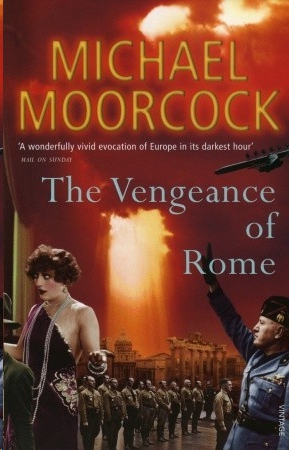
The Vengeance of Rome
- Автор: Муркок Майкл
- Серия: Between The Wars #4
- Язык: английский
- Жанр: Научная фантастика

Электронная книга - «The Vengeance of Rome». Краткое содержание книги:
Outside the sun is still trying to break through. We stand on the concrete pavement near the public toilets while Jerry and Frank reassure their mother they will be visiting her soon. Billy Beesley rolls from the newsagent removing the paper from two Mars bars. He has eaten one before he rejoins us. A little brown stuff, like blood, trickles into his jowls. ‘Well,’ he says, ‘I have some parishioners to visit. I’ll say pip-pip for the mo.’ Miss Brunner, it seems, has already left. We watch Beesley’s stately mince as he disappears into the crowd.
“E looks like ‘e’s found himself another mark,’ says Mrs Cornelius without much relish. “E’s only been out a week. Poor cow ‘ooever she is. Anyone deserves better than Billy.’
She and I cross the road and continue down Blenheim Crescent. Half the houses on the other side are boarded up. I hear there is some plan to build a new luxury complex. Who will occupy it? The gypsies? The blacks? The old council houses are no longer good enough for their tenants! It makes me sick. Those people would still be grubbing in the dirt for insects to eat if it were not for the 10 per cent or so of us who are remotely civilised. And they say they have a right to better living conditions! What qualifications have they for these rights? That they were born? In that case the rats and mice have rights. They, too, were born. Let us make sure they are housed in five-star hotels.
‘Well, look ‘oo it isn’t,’ says Mrs Cornelius.
The frail, thin figure of Major Nye is making its way up Blenheim Crescent towards us accompanied by another, slightly bulkier figure. Both wear khaki raincoats belted at the waist. They have bowler hats and umbrellas, pinstriped trousers and well-polished black shoes and wear the same regimental tie. It is all they have left of an empire they once defended with all their finest idealism, courage and discipline.
They raise their hats when they see Mrs Cornelius.
‘Hello, old boy,’ says Major Nye to me. ‘We were rather hoping we might bump into you when we didn’t find Mrs C at home. We knew we were a bit late for the pub. We’ve been having fish and chips in Ladbroke Grove.’ His skin is so thinly stretched over his almost fleshless head that it seems transparent, marking the veins and bones, tracing the progress of his blood. His pale grey eyes are as amiable and as baffled as they have been since Suez, when his entire understanding of his responsibilities changed. Beside him, a little browner, just a touch plumper, but otherwise almost a twin, is his old regimental colonel, Jim Pym. They have been enjoying their monthly reunion. Both men are so fragile these days that I cannot see them continuing this pleasant ceremony for much longer. They will have to speak by telephone, I suppose. And then one will die and the other will die. Their wives are already dead. Their children, I gather, have mostly emigrated. The best they can look forward to is being accepted by the Chelsea Pensioners. At least it will give them the chance to wear a uniform again.
Like myself, Major Nye has been on the sidelines of some monumental events, but I do not believe he ever played the same kind of crucial role as I played in the rising dominance of the Nazi Party. I personally will be very sorry when I can no longer chat with him. We are of a similar age and have had many similar experiences around the world. Also, of course, we were both in love with the same woman. That is why he still comes to Ladbroke Grove.
We return to her basement for tea.
Major Nye always called Hitler ‘that grubby little agitator’. He had no time for Röhm, sadly, or most of the others. ’Göring seemed jolly enough on the surface, but frankly I never had patience for any of them.’ He believed that the best in Germany had been wiped out by the War. Only the cripples, the walking wounded, the exiles were left. The business people were almost as bad. ‘They possessed a very low standard of intelligence,’ he says. ‘The brains had either been killed or had enough sense to stay out of the limelight. German government was in the hands of a few survivors. It wasn’t fair to punish them the way the French did. France just wanted the rest of the Allies to hold the poor bastard down while she kicked him a few times. She’s never recovered from being beaten so often by Bismarck. In French history, Napoleon was a fluke. Not that he and Hitler didn’t make precisely the same mistakes. Men of destiny always do, don’t they, old boy? At least,’ he added, ‘Napoleon had had the sense not to let businessmen or the army make political decisions. They were the absolute worst people at that. Any time business or the army dominate politics, that’s when you might as well pack your bags and leave. The one thing the British Army understands,’ he says, ‘is to stay out of the brawl. Getting into it was the German Army’s greatest mistake. They should have held aloof. But I suppose they were too afraid of Röhm.’
He and Colonel Pym often discuss matters of strategy.
Mrs Cornelius takes down her best teaset. She balances the teapot on a pile of magazines while she clears a space on her coffee table. ‘Sorry about ther smell,’ she says. ‘I think it’s ther cat.’
‘Well, it’s always been a mystery to me,’ says Colonel Pym, ‘why any decent army officer should not have taken one look at Herr Hitler and seen at once what a little turd he was.’
“E was vulnerable,’ says Mrs Cornelius, searching for her biscuits. ‘That’s orlways a plus in a politician. It’s ther same with them pop stars, innit? Women recognise it. Men c’n sense it, but they never know wot it is. ‘Itler could’ve been knocked art at any time, but they all looked after ‘im. Why d’yer fink them rich old ladies loved to mother ther little bugger? They thought ‘e was a sensitive artiste. ‘E was the Liberace of ‘is day.’
We are silent. Not one of us can think of a response.
During the following weeks Röhm had certain rooms in his villa set aside for meetings. He made me stay away from them. People would be driven up to one particular door and admitted. They never saw the rest of the place. Their impression was of an austere military base.
Röhm said the meetings would have bored me. He admitted that most of the time he himself was bored. ‘But if we’re to defeat the Antichrist,’ he said jokingly, ’we must make friends even with swine. At least for the moment.’ He was clear-headed about his political ambitions. I did not agree with all his views, but there was no doubting his integrity.
Röhm shared this with Strasser, whom I met at last. The greathearted chemist came to dinner with two or three of his people. After the others had left, I joined the two friends for drinks. Strasser was charming. He smelled of the most expensive cologne. His clothes were of excellent English cut. Strasser made me feel very comfortable. He had seen my films. He did not, as some of the SA chiefs did, take me for Röhm’s fancy boy. We discussed literature. I told him about the English fiction I read. I mentioned G. H. Teed and Anthony Skene. He himself was a great fan of Schiller. ’He is humane,’ he said, ‘in a way that Goethe is not.’
Strasser was the greatest gentleman who ever led a political party. His terrible mistake was to remain true to his ideals. That, I fear, could be the sad epitaph for many of us.
I will not forget those evenings of camaraderie during the late summer of 1931 when it was still possible to plan for a golden future, to dream, as they say, the impossible dream. I feel I was privileged. The threat of the Baroness laid to rest, the mystery of Mussolini’s behaviour at least partially explained, I felt able to relax.
The talk that evening soon returned to Hitler. Among these people, Hitler’s ups and downs were a constant subject of debate.
‘He’s a bloody Austrian,’ said Röhm. ‘What do you expect? He’s sloppy and easygoing most of the time. He just happens to have this charm, this gift. We can’t switch it on and off whenever we feel like it. We can’t twist the public round our little fingers. And so we’re annoyed! We’re jealous.’