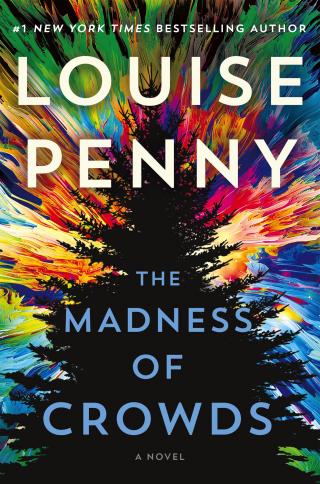
The Madness of Crowds
- Автор: Пенни Луиза
- Серия: Chief Inspector Gamache #17
- Год: 2021
- Язык: английский
- Год: St. Martin's Publishing Group
- ISBN: 9781250145284
- Жанр: Другие детективы

Электронная книга - «The Madness of Crowds». Краткое содержание книги:
You're a coward.
Time and again, as the New Year approaches, that charge is leveled against Armand Gamache.
It starts innocently enough.
While the residents of the Québec village of Three Pines take advantage of the deep snow to ski and toboggan, to drink hot chocolate in the bistro and share meals together, the Chief Inspector finds his holiday with his family interrupted by a simple request.
He's asked to provide security for what promises to be a non-event. A visiting professor of statistics will be giving a lecture at the nearby university.
While he is perplexed as to why the head of homicide for the Sûreté du Québec would be assigned this task, it sounds easy enough. That is, until Gamache starts looking into Professor Abigail Robinson and discovers an agenda so repulsive he begs the university to cancel the lecture.
They refuse, citing academic freedom, and accuse Gamache of censorship and intellectual cowardice. Before long, Professor Robinson's views start seeping into conversations. Spreading and infecting. So that truth and fact, reality and delusion, are so confused it's near impossible to tell them apart.
Discussions become debates, debates become arguments, which turn into fights. As sides are declared, a madness takes hold.
Abigail Robinson promises that if they follow her, ça va bien aller. All will be well. But not, Gamache and his team know, for everyone.
When a murder is committed, it falls to Armand Gamache, his second-in-command Jean-Guy Beauvoir, and their team to investigate the crime as well as this extraordinary popular delusion.
And the madness of crowds.
“What’re you thinking, patron?” asked Lacoste.
He was looking at the photograph. His eyes narrow in concentration.
“How did that picture get into Debbie’s possession?”
“Maybe Paul Robinson made copies, so each of them could have one,” said Isabelle.
“Maybe,” said Gamache. “Then why hide it away? I’m not so sure it was Abigail who killed Maria. You can see the affection she has for her sister. In fact, this looks like three members of a close-knit family”—he hovered his finger over Abigail, Maria, and their father—“and one outlier. Someone who didn’t quite belong.”
His finger stopped, pointing directly at Debbie Schneider.
“What’re you saying?” asked Isabelle. “That Debbie did it?”
“Why would she?” asked Jean-Guy.
“Jealousy maybe. Look at her hands. She’s not just holding Abigail’s arm, she’s gripping it. As though trying to drag her away. Everyone else is looking at Maria, but Debbie is focused on Abigail.”
“And then there are the birthday cards, also locked in the desk,” said Jean-Guy. “That’s pretty strange. Remember they said they’d drifted apart at one stage? Maybe it was more than a drift. Maybe Abigail also suspected and broke off the friendship. And it was during that time that Debbie wrote the cards, but didn’t send them.”
“But if Abigail did suspect that her friend killed her sister, would she ever reconcile?” asked Isabelle. “And why would Paul Robinson tell the coroner that he’d given Maria the peanut butter sandwich when it wasn’t true? He sure wouldn’t cover up for Debbie.”
“No,” agreed Gamache. “But he might for someone else.”
Isabelle stopped. “Abigail? He thought Abigail had done it? So he took the blame.”
Gamache inhaled deeply, then exhaled. “It’s possible he came home, found Maria dead, and realized one of the two girls must have done it. Maybe he even suspected Debbie, but he couldn’t take the chance.”
“But the coroner must’ve known, or suspected. The police must’ve been called,” said Isabelle.
“And found what?” said Gamache. “A severely disabled child who’d died and a distraught father explaining about a sandwich.”
“But wouldn’t they ask questions?” Beauvoir asked.
“Have you ever heard of the Shipman murders in England?” Gamache asked.
They shook their heads.
“Look it up. I was at a reunion in Cambridge when the arrest was finally made. He was a doctor convicted of killing fifteen of his patients.”
“Fifteen?” said Jean-Guy. “Fifteen?”
“It gets worse. A subsequent inquiry found he almost certainly killed more than two hundred. All his patients.”
They stared at him. From anyone else, they wouldn’t have believed it.
“Didn’t anyone suspect?” asked Isabelle.
“Yes, there was even an investigation. But he was a doctor, a respected member of the community, his explanations for the deaths were reasonable. The junior investigators assigned to the case didn’t take the allegations seriously. And do you know why?”
“Because he was a doctor?” asked Isabelle.
“Partly that, but there was another reason. The vast majority of those who died were elderly.” He let that sit there. “Close to death anyway, it was felt. It wasn’t worth the effort to investigate. And before we get all high and mighty, let’s remember what happened here not long ago in the pandemic. Let’s remember what happens when a street worker, a gay or transsexual man or woman, a Black man or woman, an indigenous man or woman or child is killed. There’s hardly a great outpouring of attention or resources. Or grief.”
As he spoke, they could hear the outrage simmering just below the surface. Gamache, as head of homicide and, for a time, head of the entire Sûreté, had worked to change all that. But it was the work of a lifetime.
“So, you’re saying when they saw a badly disabled child, and were given a story by a prominent member of the community, they chose to believe it?” asked Jean-Guy.
“It’s possible,” said Gamache. “Especially if they had sympathy for him and could see no benefit to digging deeper. Yes. I can see it happening.”
“But Paul Robinson had his doubts,” said Isabelle. “His suspicions. He was covering up for Abby, but he actually suspected Debbie, is that what you’re thinking?”
“It’s one way that picture got into Debbie’s possession,” said Beauvoir. “He might have sent it to her as a warning. An accusation.”
“Could be,” said Gamache. “But if so, why would she keep it? And for so long?”
They stared at each other. There seemed no answer and yet, obviously, there was one.
“And why would Debbie have killed Maria?” asked Isabelle, breaking the silence.
“Jealousy?” said Beauvoir. “Maria was taking up too much of Abigail’s time and attention.”
Isabelle could see that he might have a point. Fifteen-year-old girls weren’t famous for having the best grasp on their emotions, and jealousy was an especially toxic one.
They turned to Gamache, whose eyes had narrowed. What he was thinking, what he was feeling, went against all his beliefs.
“I think it’s possible Debbie did it out of love, not jealousy. Not hate.”
“Love?” said Beauvoir. “Of Maria? To free her?”
“No. Love of Abigail. To free her.”
Armand Gamache believed with all his soul that love could never, ever kill. Not real love. A counterfeit one, something that masqueraded as love, yes. But real love? Never.
Was he wrong? he asked himself. Could love murder? Could it put a pillow over a helpless child’s face?
This was the second time in two days it had been justified as a motive.
Haniya Daoud had killed, in cold blood, apparently out of love. Out of a mother’s driving need to protect and free her “children.”
And now Debbie might have killed Maria, out of love. To free Abigail.
And Armand Gamache was forced to finally see something he didn’t want to. That the only thing that could possibly drive him to murder wasn’t hate.
It was love. For his family.
So why not Haniya?
Why not—he looked down at the photograph—Debbie? If she thought that Maria threatened Abigail’s life. Not her physical life, but her intellectual, her emotional life.
Then he noticed something else. “What’s the photograph sitting on?”
Isabelle bent closer. “Looks like the agenda that the inventory mentioned. It must be Debbie’s.”
“No. She had her agenda on her phone,” said Beauvoir. “Why would she need another one? Especially a book. That’s pretty old school.”
He gave a sly glance at Gamache, who still used a handwritten agenda. He had reminders on his phone, but kept his daily appointments in a book.
Isabelle smiled, recalling the last time Beauvoir had teased the Chief about his ring-binder agenda. They’d been in a meeting at Sûreté headquarters, not long after the lockdown lifted but before the vaccine. They were sitting six feet apart and were masked.
“Less likely to be hacked,” Gamache had said, laying a hand on the open book on his desk.
“Thank God,” said Beauvoir. “Because your dentist appointment is of national interest.”
“Maybe not the dentist, but the barber?” Gamache said. “What the Russians wouldn’t do…”
“Your hair did look a little Soviet era, during the lockdown.”
“Ohhh, Einstein,” Isabelle had said to Jean-Guy. “Are you sure you want to bring up the subject of Covid hair?”
She herself had been shocked by the amount of gray that had come in. At thirty-three she felt she was still far too young. But a bullet in the head left more than a scar.
“Why would Debbie have two agendas?” said Gamache. “And why not bring it with her? Why leave it behind, locked in a drawer?”