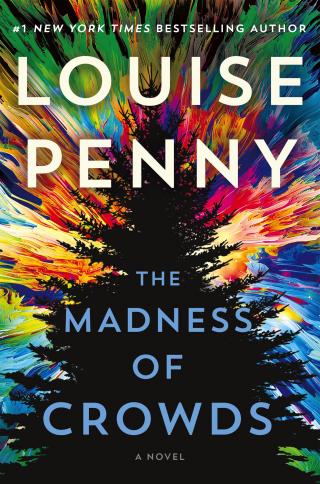
The Madness of Crowds
- Автор: Пенни Луиза
- Серия: Chief Inspector Gamache #17
- Год: 2021
- Язык: английский
- Год: St. Martin's Publishing Group
- ISBN: 9781250145284
- Жанр: Другие детективы

Электронная книга - «The Madness of Crowds». Краткое содержание книги:
You're a coward.
Time and again, as the New Year approaches, that charge is leveled against Armand Gamache.
It starts innocently enough.
While the residents of the Québec village of Three Pines take advantage of the deep snow to ski and toboggan, to drink hot chocolate in the bistro and share meals together, the Chief Inspector finds his holiday with his family interrupted by a simple request.
He's asked to provide security for what promises to be a non-event. A visiting professor of statistics will be giving a lecture at the nearby university.
While he is perplexed as to why the head of homicide for the Sûreté du Québec would be assigned this task, it sounds easy enough. That is, until Gamache starts looking into Professor Abigail Robinson and discovers an agenda so repulsive he begs the university to cancel the lecture.
They refuse, citing academic freedom, and accuse Gamache of censorship and intellectual cowardice. Before long, Professor Robinson's views start seeping into conversations. Spreading and infecting. So that truth and fact, reality and delusion, are so confused it's near impossible to tell them apart.
Discussions become debates, debates become arguments, which turn into fights. As sides are declared, a madness takes hold.
Abigail Robinson promises that if they follow her, ça va bien aller. All will be well. But not, Gamache and his team know, for everyone.
When a murder is committed, it falls to Armand Gamache, his second-in-command Jean-Guy Beauvoir, and their team to investigate the crime as well as this extraordinary popular delusion.
And the madness of crowds.
The word “burden” was never used, but it hung in the fetid air. Only a fool would refuse to see it. To hear it.
Only a fool was deaf to the whispers in the halls of power, now emboldened by Professor Robinson’s success, that most of those who died in the pandemic had underlying conditions. They’d have died soon anyway.
Perhaps, they whispered, it wasn’t such a bad thing. Perhaps it was a blessing. Perhaps the pandemic had, inadvertently, done them all a favor. Freed some to peace, freed the rest to get on with their lives.
Everyone was quick to say what happened was heartbreaking. But really, privately, they considered the tragedies of the pandemic a cull. Of the weak.
Armand Gamache was no fool. He heard the whispers. And he’d witnessed the so-called mercy. Smelled it. He’d seen the handprint on the window. The streak. An arc, like some mockery of the rainbow children worldwide had drawn.
And Armand Gamache knew that the underlying condition, the infirmity everyone talked about, did not lie with those who died, but with those who had allowed it to happen.
And now it was about to move from a tragic miscalculation to calculation.
Where was mercy now, he wondered, and what did it look like? Where was courage now, and what did it look like?
“You’re saying that Paul Robinson killed his daughter out of kindness?” asked Lacoste.
Beauvoir nodded, then shook his head. “No. Well, partly. Yes. I think that was the justification he used. But really, it was exhaustion. He just couldn’t go on.”
While Beauvoir looked down at his hands, and Gamache remained silent, Lacoste worked her way through what might have happened.
“So he smothers Maria,” she said. “Then years later kills himself. A kind of execution. A self-imposed death penalty for what he’d done?”
“Oui,” said Beauvoir. “He still had Abigail to raise, so he waited until she was settled in Oxford. Away from home. Safe with Colette Roberge.”
At the sound of that name, Gamache looked up. But remained quiet. Thinking.
Finally, he lifted his hands.
“We have no idea what actually happened. Did Professor Robinson’s father kill Maria? Maybe. We can never know for sure. Let’s focus on the murder we do know about.”
And yet, as the morning progressed, Gamache couldn’t quite shake it. This convergence of events. And the thought, the feeling really, that it did matter. That, thanks to Beauvoir, they were onto a continuum. That each step mattered. And had brought them here. To a basement, investigating the brutal murder of Debbie Schneider.
But he also felt there’d been a misstep along the way. Something off. And that was why it hadn’t brought them straight to the murderer. Straight to what had happened two nights ago, as they’d watched fireworks light the sky, while a woman was being bludgeoned to death just meters away.
The prearranged video call from Nanaimo came through for Isabelle, and she excused herself. Returning to her desk and putting on her headset, she answered.
“Inspector Lacoste?” A middle-aged man in plain clothes appeared. “It’s Sergeant Fillmore. Barry.”
“Salut, Barry. It’s Isabelle. Thank you for doing this.”
“No worries. Should we begin?”
The Nanaimo investigators had already been through Debbie Schneider’s house once, but Isabelle wanted to see it for herself.
She always found it interesting, and often revealing, to see the private space of a victim, or a suspect. Actually, she just liked looking at people’s homes, often going for walks with the kids around their neighborhood in the evening, hoping to get a peek into lighted living rooms.
Now she hit record and watched as Sergeant Fillmore took her through the modest bungalow in Nanaimo. Two bedrooms. Galley kitchen. There was a TV in the living room and what looked like good, but dated, furniture. Probably inherited from parents. Framed photographs sat on side tables and bookcases.
The home was tidy. Comfortable. Left by someone expecting to return.
The final stop was what Isabelle really wanted to see. The second bedroom had been made into an office. That was less tidy.
Fillmore panned around, then turned to the desk. “The top drawer was locked when we found it. We had to break in.”
“But there wasn’t much in it, from what I remember.”
“No. We emptied it onto the top of the desk.” He pointed his phone at the collection of items.
There were birthday cards, assorted office supplies. An agenda sat on top of a partially obscured photograph.
“Can you get a clearer picture of the photograph, please?”
He pulled it out and Isabelle’s face softened. There, unexpectedly, was Maria.
And not just Maria. There was young Debbie and Abby and a man who could only be Paul Robinson. All gathered around the wheelchair. Smiling.
“Can you box up the things from her desk and send them to me, express?”
“Fine.” Though he sounded less than pleased.
“Merci.”
After hanging up, Isabelle went back over the video, pausing at the photograph. She took a screenshot and printed out copies. Then she contemplated it.
The picture was taken at the oceanfront, one sunny summer’s day.
Isabelle guessed that Abigail and Debbie were about fifteen and Maria would have been nine.
Lacoste looked closely at the little girl with the huge brown eyes and twisted body. Was this the last year of her life? The last month? Week? She’d died on August 27th, the coroner’s report said. On a sunny summer’s day?
Isabelle sat back in her chair and stared. Now why, she asked herself, was this photograph hidden away and not up with the others? It seemed innocuous enough. It looked pretty much like any family photograph. The very pedestrian nature of it fascinated her.
Paul Robinson was bending down, his face close to Maria’s. Smiling. This was not, Isabelle thought, a man on the verge of nervous collapse. He didn’t look exhausted and spent. And contemplating the unthinkable.
He looked happy, carefree even. Though Isabelle knew that while a picture might be worth a thousand words, many of them were lies. Or at least misleading.
She’d smiled in pictures but had been seething inside. Or sad. Or bored. People were programmed to smile for pictures. To say “Cheeeeeze.” It meant next to nothing.
But still, there was an ease about this image.
Paul Robinson had one hand resting casually on the back of Maria’s wheelchair, the other on Abigail’s shoulder. Protectively.
Three of the four people in the photograph were now dead. One apparently accidental death, one perhaps by his own hand, and one had been murdered not two days ago.
One thing Inspector Lacoste did not doubt was that everything had begun with two people not in this picture.
The tragedies had started with the mind control, the mind-boggling experiments conducted in full view at one of the continent’s great universities. By a prominent madman. And by an intern who’d go on to become one of the nation’s leading academics. A healer. A humanitarian.
And when she found among her father’s things the old letter from the Allan Memorial signed by Vincent Gilbert, Abigail Robinson knew it too. And while she couldn’t get at Cameron, she could get at Gilbert.
And had he, with one swing of his arm, attempted to rid himself of that threat?
Isabelle got up and started to pace.
Jean-Guy was at his desk, tipping back in his chair, so that its two front legs were off the concrete floor.
He balanced there, absently pulsing back and forth. Back and forth. Rocking himself and staring at his blank screen.