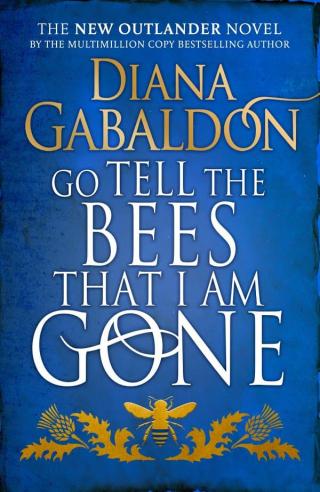
Go Tell the Bees That I Am Gone
- Автор: Гэблдон Диана
- Серия: Outlander #9
- Год: 2021
- Язык: английский
- Год: Delacorte Press
- ISBN: 978-1-473-51900-8
- Жанр: Исторические приключения

Электронная книга - «Go Tell the Bees That I Am Gone». Краткое содержание книги:
The past may seem the safest place to be . . . but it is the most dangerous time to be alive. . . .
Jamie Fraser and Claire Randall were torn apart by the Jacobite Rising in 1746, and it took them twenty years to find each other again. Now the American Revolution threatens to do the same. It is 1779 and Claire and Jamie are at last reunited with their daughter, Brianna, her husband, Roger, and their children on Fraser’s Ridge. Having the family together is a dream the Frasers had thought impossible. Yet even in the North Carolina backcountry, the effects of war are being felt. Tensions in the Colonies are great and local feelings run hot enough to boil Hell’s teakettle. Jamie knows loyalties among his tenants are split and it won’t be long until the war is on his doorstep. Brianna and Roger have their own worry: that the dangers that provoked their escape from the twentieth century might catch up to them. Sometimes they question whether risking the perils of the 1700s—among them disease, starvation, and an impending war—was indeed the safer choice for their family. Not so far away, young William Ransom is still coming to terms with the discovery of his true father’s identity—and thus his own—and Lord John Grey has reconciliations to make, and dangers to meet . . . on his son’s behalf, and his own. Meanwhile, the Revolutionary War creeps ever closer to Fraser’s Ridge. And with the family finally together, Jamie and Claire have more at stake than ever before.
“I dinna ken,” Jamie said, obviously taking care with his words, “if I could bring myself to die for an idea. No that it isn’t a fine thing,” he added hurriedly. “But … I asked Brianna whether any o’ those men—the ones who thought of the notions and the words ye’d need to make them real—whether any of them actually did the fighting.”
“In the Revolution, ye mean? I don’t think they did,” Roger said dubiously. “Will, I mean. Unless you count George Washington, and I don’t believe he does so much talking.”
“He talks to his troops, believe me,” Jamie said, a wry humor in his voice. “But maybe not to the King, or the newspapers.”
“No. Mind,” Roger added in fairness, pushing aside a pine branch, thick with a pungent sap that left his palm sticky, “John Adams, Ben Franklin, all the thinkers and talkers—they’re risking their necks as much as you—as we—are.”
“Aye.” The ground was rising steeply now, and nothing more was said as they climbed, feeling their way over the broken ground of a gravel fall.
“I’m thinking that maybe I canna die—or lead men to their own deaths—only for the notion of freedom. Not now.”
“Not now?” Roger echoed, surprised. “You could have—earlier?”
“Aye. When you and the lass and your weans were … there.” Roger caught the brief movement of a hand, flung out toward the distant future. “Because what I did here then would be—it would matter, aye? To all of you—and I can fight for you.” His voice grew softer. “It’s what I’m made to do, aye?”
“I understand,” Roger said quietly. “But ye’ve always known that, haven’t you? What ye’re made to do.”
Jamie made a sound in his throat, half surprised.
“Dinna ken when I knew it,” he said, a smile in his voice. “Maybe at Leoch, when I found I could get the other lads into mischief—and did. Perhaps I should be confessing that?”
Roger brushed that aside.
“It will matter to Jem and Mandy—and to those of our blood who come after them,” he said. Provided Jem and Mandy survive to have children of their own, he added mentally, and felt a cold qualm in the pit of his stomach at the thought.
Jamie stopped quite suddenly, and Roger had to step to the side to avoid running into him.
“Look,” Jamie said, and he did. They were standing at the top of a small rise, where the trees fell away for a moment, and the Ridge and the north side of the cove below it spread before them, a massive chunk of solid black against the indigo of the faded sky. Tiny lights pricked the blackness, though: the windows and sparking chimneys of a dozen cabins.
“It’s not only our wives and our weans, ken?” Jamie said, and nodded toward the lights. “It’s them, as well. All of them.” His voice held an odd note; a sort of pride—but rue and resignation, too.
All of them.
Seventy-three households in all, Roger knew. He’d seen the ledgers Jamie kept, written with painful care, noting the economy and welfare of each family who occupied his land—and his mind.
“Now therefore so shalt thou say unto my servant David, Thus saith the Lord of hosts, I took thee from the sheepcote, from following the sheep, to be ruler over my people, over Israel.” The quote sprang to mind, and he’d spoken it aloud before he could think.
Jamie drew a deep, audible breath.
“Aye,” he said. “Sheep would be easier.” Then, abruptly, “Frank Randall—his book, it says the war is coming through the South, not that I needed him to tell me that.
“But Claire, Brianna, and the children—and them—I canna shield them, should it come close.” He nodded toward the distant sparks, and it was clear to Roger that by “them” he meant his tenants—his people. He didn’t pause for a reply, but resettled the creel on his shoulder and started down.
The trail narrowed. Roger’s shoulder brushed Jamie’s, close, and he fell back a step, following his father-in-law. The moon was late in rising tonight, and sliver-thin. It was dark and the air had a bite in it now.
“I’ll help you protect them,” he said to Jamie’s back. His voice was gruff.
“I ken that,” Jamie said, softly. There was a short pause, as though Jamie was waiting for him to speak further, and he realized that he should.
“With my body,” Roger said quietly, into the night. “And with my soul, if that should be necessary.”
He saw Jamie in brief silhouette, saw him a draw a deep breath and his shoulders relax as he let it out. They walked more briskly now; the trail was dark, and they strayed now and then, the brush catching at their bare legs.
At the edge of their own clearing, Jamie paused to let Roger come up with him, and laid a hand on his arm.
“The things that happen in a war—the things that ye do … they mark ye,” he said quietly. “I dinna think bein’ a priest will spare you, is what I’m sayin’, and I’m sorry for it.”
They mark ye. And I’m sorry for it. But he said nothing; only touched Jamie’s hand lightly where it lay upon his arm. Then Jamie took his hand away and they walked home together, silent.
24
Alarms by Night
ADSO, DRAPED LANGUIDLY AS a scarf over the table, opened his eyes and gave a small inquisitive “mowp” at the scraping noise.
“Not edible,” I said to him, tapping the last glob of gentian ointment off the spoon. The big celadon eyes went back to slits. Not all the way closed, though—and the tip of his tail began to stir. He was watching something, and I swung around to find Jemmy in the doorway, swathed in his father’s ratty old blue calico shirt. It nearly touched his feet and was falling off one bony little shoulder, but that clearly didn’t matter; he was wide-awake and urgent.
“Grannie! Fanny’s took bad!”
“Taken,” I said automatically, corking the jar of grease to keep Adso out. “What’s the matter?”
“She’s rolled up like a sow bug and grunting like she’s got the bellyache—but, Grannie, there’s blood on her night rail!”
“Oh,” I said, taking my hand off the jar of peppermint leaves I’d been reaching for and reaching instead for a small gauze package on the highest shelf. I’d had it made up for the last two months, in readiness. “I think she’s fine, sweetheart. Or will be. Where’s Mandy?” The children all shared a room—and often enough, a single bed; it was common to come in late at night and find a mattress ticking on the floor, and all four of them sprawled in a sweetly moist tangle of limbs and clothes on top of it. Germain had gone hunting with Bobby Higgins and Aidan—Jemmy being prevented because he’d cut his foot yesterday—but Mandy was here, and I didn’t think her insistent curiosity and voluble opinions would be of help in the present situation.
“Asleep,” Jem answered, watching me drop the gauze packet of herbs into a clay teapot and pour boiling water over it. “What’s that potion for, Grannie?”
“It’s just a tea made with ginger-root and rosemary,” I said. “And a bit of yarrow. It’s an emmenagogue.” I spelled that for him, adding, “It’s to help with a woman’s courses. You’ve heard about courses?”
Jemmy’s eyes went quite round.
“You mean Fanny’s on heat?” he blurted. “Who’s going to breed her?”
“Well, it doesn’t work quite that way with people,” I said, adding craftily, “Ask your mother to explain it all to you in the morning. Right now, why don’t you go and crawl in with Grandpa, and I’ll take this up to Fanny.”
Before leaving the surgery, though, I pulled the box of river stones out from under the table and picked out my favorite: a weathered chunk of gray calcite the size of Jamie’s fist, with a thin, vivid green line of embedded emerald showing on one side, reminding me of the emerald I’d picked up by the creek. I’d added that one to my medicine bag—my amulet. I laid the stone in the hearth and shoveled hot embers on top of it, just in case heat should be required.