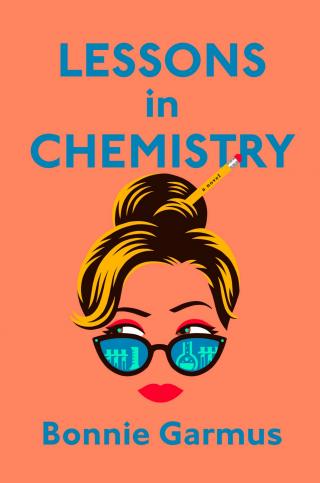
Lessons in Chemistry
- Автор: Garmus Bonnie
- Год: 2022
- Язык: английский
- Год: Doubleday Canada
- Жанр: Современная русская и зарубежная проза

Электронная книга - «Lessons in Chemistry». Краткое содержание книги:
“Wait,” the bishop said, his heart beating fast at the mention of such a large sum. “Please try to understand: it’s a privacy issue. We don’t talk about individuals. Even if that boy had been here, we’re really not allowed to say.”
“Right,” said Wakely. “Still…”
The bishop glanced up at the clock. It was almost time for his favorite show, Supper at Six. “No, now wait,” he barked, not wanting to lose the donation or miss his show. “You’ve really forced my hand on this one. Between you and me and the wall, yes, this is where Calvin Evans grew up.”
“Really?” Wakely said, sitting up tall. “You have proof of this?”
“Of course, I have proof,” the bishop said, affronted, touching his fingertips to all the wrinkles Calvin had given him over the years. “Would we be home to the Calvin Evans Memorial Fund if he hadn’t been here?”
Wakely was taken aback. “Excuse me?”
“The Calvin Evans Memorial Fund. We set it up years ago to honor that precious boy who went on to become an amazing young chemist. Any decent library will have tax documents proving its existence. But the Parker Foundation — they endowed it — insisted we never advertise it, and you can probably guess why. It’s not like they could afford to fund every home that lost a child.”
“Lost a child?” Wakely said. “But Evans was an adult when he died.”
“Y-y-yes,” the bishop stammered. “Correct. It’s just that we still refer to our past residents as children. Because that’s when we knew them best — as children. Calvin Evans was a wonderful kid, too. Smart as a whip. Very tall. Now about that donation.”
—
A few days later, Wakely met back up with Madeline in the park. “I have good news and bad news,” he said. “You were right. Your dad was at All Saints.” He went on to tell her what the bishop had told him: that Calvin Evans had been a “wonderful kid” and “smart as a whip.” “They even have a Calvin Evans Memorial Fund,” he said. “I confirmed it at the library. It was funded for nearly fifteen years by a place called the Parker Foundation.”
She frowned. “Was?”
“The foundation stopped funding it a while ago. That happens sometimes. Priorities change.”
“But Wakely, my dad died six years ago.”
“So?”
“So why would the Parker Foundation fund a memorial for fifteen years? When”—she did a calculation on her fingers—“for the first nine of those years, he wasn’t even dead yet?”
“Oh,” Wakely said, reddening. He hadn’t noticed the date discrepancy. “Well — back then it probably wasn’t really a memorial fund, Mad. Maybe more of an honorary fund — he did say it was in honor of your dad.”
“And if they have this fund, why didn’t they say so the first time you called?”
“Privacy issue,” he said, repeating what the bishop had told him. At least that made some sense. “Anyway, here’s the good part. I looked up the Parker Foundation and discovered it’s run by a Mr. Wilson. He lives in Boston.” He looked at her expectantly. “Wilson,” he repeated. “Otherwise known as your acorn fairy godfather.” He sat back on the bench, waiting for a positive response. But when the child said nothing he added, “Wilson sounds like a very noble man.”
“He sounds misinformed,” Mad said, examining a scab. “Like he’s never read Oliver Twist.”
Mad had a point. But still, Wakely had dedicated a lot of time to this and he’d expected she might be a little more excited. Or at least grateful. Although why did he think that? No one ever expressed gratitude for his work. He was out in the trenches every day comforting people going through their various trials and tribulations, and all he ever heard was the same old tired line: “Why is God punishing me?” Jesus. How the hell should he know?
“Anyway,” he said, trying not to sound dejected. “That’s the story.”
Madeline crossed her arms in disappointment. “Wakely,” she said. “Was that supposed to be the good news or the bad news?”
“That was the good news,” he said pointedly. He had very little experience with children and he was beginning to think he wanted even less. “The only bad news is that while I have an address for Wilson at the Parker Foundation, it’s only a post office box.”
“What’s wrong with that?”
“Rich people use post office boxes to shield themselves from unwanted correspondence. It’s like a garbage can for mail.” He reached down to his satchel and after some riffling, came up with a slip of paper. Handing it to her he said, “Here it is, the box number. But please, Mad, don’t get your hopes up.”
“I don’t have hopes,” Mad explained, studying the address. “I have faith.”
He looked at her in surprise. “Well, that’s a funny word to hear coming from you.”
“How come?”
“Because,” he said, “well, you know. Religion is based on faith.”
“But you realize,” she said carefully, as if not to embarrass him further, “that faith isn’t based on religion. Right?”
Chapter 35
The Smell of Failure
On Monday morning at four thirty a.m., Elizabeth left her house as she usually did, in the dark, in warm clothes, headed for the boathouse. But as she pulled into the normally empty parking lot, she noticed nearly every space was already taken. She also noticed one other thing. Women. A lot of women. Trudging toward the building in the dark.
“Oh god,” she whispered as she pulled her hood over her head and slipped past the small throng, hoping to find Dr. Mason in time to explain. But it was too late. He was sitting at a long table handing out registration forms. He looked up at her, unsmiling.
“Zott.”
“You may be wondering what this is all about,” she said in a low voice.
“Not really.”
“I think what happened,” Elizabeth said, “was that one of my viewers asked for a diet tip, and I suggested she start exercising. I may have mentioned rowing.”
“May have.”
“Possibly.”
A woman in line turned to her friend. “The thing I like about rowing already,” she said, pointing at a photograph of eight men in a shell, “is that it’s all done sitting down.”
“See if this jogs your memory,” Mason said, handing the next woman in line a pen. “First you described rowing as the worst form of punishment, then you suggested that women all over the nation give it a whirl.”
“Well. I don’t think those were my exact words—”
“They were. I know because I saw your show while I was waiting for a patient to dilate. So did my wife. She never misses.”
“I’m sorry, Mason, truly. I never expected—”
“Really?” he snapped. “Because two weeks ago, one of my patients refused to push until you finished explaining the Maillard reaction.”
She looked up surprised, then reconsidered. “Well. It is a complicated reaction.”
“I’ve been calling you about this since Friday,” he said pointedly.
Elizabeth started. He had. He’d called both the studio and home and in her avalanche of things to do she’d neglected to call him back.
“I’m sorry,” she said. “I’ve been so busy.”
“Could have used your help in getting this organized.”
“Yes.”
“Obviously we won’t be getting on the water today.”
“Again, sorry.”
“You know what really kills me?” he said, gesturing at a woman doing jumping jacks. “I’ve been trying to get my wife to row for years. As you know, I believe women have a higher threshold for pain. Still nothing I could say could convince her. But one word from Elizabeth Zott—”