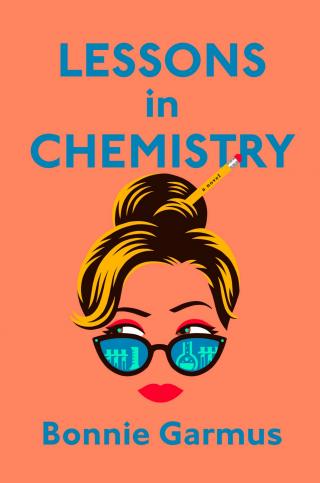
Lessons in Chemistry
- Автор: Garmus Bonnie
- Год: 2022
- Язык: английский
- Год: Doubleday Canada
- Жанр: Современная русская и зарубежная проза

Электронная книга - «Lessons in Chemistry». Краткое содержание книги:
From the audience came a murmur of distress.
“Which is why,” Elizabeth said, “when you think about fueling your body, think water first. But now, back to meat.” She picked up a large, sleek knife, and while demonstrating how to butterfly a hunk of meat, launched into the steak’s vitamin content, explaining not only what the body did with its iron, zinc, and B-vitamins, but why protein was critical to one’s growth. She then explained what percentage of the water in the muscle tissue existed as free molecules, ending with what she obviously thought were exciting definitions of free and bound water.
Throughout her explanation, the studio audience remained rapt — no coughing, no whispering, no crossing and uncrossing of legs. If there was one sound, it was only the occasional scratching of pen on paper as people took notes.
“Time for station identification,” Elizabeth said, acknowledging a cue from the cameraman. “Stay with us, won’t you?” Then she put the knife down and strode off the set, pausing briefly as the makeup woman pressed a sponge to her forehead and patted down a few loose hairs.
Madeline turned to take in the audience. They sat nervously, impatient for Elizabeth Zott to reappear. She felt a small pang of jealousy. She suddenly realized she had to share her mother with a lot of other people. She didn’t like it.
—
“After you’ve rubbed your steak with a halved clove of fresh garlic,” Elizabeth said a few minutes later, “sprinkle both sides of the meat with sodium chloride and piperine. Then, when you notice the butter foaming”—she pointed to a hot cast-iron skillet—“place the steak in the pan. Be sure and wait until the butter foams. Foam indicates that the butter’s water content has boiled away. This is critical. Because now the steak can cook in lipids rather than absorb H2O.”
As the steak sizzled, she removed an envelope from her apron pocket. “While that’s cooking, I wanted to share with you all a letter I received from Nanette Harrison in Long Beach. Nanette writes, ‘Dear Mrs. Zott, I’m a vegetarian. It’s not for religious reasons — it’s just that I don’t think it’s very nice to eat living things. My husband says the body needs meat and I’m being stupid, but I just hate thinking an animal has given up its life for me. Jesus did that and look what happened to him. Sincerely yours, Mrs. Nanette Harrison, Long Beach, California.’
“Nanette, you’ve brought up an interesting point,” Elizabeth said. “What we eat has consequences for other living things. However, plants are living things too, and yet we rarely consider that they are still alive even as we chop them to bits, crush them with our molars, force them down our esophagi, and then digest them in our stomachs filled with hydrochloric acid. In short, I applaud you, Nanette. You think before you eat. But make no mistake, you’re still actively taking life to sustain your own. There is no way around this. As for Jesus, no comment.” She turned and, jabbing the steak out of the pan, the dripping juices a bloody red, looked directly into the camera. “And now a word from our sponsor.”
Harriet and Madeline turned to look at each other, their eyes wide. “Sometimes I ask myself: How is this show popular?” Harriet whispered.
“Excuse me, ladies.” The secretary was back. “Mr. Pine asked if he might have a quick word?” She phrased it as a question even though it wasn’t. “Follow me?” She spirited them away from the stage and down a corridor until they reached an office where Walter Pine was pacing back and forth. Four TVs were lined up against the wall, all airing Supper at Six.
“Hello, Madeline,” he said. “I’m delighted to see you, but also surprised. Shouldn’t you be in school?”
Mad tipped her head to the side. “Hi, Mr. Pine.” She pointed at Harriet. “This is Harriet. It was her idea. She forged the note.”
Harriet threw her a look.
“Walter Pine,” Walter said, taking Harriet’s hand. “At long last. Very pleased to meet you, Harriet…Sloane, correct? I’ve heard nothing but good things. But,” he said, his voice dropping, “what were you two thinking? If she finds out you’re here—”
“I know,” Harriet said. “For the record, we asked to sit in the back.”
“Amanda wanted to come too,” Mad said, “but Harriet didn’t want to compound the crime. Forgery is a felony, but kidnapping—”
“How thoughtful of you, Mrs. Sloane,” he interrupted. “Although just so you both know, if it were up to me, you would always be welcome. Still, it’s not up to me. Your mother,” he said, turning to Madeline, “is only trying to protect you.”
“From radioactivity?”
He hesitated. “You’re a very smart little girl, Madeline, so when I tell you your mom is trying to protect you from celebrity, I’m betting you’ll know what I mean.”
“I don’t.”
“It means that she wants to protect your privacy. To protect you from all the things people say and think about someone who is in the public eye. Someone who is famous.”
“How famous is my mom?”
“Since syndication,” Walter said, touching his fingertips to his forehead, “she’s a bit more well-known. Because now people in places like Chicago and Boston and Denver can watch your mommy, too.”
“Chop the rosemary,” Elizabeth was saying quietly in the background, “with the sharpest knife you have. This minimizes damage to the plant and avoids excess electrolyte leakage.”
“Why is being famous bad?” Madeline asked.
“I wouldn’t say it’s bad,” Walter said. “It’s just that it comes with some surprises and not all of them are good. Sometimes people want to believe they know a celebrity like your mom on a personal level. This makes them feel important. But to do this, they have to make up stories about your mom, and not all the stories are very nice. Your mom is just trying to make sure no one makes up a story about you.”
“People are making up stories about my mom?” Madeline said, alarmed. It had to be the lights — the way they made her mother look invincible. That’s what the audience needed to see: a woman who both demanded respect and got it — even if her mother had problems like everybody else. Mad guessed it was a bit like her pretending she couldn’t read very well. You did what you did to get by.
“Don’t worry,” Walter said, placing his hand on her bony shoulder. “If there’s one person who can handle herself, it’s your mother. Very few will try to take on Elizabeth Zott. All she’s trying to do is make sure they don’t try to take advantage of you. Do you understand? That goes for you too, Mrs. Sloane,” he said, turning to look at Harriet. “You spend more time around Elizabeth than most; I’m sure your friends would love to hear you tell all.”
“I don’t have a lot of friends,” Harriet said. “And even if I did, I know better.”
“Smart woman,” Walter said. “I don’t have a lot of friends either.”
Actually, he thought to himself, he only had one: Elizabeth Zott. And she wasn’t just a friend, she was his best friend. He’d never told her she was, but she was. Yes, there were plenty of people who would argue that a man and woman couldn’t really be friends. They were wrong. He and Elizabeth discussed everything, intimate things — death, sex, and children. Plus, they had each other’s backs like friends do, even laughed together like friends do. Granted, Elizabeth wasn’t a big laugher. Still, despite the show’s growing popularity, she seemed more depressed than ever.
“So,” Walter said, “why don’t we get you out of here before your mom sees us and we all fry in stomach acid.”
“But why do you think my mom’s so popular?” Madeline asked, still wishing she didn’t have to share her.
“Because she says exactly what she thinks,” Walter said. “Which is very rare. But also because the food she makes is very, very good. And because everyone seems to want to learn chemistry. Oddly.”