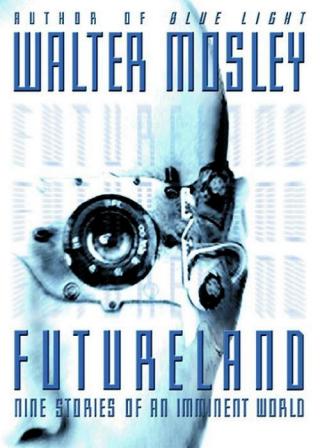
Futureland: Nine Stories of an Imminent World
- Автор: Мосли Уолтер
- Год: 2001
- Язык: английский
- Год: Aspect / Warner Books
- ISBN: 978-0-446-52954-9
- Жанр: Научная фантастика

Электронная книга - «Futureland: Nine Stories of an Imminent World». Краткое содержание книги:
Harold knew a lot about leasing because L&L Leasing was the company he worked for. L&L acted as a middleman for various industries. They advertised and brokered the deals while the major manufacturers supplied the goods.
“The people live on the installment plan,” XX Y, the revolutionary, said on the poster circulated over ghostnet, “while corpse-barons buy up the sky.”
The slogan played its way through Harold’s mind while he rolled over the Brooklyn Bridge. He knew that every word of what the militant chromosome of RadCons 6 and 7 said was true. But he also remembered what his professor, Len Gorzki, had said in Political Science 101 at City College.
“Product is everywhere and everything,” the slender, AIDS-ridden educator exclaimed. “From the bricks in the wall to the chair under your butts to your butt itself. It’s all product, either product or waste.”
Harold understood the threat posed to him. He believed in XX’s ideal but lived according to the cycles.
Blanklands was a moveable feast. A bar, restaurant, Eros-Haus, DJ joint hotbed of perversions and alternative lifestyles.
Yasmine Mü — onetime executive secretary for L&L Leasing — was now an Eros-girl working illegally for the drifting Blanklands boutique.
Harold had never met anyone like her. Her Persian family had become fabulously wealthy by developing one of the first labor corps in the Middle East.
A labor corps was a large group of men and women who did a specific kind of labor, usually manual, either at a home base or on location. From apple picking in Vermont to disaster relief in Peru, the labor corps provided sweat and sinew for an annual wage.
Yasmine’s parents owned a palace in southern Persia. They also owned two hundred thousand hands. Yasmine was their only child. Everything would one day belong to her. But she left it all for the prod’s life in New York City.
“My mum and da,” she said in her tutored English accent, “don’t see that it’s slavery. If you got married you were fired and fined. Salaries are paid in advance and so if you quit you’re arrested. Then the government confiscates your labor account and you’re forced to work out your term without pay. Everybody says that it’s good for the people. Da says that some people are made to work and others are made to rule. So I left and came here to live as a worker.”
She confided in Harold, called him a friend. But she never returned his ardent passions. Harold had loved her from the first moment he saw the grim longing in her eyes.
Jamey was waiting in the alley when Harold got there.
“Hey, man,” Harold said. “I thought you said the place was here.”
“It is.”
“Then how come we’re the only people here?”
“It’s early. When I saw Yas she said she could get us in if we came early. You got your chip?”
Harold pulled out a clear plastic card in which his identity chip was embedded. The ID-chip was a cycler’s most important piece of property. It was everything. His PBC (personal bar code), his work history, his current résumé, and his DNA voter’s registration data. The loss of an ID-chip was an immediate fifty-one points against your labor record — a consecutive nine months of unemployment cycles, almost a year of beans and rice, living in an octangular hive cubicle; three of the eight steps before becoming a Muzak Jack.
The ID-chip meant everything, and so when they demanded to hold Harold’s before he could go into Blanklands he balked.
“Com’on, man,” the nervous white doorman said. He had brown scars on his throat and arms from a recent bout with the striped flu. “I ain’t got time.”
“Just let it go,” Jamey said from behind. He put his hand on Harold’s shoulder, and Harold released his grip on the card.
While walking down the long, brick-lined corridor Harold felt panic in his chest and across his brow. He hadn’t let go of his ID-chip in twelve years, since the day of his labor adulthood at fifteen. The eerie glow from the light decals slapped on the wall at irregular intervals only served to make him more apprehensive. He had never spent a day in Common Ground, the underground public homestead that provided compartments barely large enough to hold a fiberplas mattress. But Harold knew from his uncle that it was no free ride like the holo-ads claimed. It was dangerous and it smelled. You couldn’t lock your space and you couldn’t own anything. The place was full of gangs of Backgrounders who raped and robbed men and women alike.
The way most cyclers survived an unemployment cycle was by finding illegal labor or a relative or friend who knew the drill. He could become a prettyboy or maybe sell a body part — but, no, it wouldn’t have to come to that. His brother, Rand, in Oklahoma City would take him in. He’d make Harold work in the communal gardens but that was bearable. He wouldn’t have to get involved with the black market, or worse, the weapons market — or worse still, to become a thief. To be caught stealing would mean a thirty-year minimum sentence in one of the corporate prisons. There was no early release, parole, or life after prison. The few ex-cons that Harold had seen were hollow-eyed, slack-jawed men and women. Maybe black people didn’t get the striped flu, but they sure got bit by prison — they sure did.
“Prison sucks the soul out of our men and women through a pinhole in the heart,” XX Y had proclaimed more than fifteen years before. “And we just look the other way...”
Harold’s heart was racing. What was he doing thinking about Common Ground and Angel’s Island prison? He decided to go back, pay the hundred dollars, and leave.
“Here you go,” the nervous doorman said as he opened a door. Jamey pushed Harold through into a room filled with light.
Harold went through the door thinking that he would turn around and go back out again. Yasmine meant a lot to him, but not enough to live in hell.
He looked around to get his bearings. He was standing in a cavernous room full of large raised platforms that held fiberplas beds. There was a ledge around the mattresses and chairs, too. Going by the size of the room Harold figured that it held over forty tablebeds. At a table a few feet away Harold saw something that slowed his exit.
An elderly man, bald and gray, with parchmentlike skin, was sitting on the ledge of a table while a young woman, no more than twenty, stroked his huge penis. The white man had well-defined muscles to complement his twenty-inch boy-hard erection. The slender Asian girl rocked back and forth holding on with both hands. The look of reverence on her face seemed studied but that didn’t detract from Harold’s fascination. He had heard about the sex therapies that the uppers could afford. The process of cell rejuvenation could make parts of the body young again, at least for a while. Drugs could make you virile. An every-other-day visit to sensory-dep tanks could exercise your body until it had what was advertised as peak physique.
This man had it all.
“Yeah, yeah,” the man grunted. Then he looked up at Harold and winked just before he came.
“Yeah, baby,” the Asian prettygirl said.
The man’s emission went on and on. He looked at Harold and Jamey, winking again, as if to say, “Who’s the man?”
“Damn,” Jamey said. “You see that?”
Two tables over a woman who was near the man’s age sat naked at a table. Her face, thighs, and belly were pudgy and somewhat wrinkled, but her breasts put the prettygirl’s to shame. Harold felt nauseated and aroused at the same time. The man was strutting around now with his erection tilting up, still dripping semen.