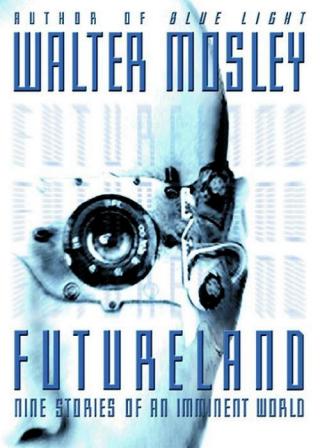
Futureland: Nine Stories of an Imminent World
- Автор: Мосли Уолтер
- Год: 2001
- Язык: английский
- Год: Aspect / Warner Books
- ISBN: 978-0-446-52954-9
- Жанр: Научная фантастика

Электронная книга - «Futureland: Nine Stories of an Imminent World». Краткое содержание книги:
“M Halloway, M Bottoms,” M Shirley Bride said by way of greeting later that morning.
“Morning, M Bride,” Harold said to the boss.
“Morning—” Jamey Halloway got out, and then he coughed.
“You got that flu?” the Unit Controller asked.
“No, M, not me. Went to the tobacco den to meet a friend. We talked too long in the smoke and, well, I kinda lost my voice.”
Shirley Bride sniffed the air with her delicate nostrils and frowned.
“You don’t smell like smoke.” she said.
“Scrubbed off in the tanks last night.”
Public bathing in recycled waters was the new rage since the water laws. FastBath of NYC was the largest franchise in North America.
“Oh,” she said. “Because if you were sick I could send you home.”
“Then you might as well kick me out of my house and annul my marriage license, too.”
“That doesn’t cut it with a controller,” Shirley Bride said. “If I thought the office would be better off I’d have to send you home even if it did put you over seventeen. If I didn’t I’d get a permanent mark. You know they’re harder on management than they are on cyclers.”
Harold and Jamey both hid the derision they felt. Upper management got the Life Plan. They were covered for anything short of a neutron bomb, as the outlawed Wildcat Union claimed on ghostnet.
“But I can send you home without a mark if that’s a real cough,” Bride continued. “It’s an epidemic now, and the uppers have decided that I can give out nonpunitive sick leave.”
A cough came unbidden to Harold Bottoms’s lips.
“Not you, M,” Bride said.
It was from that moment Harold could trace the beginning of his suspicions.
2
That night Harold decided to stay in — or out of the viral cluster — and watch the IT curve. The curve was the latest innovation of Internet presentation. A thin sheet of plastic nine feet wide, stretched out to its full length, and four and a half feet high. The screen rolled out on a stand so that it curved around, forming an inner space that was two feet deep at the center and six feet across. Using the chip technology in the stand, the laser optics woven into the plastic could create three-dimensional images.
“... and hello New York,” onetime rapper Chantel was saying. “Well, it’s finally happened — Claw-Cybertech Angola has annexed Luxembourg, making that business-state the first Afro-European nation. The Luxembourgers, as you will remember, have been opposing this deal for the past seven years. A general strike led to violence in that tiny nation’s capital today, where some three hundred thousand turned out to protest the merger. When CEO Moto of Claw-Cybertech ordered out security forces, the crowd threw flaming balls of waste tar. The protesters made no attempt to hide the racial nature of their political unrest.”
An image of thousands of angry protesters appeared in the curve. Many were hurling flaming balls of waste tar, a byproduct of modern recycling dumps, at the security forces, which advanced in wheeled plexiplas bubbles, debilitating rioters with dozens of stun whips flailing out from all sides.
“Lars McDermott,” Chantel said, reappearing on the screen, “corporate ambassador to the UN, had this to say about today’s protest and annexation.”
The image of the middle-aged black woman shifted to the full image of a young white man in a rather close-fitting black andro-blouse.
“I applaud the annexation,” the man said in an indistinct European accent. “And, no, I do not feel that the Luxembourgers have any reason to fear this move. International Law expressly prohibits migrant labor from overwhelming a new territory beyond prescribed limits within the first twenty-five years.”
“But hasn’t Claw-Cybertech asked for a relaxation of the migratory clause?” a bodiless, masculine voice asked.
“That is only for them to be able to iron out a few labor problems in their Angolan holdings.” Lars McDermott’s smile belied his answer.
“Isn’t the unemployment cycle in Angola now up to thirty-five percent?” the voice inquired.
That smile again, and, “Merely a transitional phase. Claw-C has to retool for a more advanced chip market. That has nothing to do with Europe.”
Harold was astonished at how the extra chip he’d bought for the curve cleared up his digital reception. He said, “My fav,” and the station changed to a scene where three beautiful black women in military uniform were adjusting weapons holsters on their breasts before jumping out of an aircraft hovering over a moonlit island.
The winking lunar light between the ripples of the sea seemed so real that Harold moved closer to the IT curve, which took up fully half of his Tribeca loft subdivide. Enchanted by the ocean, he stuck his hand in and it disappeared momentarily under the waves. Chesty Love dived into his palm and swam out through his fingers.
“Hey hey hey.” Jamey Halloway’s blond head replaced the hovercraft. He had a maniacal look on his face. Harold leaped backward, shocked by the ITV buddy break-in call.
“Hey, man, you scared me,” Harold said.
“Turn on the two-way,” Jamey commanded.
“Two-way on,” Harold intoned.
Immediately the curve became Jamey’s room in the Bubble, a condominium that floated off the eastern shore of Staten Island. A small patch in the lower left-hand corner continued the Devil Girls show.
“How you feelin’?” Harold asked.
“Flu’s gone,” Jamey replied. “Just like the med-heads said, three days and it clears up. You wanna go out?”
“Naw, man. I might pick up somethin’ out there.”
“Aw, com’ on, bro. You know the nigs don’t get it.”
“Hey, man. Why you wanna use that kinda language?”
“Sorry, bro. I didn’t know you were sensitive.”
“I’m not sensitive,” Harold said. “It’s just that it’s not respectful.”
“I said I’m sorry, okay? Can we go out now?”
“I don’t know.”
“I found Yasmine,” Jamey said in a tantalizing tone.
“Where?”
“Blanklands.”
“No shit?”
“Not even an address. Down in an alley off of Gore near Yclef Terrace. You need a chip to get in and a hundred dollars cover to get out — and that doesn’t include Yas.”
“I’ll meet you there,” Harold said. Then he clapped his hands together three times, hard. The screen went blank and the curve rolled itself up into a scroll.
3
Harold rode his adult-size tricycle down Lower Broadway, headed for the Brooklyn Bridge. There had been no motorized traffic allowed on Broadway for over thirty years. A quarter of the streets in Lower and Upper Manhattan were closed to motor-driven vehicles because no cycler could afford the leasing fees and insurance rates on an automobile. Cycler was a term meant for those who rode the unemployment cycles, but it also fit those same individuals’ mode of transportation.
Harold rode down the crowded avenue looking at the crumbling old brick that showed here and there between holo-ads. Lower Manhattan was falling apart. Every now and then a building was refaced. But the only real improvements came when big business could find a profit niche. Lately that niche had been leased window holo-ads. All you had to do was put a holo-screen across your outside wall space and allow whatever advertiser to display his wares on it. At a dollar per square foot per day — for prime space, at prime time — you could make pocket money for the kids. And now with the new screens you could look out of your windows as if there were nothing there at all.
All down Broadway there were animated signs for leasing IT curves, household utilities, even furniture and some finer clothes. Almost everything by 2055 was leased. That stabilized the profit factor and created a built-in insurance policy. No one owned anything except the manufacturers.